
 Search


Blogs.nvidia.com
Nvidia announced Rubin HPC at SC26 on Monday, Nov. 16, a GPU with more than 50,000 CUDA cores that the company expects to make available in 2028.
The core count says little about speed on the sparse workloads Nvidia names, because those codes wait on memory more than on arithmetic: none of the top 10 systems on the November 2025 HPCG benchmark list got past 3 percent of peak. Nvidia has published no memory bandwidth, FP64 rate, power draw or price for Rubin HPC, and Tom's Hardware reported no new NVLink 7 bandwidth details, so buyers planning 2028 systems have no figure yet that shows how fast it would run their codes.
Nvidia Rubin HPC Pairs Over 50,000 CUDA Cores With Sparse Data Acceleration and NVLink 7
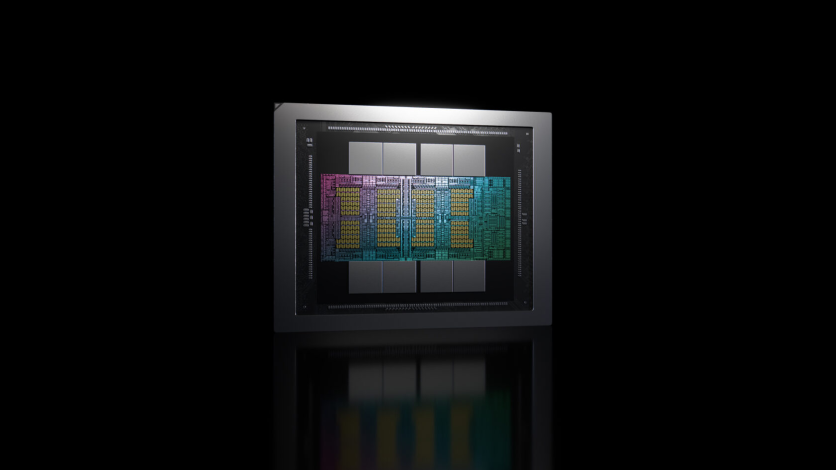
Nvidia describes Rubin HPC as a new Vera Rubin GPU designed to speed simulation and data processing for science, engineering and analytics. It combines a record core count with sparse data acceleration meant to keep those cores supplied with data, and with seventh-generation NVLink for communication between GPUs. Nvidia says the design couples a record leap in CUDA cores with accelerated data movement.
The company names sparse matrix operations, stencil computations, sorting and reductions as its target workloads, patterns that recur in climate models, engineering simulation, genomic analysis and financial risk modeling. "For agents tackling science and engineering, faster simulation means faster discovery," said Ian Buck, Nvidia's vice president of hyperscale and high-performance computing, who helped create CUDA.
How Many CUDA Cores Does Rubin HPC Have, and What Do They Measure?
More than 50,000, which Nvidia calls a record for one of its GPUs. Tom's Hardware reported that today's Rubin GPU has 224 streaming multiprocessors and 28,672 CUDA cores, so Nvidia's figure is at least 1.74 times that count by TechTimes arithmetic. The outlet said the number might imply a four-die package like Rubin Ultra, which it reported in August 2025 would use four GPU chiplets instead of two, but Nvidia has not disclosed Rubin HPC's physical layout.
A core count is one number among several. Wikipedia's CUDA entry lists lane counts separately for 32-bit integer, FP32, FP16 and FP64 arithmetic, notes that they vary by chip model, and treats the term "CUDA core" as a deprecated name. FP64, the 64-bit double-precision format, carries 15 to 17 significant decimal digits. Nvidia's specification page for the current Rubin GPU lists 130 teraflops of FP32 against 33 teraflops of FP64, a ratio of about 3.9 to 1 by TechTimes arithmetic.
If Rubin HPC kept that ratio, 1.74 times the cores would point to at least roughly 57 teraflops of FP64 per GPU, an illustration from TechTimes arithmetic and not a forecast. Nvidia has not said whether Rubin HPC keeps the ratio, and a core count alone cannot answer that.
HPCG Benchmark Results Put Top Supercomputers at 3 Percent of Peak or Less
The HPCG benchmark, proposed by Michael Heroux, Jack Dongarra and Piotr Luszczek, models the data access patterns of real applications such as sparse matrix calculations. It runs a sparse iterative solver, and its own FAQ says overall performance stays heavily influenced by the memory system even after optimization.
On the November 2025 list, El Capitan led at 17.41 petaflops, which is 0.6 percent of its peak. Japan's Fugaku reached 3.0 percent, the highest fraction in the top 10, while Frontier managed 0.7 percent and Aurora 0.3 percent.
The roofline performance model, described in a 2009 paper by Williams, Waterman and Patterson, explains the pattern: a kernel that does little arithmetic per byte moved is limited by memory bandwidth, not by peak compute. Stencil computations, one of Nvidia's named workloads, are typically memory bound, needing many memory accesses per calculation.
Nvidia Says Sparse Data Acceleration Keeps Cores Fed but Does Not Explain How
Nvidia says the capability keeps those cores fed with data. The announcement describes the goal but not the mechanism.
Sparse formats store only nonzero entries, which saves memory but complicates element access. If the feature raises the share of peak memory bandwidth that sparse kernels reach, it targets the constraint HPCG exposes; if it does not, extra cores may sit idle. Judging which happens requires bandwidth per GPU and measured results on sparse codes, and Nvidia has published neither.
Rubin HPC Has No Published Memory Bandwidth, FP64 Rate, Power Draw or Price
Nvidia's announcement gives no memory capacity or type, no power draw, no FP64 throughput and no pricing, and it names no launch partners or customers. Tom's Hardware also found no HBM capacity or bandwidth figures and no new bandwidth or physical-layer details for NVLink 7.
Each missing number answers a different question. Memory bandwidth sets the ceiling for memory-bound code. The FP64 rate matters most for dense double-precision work such as the High Performance Linpack test the Top500 list uses. NVLink 7 bandwidth governs how well a job scales across GPUs.
AMD Instinct MI430X Lists Up to 288 Teraflops of FP64 and 432 GB of HBM4 for 2027 Launch
AMD's product page lists up to 288 teraflops of hardware FP64 peak, up to 432 GB of HBM4 and 23.3 terabytes per second of memory bandwidth for the Instinct MI430X, with launch expected in 2027, a year before Rubin HPC. The page names Oak Ridge National Laboratory's Discovery system and Europe's Alice Recoque and Herder systems as expected MI430X deployments, and its footnotes call AMD's FP64 comparisons engineering projections from July 2026 that may change at launch.
Nvidia's current Rubin GPU lists 33 teraflops of FP64 and 288 GB of HBM4. HPCwire reported that FP64 Tensor Core throughput fell from 67 teraflops on Hopper to 30 teraflops on the B100, and that Blackwell Ultra devotes barely a single teraflop to FP64. The Register reported in January that Rubin's 33 teraflops is one teraflop below the four-year-old H100, and that Nvidia claims up to 200 teraflops of FP64 matrix performance through software emulation. AMD fellow Nicholas Malaya estimated 60 to 70 percent of HPC workloads gain little or nothing from emulation.
Nvidia said in June that Vera Rubin NVL4 systems from Bull, Dell Technologies, Gigabyte, HPE and Supermicro are expected to be available in the fourth quarter of 2026, and it cited 5 petaflops of native FP64 for Vera Rubin systems with up to 144 GPUs per rack. At about 33 teraflops per GPU, 144 GPUs total roughly 4.75 petaflops by TechTimes arithmetic, so that figure is consistent with GPU count rather than a faster chip.
Rubin HPC Follows Rubin Ultra and Shares Its 2028 Window With Feynman
Tom's Hardware's August 2025 roadmap listed Rubin Ultra for 2027, with NVLink 7 and NVSwitch 7, and Feynman GPUs for 2028. Rubin HPC is not on that roadmap, and Nvidia's announcement does not say how it relates to either part.
Four Missing Numbers Will Decide How Buyers Judge Rubin HPC
Four figures would let a buyer judge Rubin HPC: memory capacity and bandwidth per GPU, NVLink 7 bandwidth, the native FP64 rate, and measured fraction of peak on sparse benchmarks such as HPCG. Power draw and price follow. Until Nvidia publishes them, the core count cannot rank Rubin HPC against AMD's MI430X, which has published FP64 and memory figures, though AMD labels its FP64 comparisons engineering projections. Buyers should treat any vendor figure from either company as a claim to test on their own codes, not a result.
Frequently Asked Questions
When will Nvidia Rubin HPC be available?
Nvidia expects availability in 2028 and has not published pricing, power draw, memory specifications or launch partners.
Does a higher CUDA core count make sparse scientific code faster?
Not by itself. Sparse and stencil codes are typically limited by memory traffic, so extra cores help only if memory bandwidth and data access improve alongside them, because memory-bound kernels are bandwidth-limited. Nvidia says Rubin HPC's sparse data acceleration keeps its cores fed but has published no bandwidth figures or benchmark results.
What is the HPCG benchmark, and why do top supercomputers score so low on it?
HPCG measures how a machine performs on a sparse iterative solver and complements the Linpack test rather than replacing it. Its data is too large for processor caches, so results depend on memory and interconnect and reach only a small share of peak, 3 percent or less on the top 10.
How does Rubin HPC compare with AMD's Instinct MI430X?
They cannot be compared directly yet. AMD lists up to 288 teraflops of FP64, up to 432 GB of HBM4 and 23.3 terabytes per second for a 2027 launch, while Nvidia has published none of those figures for Rubin HPC. Nvidia's current Rubin GPU lists 33 teraflops of FP64 and 288 GB of HBM4 on its specification page.

-
 C114 Communication Network
-
 Communication Home
