
 Search

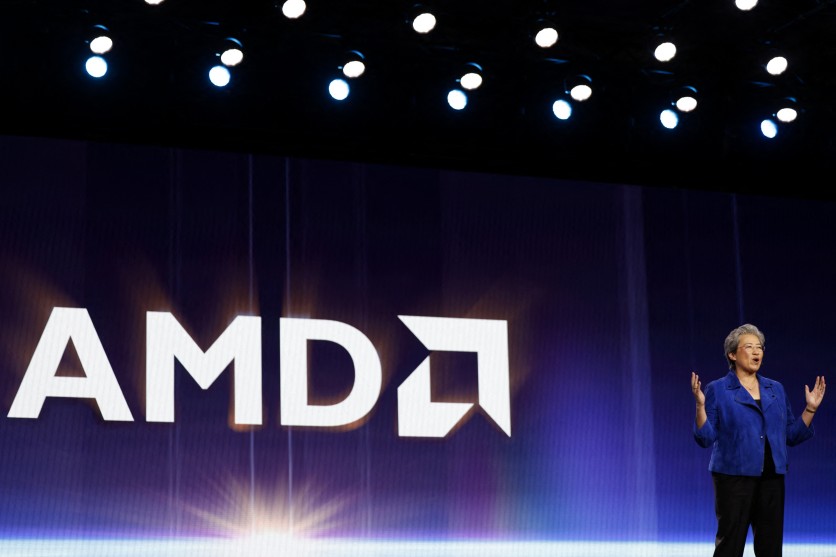
Lisa Su, chair and chief executive officer of Advanced Micro Devices Inc. (AMD), speaks during an AMD news conference ahead of the annual Consumer Electronics Show in Las Vegas, Nevada, on January 5, 2026. Caroline Brehman/AFP via Getty Images
AMD is positioning embedded computing as a next growth engine, aiming to carry the x86 CPU competitiveness it has built in data centers and PCs into industrial systems — cars, robots, and medical equipment. The harder part of the story is the one AMD did not lead with: in physical AI, the rivals it is chasing, Nvidia and Qualcomm, build their robotics and automotive platforms on Arm, the architecture the industry has largely treated as the default for power-constrained edge devices. AMD's pitch is that x86, packaged the right way, can compete there too.
At the "AMD x86 Embedded Solutions Day" held June 10 at L-Tower in Seoul's Yangjae district, Lee Hee-man, head of Korea sales for AMD's Adaptive and Embedded Computing Group, said the company is extending x86's success in data centers, PCs, and gaming consoles into the embedded space. AMD has secured 7,000 embedded customers worldwide, he said, spanning not just automotive but healthcare devices, broadcast equipment, and even satellites.
Embedded systems are computers built into cars, robots, and medical or telecom equipment to handle specific tasks. Unlike a general-purpose PC or server, their defining trait is reliably delivering the control, computation, visualization, and AI processing that a particular industrial setting requires — often in places a normal computer would never survive.
What Makes the Ryzen AI Embedded Chips Different
AMD broadened its embedded AI lineup this year with the Ryzen AI Embedded P100 and X100 series, first unveiled at CES in January. The design point is integration: each chip combines high-performance Zen 5 x86 CPU cores, an RDNA 3.5 GPU for real-time graphics and visualization, and an XDNA 2 neural processing unit delivering up to 50 TOPS of low-power AI acceleration — control, graphics, and AI compute on a single piece of silicon.
That single-chip layout is the engineering argument. In an embedded device, board space, power, and heat are tightly limited, so splitting the work across the right engine matters: always-on, low-power inference can sit on the NPU, heavier visual reasoning or bursts of compute can move to the GPU, and the x86 cores handle deterministic control. Folding all three into one package instead of wiring together separate chips cuts footprint, power draw, and cost — which is what lets a battery-powered robot run longer on a smaller battery. The P100 targets in-vehicle infotainment and industrial automation, while the higher-core X100 aims at more demanding "physical AI" and autonomous systems, putting AMD into more direct competition with Nvidia and Qualcomm in automotive and robotics chips.
Read more: AMD Unveils Ryzen AI Max 300 Series and Ryzen 7 9850X3D for Compact PCs and Gamers
Why the x86-Versus-Arm Question Hangs Over the Push
The reason this is a genuine contest, not a sure thing, is architecture. At CES 2026 Nvidia showed its robotics stack running on Jetson Thor, built on Arm cores, and its automotive compute on the Arm-based DRIVE platform; Qualcomm's Snapdragon Digital Chassis is likewise Arm-based. Arm's appeal in these markets has been power efficiency and a mature, decades-deep software ecosystem. AMD is wagering that x86's familiarity to developers, its raw compute, and a single-chip design can offset Arm's efficiency edge in the places where physical AI is heading — a market a Strategy& analysis pegs at roughly 430 billion euros by 2030, with automotive the single largest slice.
On raw AI throughput, AMD is not trying to out-muscle Nvidia's top edge parts — Nvidia's Jetson Thor is rated in the thousands of AI teraflops — but to win on integration, x86 compatibility, ruggedness, and long-term support in systems where those traits matter more than peak performance.
The Toughness Argument, and the Xilinx Inheritance
Lee described AMD's server EPYC and consumer Ryzen CPUs as the foundational technologies for embedded: EPYC for applications needing heavy computation, and Ryzen for flexible, adaptive designs such as robots and humanoids. AMD's edge, he argued, lies in the experience of the business itself. Embedded devices go into harsh environments full of vibration and heat, as well as outdoor robots and vehicles, demanding hardware built for those conditions — the P100, for instance, is rated to operate from −40°C to 105°C — along with long-term software support that industrial customers need over product lifecycles measured in years.
He also pointed to assets carried over from Xilinx, the programmable-chip maker AMD acquired in 2022 for about $49 billion: four decades of embedded computing know-how and related intellectual property for guaranteeing software functionality and security. The deal, the largest chip acquisition at the time, created AMD's Adaptive and Embedded Computing Group and folded in Xilinx's FPGA and adaptive-SoC expertise. AMD plans to apply more than 400 partnerships built over two decades in FPGAs and adaptive SoCs to its embedded x86 business and expand them to fit customer needs.
Whether x86 can carve real share from Arm in cars and robots will take years of design wins to answer. But AMD's argument is that the combination of one-chip integration, ruggedized hardware, FPGA heritage, and long-term support gives it a credible opening in a market that is only now taking shape.
Frequently Asked Questions
What is an embedded processor?
An embedded processor is a chip built into a device — a car, robot, or medical or telecom system — to handle specific tasks rather than serve as a general-purpose computer. Its defining trait is reliably delivering control, computation, visualization, and AI processing for a particular industrial setting, often in harsh conditions.
What is the AMD Ryzen AI Embedded P100?
The Ryzen AI Embedded P100 is an AMD embedded x86 processor that combines Zen 5 CPU cores, an RDNA 3.5 GPU, and an XDNA 2 NPU delivering up to 50 TOPS of AI acceleration on a single chip. It targets in-vehicle infotainment and industrial automation and is rated to run from −40°C to 105°C.
What is physical AI?
Physical AI refers to systems that autonomously sense, reason about, and act on the real world — vehicles, industrial robots, and humanoids — rather than producing only digital outputs. It requires on-device compute for control, perception, and low-latency AI, which is why chipmakers are competing for it.
How does AMD compete with Nvidia and Qualcomm in embedded chips?
AMD uses an x86 approach with integrated CPU, GPU, and NPU on one chip, plus ruggedized hardware and FPGA expertise from its Xilinx acquisition. Nvidia and Qualcomm build their robotics and automotive platforms on Arm, so AMD competes mainly on integration, x86 software compatibility, durability, and long-term support rather than peak AI throughput.

-
 C114 Communication Network
 -
 Communication Home
