
 Search

(Image credit: AMD)
-
Facebook -
X -
-
-
Pinterest -
Flipboard -
Email
Get Tom's Hardware's best news and in-depth reviews, straight to your inbox.
You are now subscribed
Your newsletter sign-up was successful
Robust financial performance and strong growth expectations from ASML and TSMC this week boosted sentiment across the tech industry, lifting stock prices and market capitalizations throughout the AI supply chain. Among the most notable beneficiaries of this AI-driven momentum are AMD, with a market capitalization that reached an all-time high on Thursday, and Intel, whose market cap hit a 25-year high. Other notable beneficiaries are Arm Holdings and Nvidia.
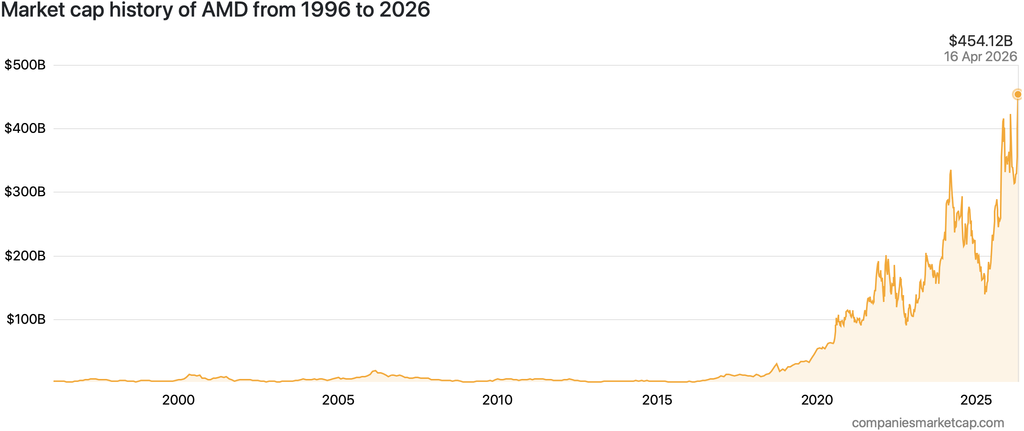
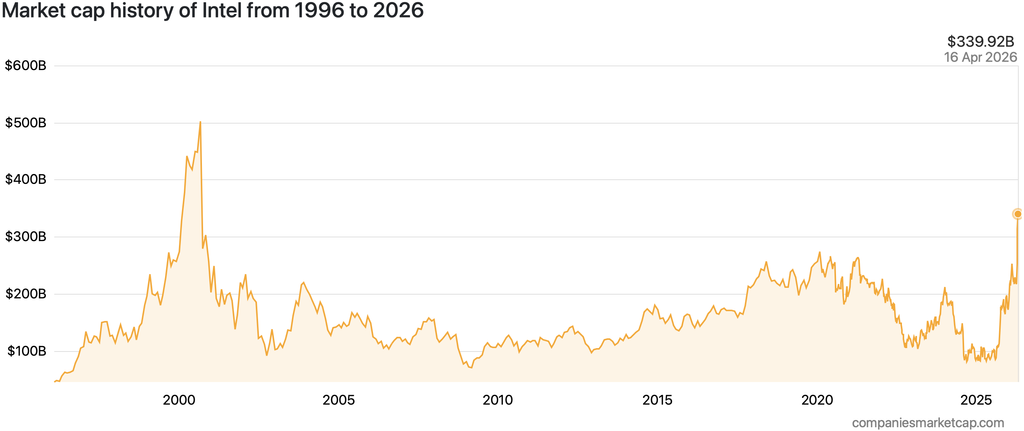
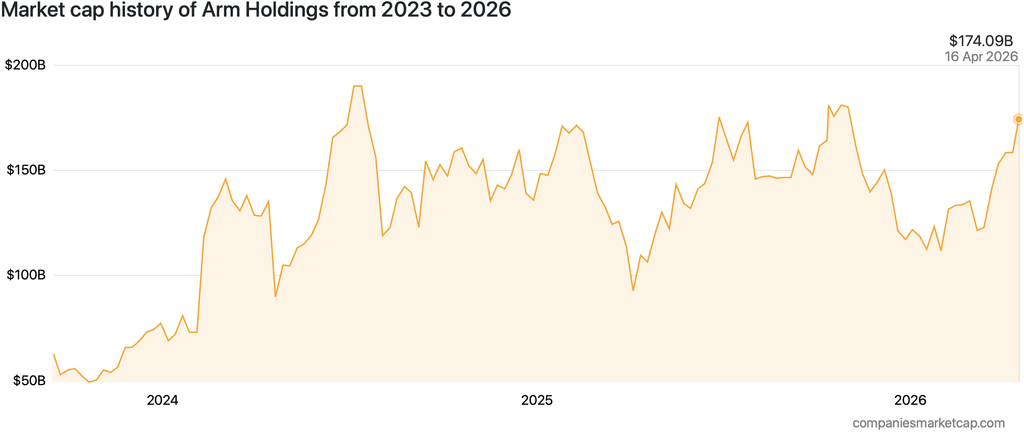
AMD's market cap hit $454 billion as its stock price touched $278, an all-time high for the company. Intel continued its rally that began in early March, and its market cap reached nearly $340 billion on April 16 as its stock price tested $68. For Intel, this is its second-best result since August 2020, when its valuation briefly achieved $502.71 billion. Arm has been on the rise since early March; its current market capitalization is $174 billion as its stock approached $165.
All three CPU stocks are driven by AI hype — specifically, rapid adoption of agentic AI and retrieval augmented generation (RAG) systems that benefit from high-performance CPUs and high-bandwidth memory subsystems. While it remains to be seen whether AMD and Intel can actually increase sales of their EPYC and Xeon CPUs tangibly due to the adoption of agentic AI and RAG systems by various parties, it is obvious that both companies benefit from the AI infrastructure buildout and AI adoption by enterprises, as these drive demand for data center-class processors.
Article continues below
(Image credit: CompaniesMarketCap.com)
If you look at AMD's historical market performance, you'll notice that for roughly 20 years, AMD's market capitalization remained low and volatile, generally in the single-digit to low tens of billions. Peaks around the early 2000s (Athlon era) and mid-2000s (Athlon 64 and Opteron success) were followed by prolonged declines tied to execution issues and performance disadvantages compared to Intel. AMD's inflection started around 2017 with the launch of the Zen microarchitecture as well as EPYC and Ryzen processors on its base, though it was not until around 2020 when the company's market cap hit $100 billion. That was after the market finally believed that the company could execute.
Meanwhile, the majority of AMD's current valuation was created after 2020 and the valuation is based on the market's belief that AMD can benefit from industrial megatrends like AI and cloud computing. So far, AMD has been successful.
(Image credit: CompaniesMarketCap.com)
When it comes to Intel, its market cap was below its book value last August, but began to climb after the U.S. government, accompanied by SoftBank and Nvidia, injected some cash into the company. To a large degree, the company's current valuation is based on expectations about Intel's ability to execute and sell a boatload of processors for AI systems.
(Image credit: CompaniesMarketCap.com)
For Arm Holdings — which became a CPU maker a few weeks ago and which gets most of its revenue by licensing CPU technologies rather by selling hardware — the positive sentiment reflects its unique position in the client and AI ecosystems. Arm is the indisputable leader in smartphones and tablets and the rising star in automotive and client PCs. Meanwhile, the Arm ISA has become the architecture of choice for hyperscalers developing custom silicon.
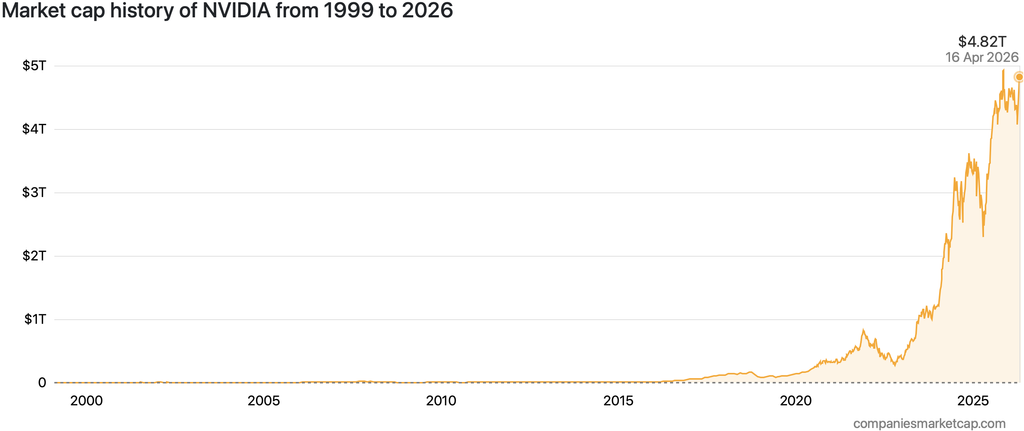
(Image credit: CompaniesMarketCap.com)
As for Nvidia, its undeniable leadership in the AI infrastructure in general and AI accelerators in particular is driving its market capitalization towards $5 billion. Nvidia's market cap on Thursday reached $4.82 trillion, down slightly from $4.92 trillion on October 21, 2025.

Follow Tom's Hardware on Google News, or add us as a preferred source, to get our latest news, analysis, & reviews in your feeds.

-
 C114 Communication Network
 -
 Communication Home
