
 Search

(Image credit: Tom's Hardware)
-
Facebook -
X -
-
-
Pinterest -
Flipboard -
Email
Get Tom's Hardware's best news and in-depth reviews, straight to your inbox.
You are now subscribed
Your newsletter sign-up was successful
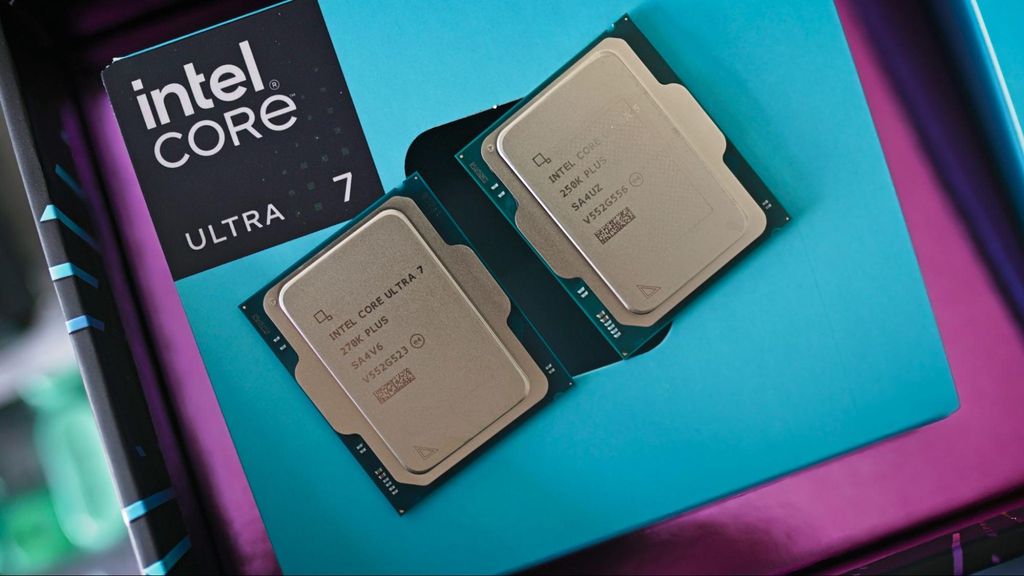
CPU reviews aren’t made equally. They should, and do, follow the same process. I double-check everything on the test bed is the same, run a gauntlet of benchmarks using the same software stack and OS configuration, and spit the results out into various spreadsheets to eventually turn that raw data into hundreds of graphs for you to peruse. But the ups and downs during that process can vary wildly, and I was caught on the extreme end of that variation with Intel’s new Core Ultra 7 270K Plus and Core Ultra 5 250K Plus.
Blindly running benchmarks and throwing the data into a chart is a quick way to come to bunk conclusions. PCs and benchmarks aren’t perfect, and when you run as many benchmarks as we do here at Tom’s Hardware, it’s inevitable that you’ll encounter some strange results. The challenge with Intel's 270K Plus and 250K Plus was that those strange, unbelievable results were actually representative of the real performance of the chips. I spent no less than 50 hours (and probably more) simply rerunning benchmarks on various CPUs because I didn’t believe the results I was seeing.
That’s the best compliment I can give Intel’s small but potent range of Arrow Lake Refresh CPUs. There are still problems with them, and I want to make that clear lest this devolves into some marketing slop about unbelievable benchmark results. But the fact remains that I spent a lot of extra time sanity checking, because the performance was so impressive, and that’s worth closer examination.
Article continues belowThe launch dust has settled on the 270K Plus and 250K Plus. The comparisons are in and the conclusion is clear: Intel made some compelling, value-oriented CPUs. Here, I’m going to take you behind the scenes of the testing process, as well as break down why these two CPUs are so important for Intel.
Arrow Lake is difficult to benchmark
There’s no other way to put it: Arrow Lake is annoying to benchmark. To avoid massive retests hours before a review embargo lifts, I’m constantly checking results against other data I’ve gathered to make sure my testing is on track. It’s much easier to quickly rerun a test with an odd result than it is to realize your data is off after you’ve already gone through a dozen CPUs. These checkpoints are even more important when working under an NDA. You’re working in a vacuum, bound contractually not to compare your results with other reviewers.
In generations past, it was pretty easy to know if you could trust the data you were seeing, but not with Arrow Lake. Even when the first CPUs rolled out, Intel made it clear that there would be performance regressions in some workloads. Further, there are still some workloads that do not play nicely with Intel’s Arrow Lake’s SoC-like CPU architecture.
(Image credit: Tom's Hardware)
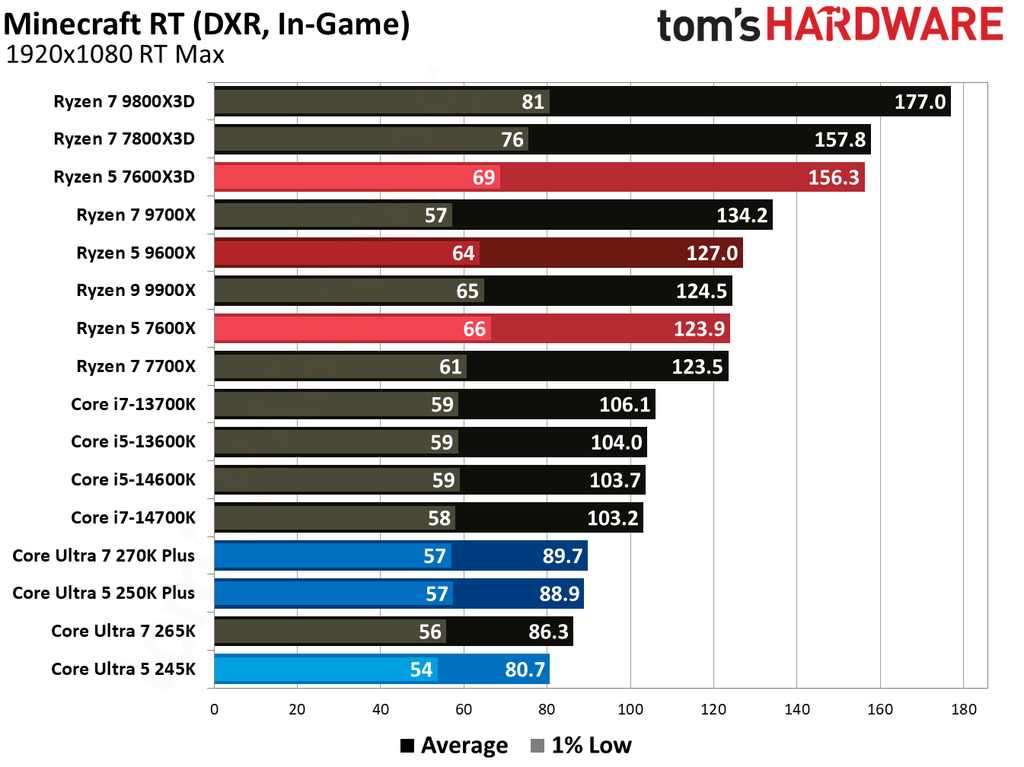
Overall, the 270K Plus is about as fast as the Core i9-14900K and 2.4% faster than the Ryzen 7 9700X in games at 1080p. But in Minecraft, the Ryzen 7 9700X is nearly 50% faster. There are reasons why Arrow Lake chips perform poorly in this particular game: namely, how the maximum render chunk distance stresses the memory chain throughout your system, but the reasons aren’t important. When working in a vacuum, it’s hard to take these extreme outliers at face value.
(Image credit: Tom's Hardware)
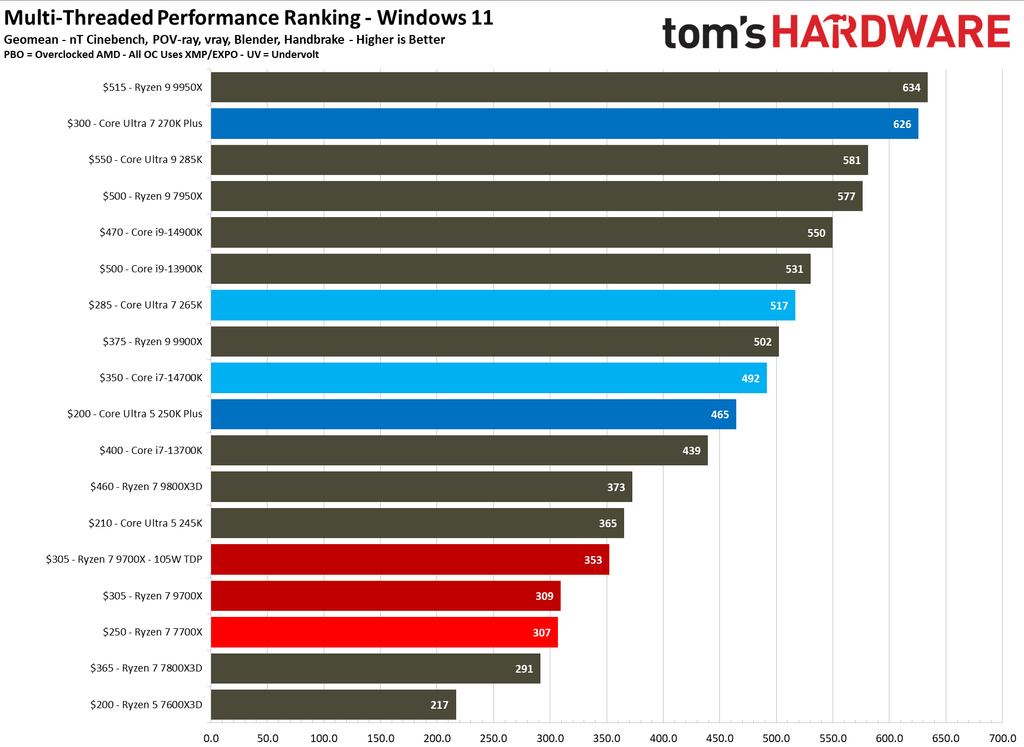
That’s true at the other end of the spectrum, as well. Even looking at the multithreaded performance geomean, there’s reason to doubt the results. Am I supposed to believe that the 270K Plus is nearly 8% faster than the Core Ultra 9 285K, despite costing half the price and coming with a reduction in peak clock speed? Again, there are reasons for this discrepancy — in this case, a massive boost in die-to-die frequency — but these kinds of results pop up everywhere with Arrow Lake CPUs. You can come up with a technical explanation for a few odd results, but expand that over dozens of (what would otherwise be) outliers, and it gets difficult to trust you actually gathered the right data.
In fairness, this isn’t a problem specific to Arrow Lake, but it is a problem specific to any radical architecture shift. We just don’t see radical architecture shifts often. AMD has been building on the foundation of Zen for nearly a decade, and although Intel shook things up with Alder Lake and its hybrid architecture, it took a similar approach to what we saw in the 14nm days by pushing clocks and power as far as they could go. Arrow Lake completely threw a wrench in the system by not only featuring a hybrid core architecture, but also a disaggregated design and the elimination of Hyperthreading.
The difficulty comes up not in evaluating discrepancies, but rather in how big those discrepancies should be. It’s one thing to say that the Core Ultra 5 245K isn’t a very good gaming CPU. It’s another to say that it’s 7.5% slower, and not 10% or even 15% slower, than AMD’s Ryzen 5 9600X in games at 1080p. That is the challenge when reviewing Arrow Lake, and it’s a challenge I ran up against when evaluating the 270K Plus and 250K Plus.
Rerunning the test benches
After it was all said and done, I ended up retesting the entire Arrow Lake stack, short of the Core Ultra 5 225, which wasn’t included as part of my test pool. I rerun benchmarks all the time; that isn’t unique. But with the 250K Plus and 270K Plus, I reran the full suite of tests for each chip. That’s somewhere between 10 and 12 hours of testing per CPU for applications, an additional two to three hours for power testing, and another few hours for game testing. In other words, a full retest isn’t something I resort to lightly.
(Image credit: Tom's Hardware)
I had tested the main Arrow Lake stack prior to the 270K Plus and 250K Plus showing up on my doorstep. I use a frozen test image, so gathering that data early gave me some time when the CPUs showed up to deal with any anomalies. After they arrived and I ran my tests, that’s when the reality of retesting started to set in. Seeing multithreaded performance with the 270K Plus that outdid the 285K set off alarm bells. Especially in applications, both CPUs were handily beating chips that cost twice as much without batting an eye.
First, I started with the raw comparison points, retesting the 265K and 245K, and looking at the uplifts with their Arrow Lake Refresh counterparts using Intel’s data as a reference point. The results were the same. I then expanded up to the 285K and threw games into the mix. The results were the same. By the end of the gauntlet, I realized that the performance was so impressive that it made me doubt the reliability of a benchmark suite that’s been refined over the course of decades of CPU testing here at Tom’s Hardware.
A lot of that doubt comes down to how Intel positioned the 270K Plus and 250K Plus. We’re talking about a $300 and $200 CPU, respectively, and although prices have trended upward since release, they’re still value-focused, midrange chips, based on pricing. Based on performance, they’re a tier above what their prices would suggest and probably $100 cheaper than what the market demands.
CPU | Street (MSRP) | Cores / Threads (P+E) | P-Core Base / Boost (GHz) | E-Core Base / Boost (GHz) | Cache (L2 + L3) | TDP / MTP | Memory |
|---|---|---|---|---|---|---|---|
Core Ultra 9 285K | $530 ($589) | 24 / 24 (8+16) | 3.7 / 5.5 | 3.2 / 4.6 | 76 MB | 125W / 250W | 6400MT/s |
Core Ultra 7 270K Plus | $300 | 24 / 24 (8+16) | 3.7 / 5.4 | 3.2 / 4.7 | 76 MB | 125W / 250W | 7200MT/s |
Core Ultra 7 265K | $270 ($394) | 20 / 20 (8+12) | 3.9 / 5.4 | 3.3 / 4.6 | 66 MB | 125W / 250W | 6400MT/s |
Core Ultra 5 250K Plus | $200 | 18 / 18 (6+12) | 4.2 / 5.3 | 3.3 / 4.6 | 60 MB | 125W / 159W | 7200MT/s |
Core Ultra 5 245K | $200 ($309) | 14 / 14 (6+8) | 4.2 / 5.2 | 3.6 / 4.6 | 50 MB | 125W / 159W | 6400MT/s |
Core Ultra 5 225 | $180 ($246) | 10 / 10 (6+4) | 3.3 / 4.9 | 2.7 / 4.4 | 42 MB | 65W / 121W | 6400MT/s |
It’s a radical departure for Intel. Since the dying days of 14nm, we’ve seen Intel slowly cede ground to AMD. But prices have slipped. Last-gen CPUs have become more viable from a value perspective, and Intel hasn’t been able to adequately address the gaming crowd with an X3D competitor. That all came to a head with the original launch of Arrow Lake. Intel was still postulating that it could counter AMD’s offerings point-for-point, but the data just didn’t back that up. We were left in a situation where Intel’s chips were so undesirable that CPUs that were two generations old were selling for more than the shiny new Arrow Lake options.
Intel needed a reset, both on pricing and messaging, to signal to buyers that although AMD dominates at the high-end, Team Blue can still deliver a lot of value around midrange price points. And the 270K Plus and 250K Plus are an aggressive reset. They deliver in an area that’s largely been ignored by AMD as it pushes out endless X3D variations, and the slightly elevated prices of Arrow Lake Refresh chips are a signal that Intel’s new position is paying off.
The question, and my concern, is how long this will last. It’s one thing to sell off silicon on a fire sale to make up for a lacking generation of chips. It’s another to commit to a new position in the consumer CPU market, especially after decades of being the top dog.
The Arrow Lake reset — and looking toward Nova Lake
Arrow Lake Refresh alone isn’t enough for Intel to turn things around on the consumer front. Let’s not be shortsighted. They’re great chips, and easy to recommend in a value-oriented build, but there’s a reason not a single Intel chip appears in the top 10 of Amazon’s CPU best sellers, and why its chips only occupy five of the top 25 slots. We can look at best-seller lists, region or retailer-specific data, or even the Steam hardware survey. But anyone who builds PCs and is around those who are building PCs doesn’t need to look far to see that you go with an AMD chip more often than not.
Intel can’t overcome that level of mind share with two CPUs, especially not two CPUs that still only manage to match AMD’s non-X3D offerings in gaming performance. What it can do is set the tone for Nova Lake.
(Image credit: Tom's Hardware)
One consistent thread throughout reviews of the 270K Plus and 250K Plus — and one I particularly harped on in my reviews — is the LGA 1851 socket. It’s a dead end. Intel hasn’t outright confirmed we won’t see another chip using this socket, but I’d be shocked if we did. And unlike sending out a long-lived platform on a high note, as we saw with AM4 and the Ryzen 7 5800X3D, LGA 1851 barely saw the light of day with the disappointing reception of the original Arrow Lake chips.
Regardless if you upgrade your CPU every generation or wait for a new memory standard to finally make a platform swap, socket longevity is important. It’s not just about if you’ll upgrade to a new CPU; it’s about having the option to upgrade. It’s why you buy a motherboard with four M.2 slots even if you’ll never fill them. It’s why an ATX board comes with four DIMM slots despite the fact that most builders will only occupy two. The option to upgrade your CPU is powerful, even if you’ll never do it. Buy into an AM5 platform, and you can go further in the future. Buy into an LGA 1851 platform, and you’re already restricting yourself to a full motherboard and CPU swap down the line. This shouldn’t be your only consideration when choosing a CPU, but these types of differences can sway a buying decision when other differentiators are exhausted.
Intel, I suspect, is aware of this. We don’t know if the LGA 1954 socket that Nova Lake chips will use will continue forward for multiple generations, but it’s a lot easier to buy into a platform that’s just rolling out than one that already has a foot out the door. The stance Intel is taking with the 270K Plus and 250K Plus, situating itself as a value-oriented alternative that punches above its price tag, has to extend beyond these two CPUs, onto a platform that future-looking buyers are willing to invest in.
That’s what I’m looking for with Nova Lake. We have big rumors about Intel’s X3D competitor, supposedly called bLLC, and speculation about a 44-core flagship. That’s great, and I’m sure there will be fireworks between AMD and Intel at the high-end. It’s these chips like the 270K Plus and 250K Plus, however, where Intel needs to take ground. Arrow Lake Refresh is resounding proof that it can occupy that space. Let’s just hope Intel doesn’t change its mind again.

-
 C114 Communication Network
 -
 Communication Home
