
 Search

(Image credit: Primate Labs)
-
Facebook -
X -
-
-
Pinterest -
Flipboard -
Email
Get Tom's Hardware's best news and in-depth reviews, straight to your inbox.
You are now subscribed
Your newsletter sign-up was successful
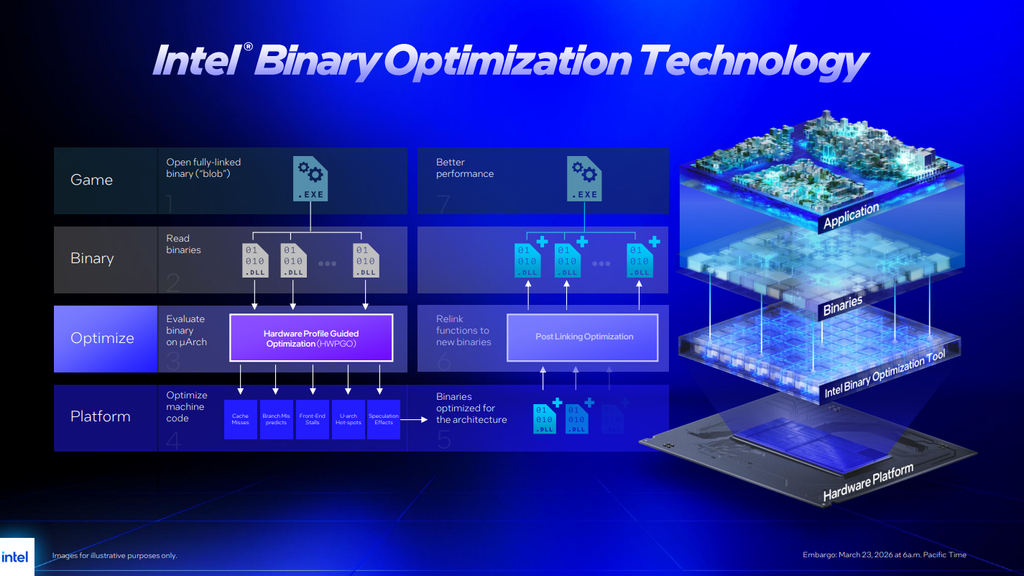
Intel's latest Core Ultra 200 Plus (Arrow Lake refresh) and Core Ultra 300 (Panther Lake) chips support a new feature called Binary Optimization Tool (BOT) that improves performance in some apps. We've tested it extensively and found it to be largely consistent, but Geekbench developer Primate Labs says it "paints an unrealistic picture" in terms of daily usage. The latest update, Geekbench 6.7 came out today with BOT detection built-in to ensure benchmark results with it enabled are flagged as invalid.
(Image credit: Tom's Hardware)
- CPU scaling with DLSS
- Ryzen to the top: How AMD innovated in the gaming CPU market
- How ARM is working its way into PCs
- AMD CES 2026 gaming trends press Q&A roundtable transcript
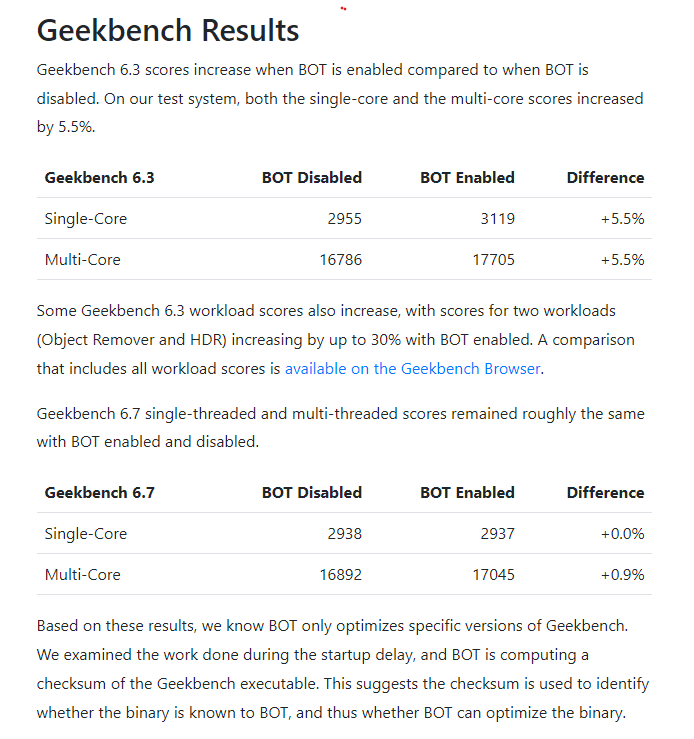
The saga started last month when Primate Labs first put out a warning against BOT, claiming it can increase Geekbench workload scores by up to 40%. Then, it actually investigated the tool and saw a 5.5% improvement in both multi- and single-core scores. However, some specific tests, like HDR processing, achieved 30% better results with BOT enabled, showing how it can selectively favor certain workloads over others.
(Image credit: Future)
The issue is how biased these performance uplifts can be since BOT isn't supported in every app. Geekbench argues its benchmark is designed to evaluate against a broad range of workloads that accurately represent real-world performance; any test with BOT enabled goes against that by replacing the existing varied code with specifically tuned binaries that only two desktop CPUs (currently) benefit from.
Article continues belowBOT runs a checksum on every executable to identify and compile optimized binaries for it — that's how and why the previous version was affected. It seems BOT doesn't yet have the tuned binaries for Geekbench 6.7, so you'll see no difference in performance. Even when they're ready to apply, runs with BOT enabled will be marked invalid and incomparable to other CPUs in the database.
(Image credit: Intel)
The update also brings some other welcome changes, such as improved SoC identification on Android that now reports the actual model of the chip along with its architecture. Similarly, Geekbench 6.7 will now display the name of RISC-V processors instead of just their ISA string. And lastly, Arm-based Linux systems should be more stable running Geekbench's multi-threaded workloads.

Follow Tom's Hardware on Google News, or add us as a preferred source, to get our latest news, analysis, & reviews in your feeds.

-
 C114 Communication Network
 -
 Communication Home
