
 Search

Credit: Apple
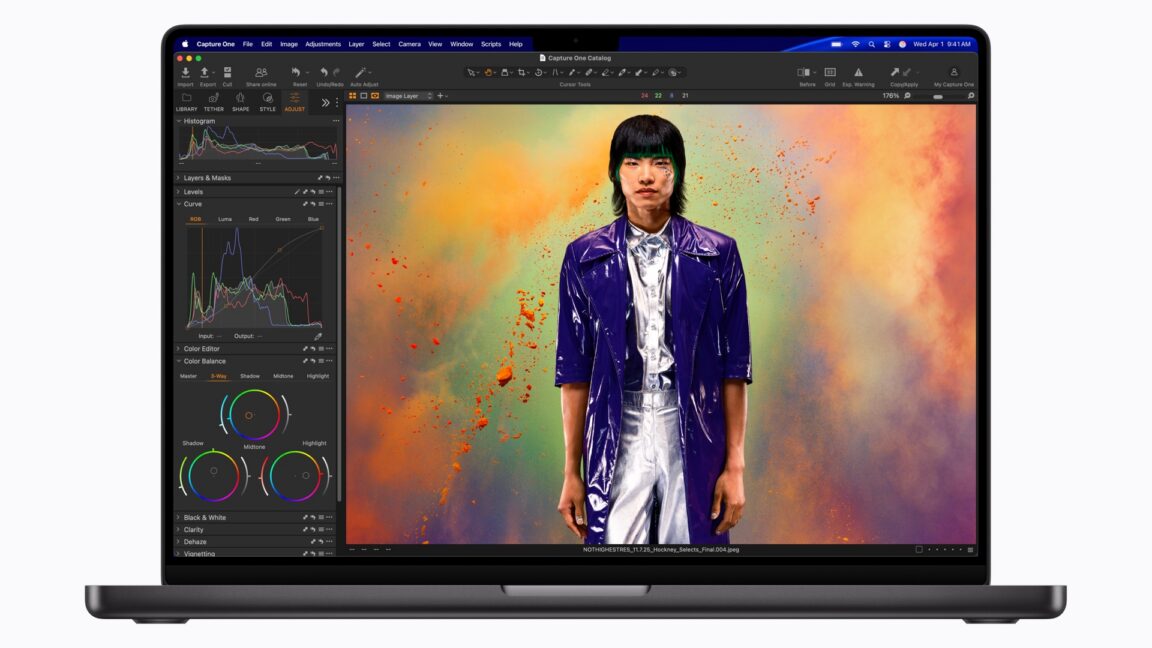
Apple updated its low-end MacBook Pro with the Apple M5 back in October, but the higher-end 14-inch and 16-inch Pros stuck with the M4 Pro and M4 Max chips. This morning, Apple circled back and updated the rest of the lineup, adding the M5 Pro and M5 Max to the higher-end machines and bumping the base storage—the M5 Pro now comes with 1TB of storage by default, while M5 Max chips come with 2TB of storage by default. The internal storage is said to be “up to 2x faster” than the previous-generation Pros. Apple is also bumping the base storage for the M5 MacBook Pro from 512GB to 1TB.
Unlike Apple’s other announcements this week, though, these upgrades also come with increases to their starting prices; the 14-inch MacBook Pro with an M5 Pro now starts at $2,199 instead of $1,999, and the 16-inch model with an M5 Pro starts at $2,699 instead of $2,499. The M5 MacBook Pro now starts at $1,699, up from $1,599. Granted, you’re getting double the storage of those old base models, but you no longer have the option to pay less if you don’t need 1TB of space.
The M5 Pro and M5 Max look like fairly major updates from the M4 Pro and M4 Max. Both use an 18-core CPU with six higher-performing cores and 12 lower-performing cores, but Apple is changing how it talks about each kind of core. The high-performance cores are now called “super cores,” a change that Apple says will retroactively apply to the high-performance cores in the basic Apple M5. The M5 has four of them, and M5 Pro and M5 Max have six.
Apple says the 12 other CPU cores in the M5 Pro and M5 Max are an “all-new performance core that is optimized to deliver greater power-efficient, multithreaded performance for pro workloads.” These appear to be different from the efficiency cores used in M5 and older Apple chips. Apple didn’t make direct generation-over-generation performance comparisons, but it did say that M5 Pro and M5 Max “deliver up to 2.5x higher multithreaded performance than M1 Pro and M1 Max.”
Though they use the same CPU cores, the GPU continues to be a major point of differentiation between the Pro and Max chips. The M5 Pro can include up to 20 GPU cores, twice as many as the basic M5. The M5 Max can include up to 40 GPU cores. Both chips also feature improved memory bandwidth compared to M4 Pro and M4 Max (up to 307 GB/s for M5 Pro, and 614 GB/s for M5 Max). Altogether, the GPU improvements should improve performance by about 20 percent compared to M4-generation GPUs with the same number of cores.
An Apple N1 wireless chip rounds out the internal upgrades, shifting to internally developed silicon to provide Wi-Fi 7 and Bluetooth 6 connectivity.
The external designs of the 14- and 16-inch MacBook Pros haven’t changed this year—they look essentially the same as they have since the M1 Pro and M1 Max MacBook Pros came out half a decade ago.
The new laptops are available for pre-order on March 4 and will be available on March 11. They’re available in both black and silver finishes.
New screens, and the departure of the Pro Display XDR
The Studio Display and Studio Display XDR share the same screen size, resolution, and basic design, but the XDR is much more capable.
Credit: Apple
To go with the new MacBook Pros, Apple has also introduced a pair of new displays, its first monitor update since launching the original Studio Display four years ago.
The Studio Display update is the least exciting of the two because it doesn’t affect the display itself. The screen is still a 27-inch 5K IPS LCD, and it still costs $1,599. The updates are mostly at the margins; Apple says that the 12MP Center Stage Camera features “improved image quality,” which I would assume comes mostly from including a newer chip than the Apple A13 in the first Studio Display. Its Thunderbolt port has been upgraded to Thunderbolt 5, and it has one upstream and one downstream Thunderbolt port for connecting high-speed accessories. But the 600 nits peak brightness, the 60 Hz refresh rate, and the other specs remain mostly the same as before.
The higher-end display is more interesting, though it’s not quite a replacement for the now-departed Pro Display XDR. That screen was a 32-inch 6K monitor that cost $5,000; the new Studio Display XDR is more like a supercharged version of the basic Studio Display.
The Studio Display XDR is still a 27-inch 5K screen with a 12MP Center Stage camera and a mix of Thunderbolt 5 and USB-C ports. But it uses mini-LED technology rather than basic LED, and it features both Adaptive Sync support and a 120 Hz refresh rate (Apple doesn’t brand it as ProMotion, for whatever reason, but that’s the same refresh rate as the MacBook Pro screens). It supports up to 1,000 nits of peak brightness for SDR content and up to 2,000 nits for HDR content. It also comes mounted to a height-adustable stand; this is a $400 upgrade for the regular Studio Display, but it’s standard here.
Those are all good updates, but the pricing will still put off many buyers: the Studio Display XDR starts at $3,299. Both the Studio Display and Studio Display XDR also offer a nano-texture matte finish for an extra $300.
Like the new MacBook Pros, these displays will be available for preorder on March 4 and will be available on March 11.
The new MacBook Pros and Studio Displays are part of a string of announcements that Apple is making this week in the run-up to a “special experience” event on Wednesday morning. So far, the company has also announced a new iPhone 17e and an updated iPad Air with an M4 chip and additional RAM, plus new MacBook Airs with the M5 chip.

-
 C114 Communication Network
 -
 Communication Home
