
 Search

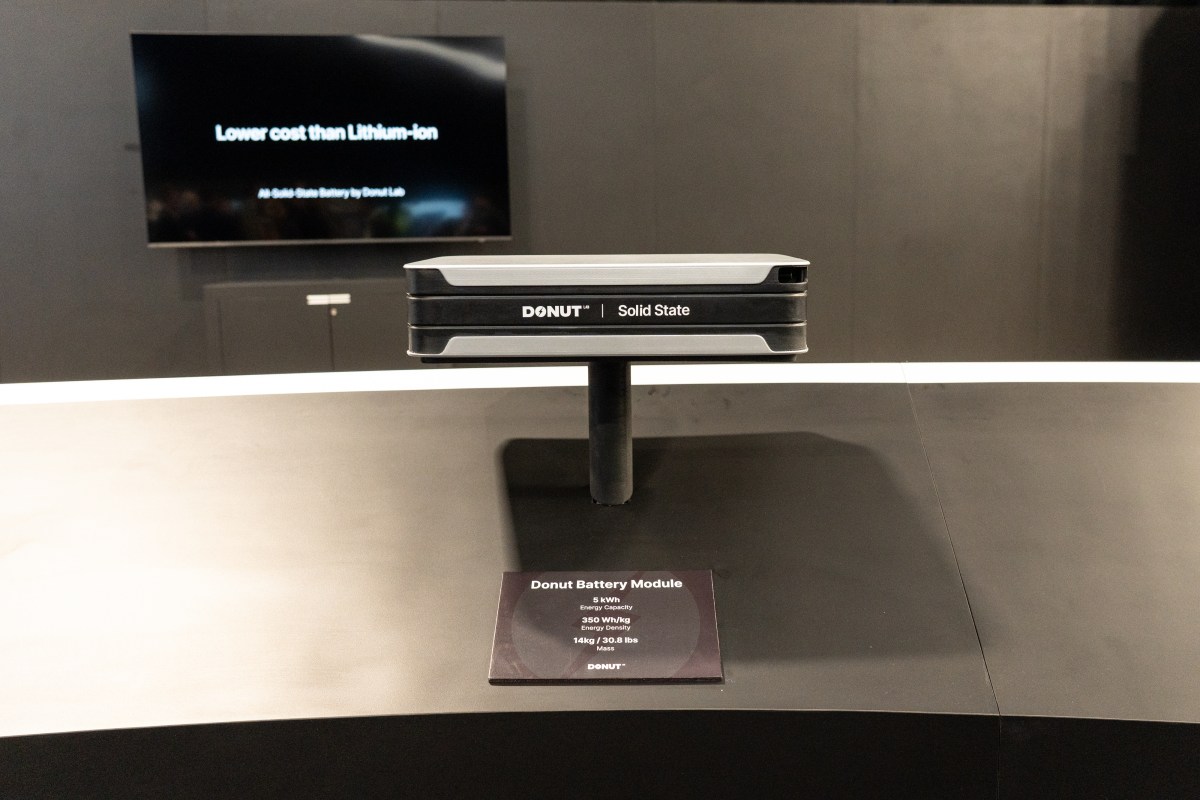
Finnish startup Donut Lab is out to prove that its solid-state battery is all that it claims to be. Last week, the test was about fast charging. This week is where things get hot.
Like the first test, this one was also conducted by state-owned VTT Technical Research Centre of Finland. The team set out to determine how well Donut Lab’s cells held up under extreme heat, which has been known to adversely affect traditional lithium-ion batteries. The results show that not only can the Finnish startup’s solid-state battery still discharge energy under conditions of up to 100 degrees Celsius (212 degrees Fahrenheit), it actually gains capacity.
The group tested the 3.6V/26 Amp-hour solid-state battery under three different temperatures: 20C for a baseline at room temperature; “high heat” at 80C; and “extreme heat” at 100C. To ensure the battery functioned correctly during the test, VTT applied physical pressure to it using a steel plate and placed it on a heatsink inside a temperature-controlled chamber.
At room temperature, the cell delivered 24.9Ah, which served as the benchmark for the other tests. At 80C, the performance actually improved, delivering 27.5Ah, or about 110.5 percent of its room-temperature capacity. And at 100C, the cell delivered 27.6Ah, or 107.1 percent of its room-temp performance. While the battery still worked and could be recharged afterward, the physical pouch lost its vacuum seal, likely due to the extreme heat.
VTT found that the solid-state cell actually became more efficient at higher temperatures, providing more energy than it did at room temperature. Even at over 100C (a temperature that would be very dangerous for many standard batteries), the cell continued to provide power and could still be recharged.
Solid-state batteries, which are often referred to as the “holy grail” of batteries, have eluded researchers for decades. Most EV companies use “wet” lithium-ion batteries, which use liquid electrolytes to move energy around. But these batteries can be slow to charge, can freeze up in subzero temperatures, and contain flammable material that can be hazardous in the event of a crash. Solid-state packs are made of “dry” conductive material that can hold more energy without any of the thermal runaway problems of a traditional battery. This could mean electric vehicles with longer range, shorter charging times, and better performance under extreme conditions.
Lithium-ion batteries with liquid electrolytes are more susceptible to extreme heat. If a liquid battery gets too hot, the liquid can vaporize and catch fire — a process called thermal runaway. And at high temperatures, the liquid can degrade, shortening the battery’s life or causing it to swell dangerously.
By replacing the flammable liquid with a solid ceramic or polymer material, Donut Lab says it can improve the battery’s tolerance to extreme heat, which could mean better efficiency. As seen in VTT’s study, heat actually lowers the internal resistance of the solid electrolyte, which allows ions to move more easily. That’s why the battery’s capacity actually increased at 80C and 100C.
But before you go popping the champagne, keep in mind that the report doesn’t address some key questions regarding Donut Lab’s solid-state battery. First, VTT doesn’t confirm the chemistry of the pack, but simply takes it at face value. Second, the test didn’t address what Verge contributor Tim Stevens refers to as the “dendrite issue,” in which microscopic stalagmites growing from anode to cathode across the solid-state electrolyte can cause electrical shorts. Perhaps Donut Lab will address that in subsequent independent test results, which it is promising as part of its “I Donut Believe” series.

-
 C114 Communication Network
 -
 Communication Home
