
 Search

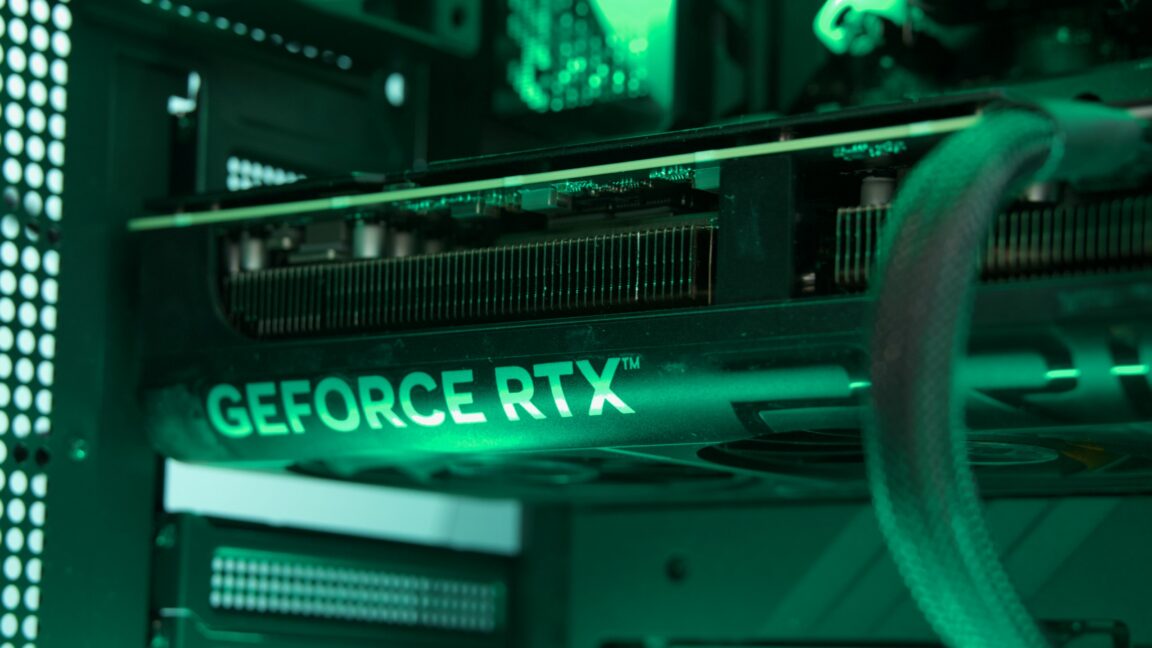
Credit: Andrew Cunningham
Big Tech’s AI-fueled memory shortage is set to be the PC industry’s defining story for 2026 and beyond. Standalone, direct-to-consumer RAM kits were some of the first products to feel the bite, with prices spiking by 300 or 400 percent by the end of 2025; prices for SSDs had also increased noticeably, albeit more modestly.
The rest of 2026 is going to be all about where, how, and to what extent those price spikes flow downstream into computers, phones, and other components that use RAM and NAND chips—areas where the existing supply of products and longer-term supply contracts negotiated by big companies have helped keep prices from surging too noticeably so far.
This week, we’re seeing signs that the RAM crunch is starting to affect the GPU market—Asus made some waves when it inadvertently announced that it was discontinuing its GeForce RTX 5070 Ti.
Though the company has tried to walk this announcement back since then, if you’re a GPU manufacturer, there’s a strong argument to be made for either discontinuing this model or de-prioritizing it in favor of other GPUs. The 5070 Ti uses 16GB of GDDR7, plus a partially disabled version of Nvidia’s GB203 GPU silicon. This is the same chip and the same amount of RAM used in the higher-end RTX 5080—the thinking goes, why continue to build a graphics card with an MSRP of $749 when the same basic parts could go to a card with a $999 MSRP instead?
Whether Asus or any other company is canceling production or not, you can see why GPU makers would be tempted by the argument: street prices for the RTX 5070 Ti models start in the $1,050 to $1,100 range on Newegg right now, where RTX 5080 cards start in the $1,500 to $1,600 range. Though 5080 models may need more robust boards, heatsinks, and other components than a 5070 Ti, if you’re just trying to maximize the profit-per-GPU you can get for the same amount of RAM, it makes sense to shift allocation to the more expensive cards.
Either way, those GPUs are selling for at least 40 or 50 percent more than their original MSRP right now—it’s a bad time to want a graphics card that can hit 4K without leaning too heavily on upscaling technologies.
The good news, if there is any, is that it’s still not a historically awful time to want a low-end to midrange GPU for 1080p or 1440p gaming. The regular RTX 5070 is hanging out around $560 or $570, just a hair over its $549 MSRP. The situation is similar for the Radeon RX 9070 (MSRP $549, current street price around $580), the 16GB version of the RX 9060 XT (MSRP $349, street price $400ish), and the GeForce RTX 5060 (currently available at its $300 MSRP). The Radeon RX 9070 XT is faring a bit worse, though not as badly as the RTX 5070 Ti or 5080 (MSRP $599, street price around $730 or $750).
We’re past the period late last year where you could consistently find many of these cards for under MSRP, but we aren’t (yet?) at the point where you have to fight with scalpers for the privilege of paying just 1.5 times the normal price for any of them. It’s something to bear in mind if you’re thinking about upgrading an existing build to get around having to buy new RAM.
Storage wars
SSD prices have been climbing alongside RAM prices for months, but as of last month the price increases for 500GB, 1TB, and 2TB drives were around twice as expensive as they had been in August 2025, compared to three or four times as expensive for DDR5 RAM kits. But things are moving in a bad direction, and high-capacity SSDs in particular are being hit hard.
If you want a 1TB internal M.2 SSD from a recognizable company, that will generally run you somewhere between $120 and $150—often a little higher than the $135 we recorded for a 1TB WD Blue drive back in January, but not absurdly so.
It’s still possible to find a decent 2TB drive like this SiliconPower model for around $230, the price we quoted for a 2TB Western Digital SN7100 back in December. But currently, SSDs from big-name companies like Samsung and WD/SanDisk (currently in a state of flux, but the SanDisk-branded versions of these drives don’t appear to be at retail yet) are either out of stock at many major retailers or have shot up dramatically in price. Best Buy will sell you a 2TB SN7100 for $370, which the site proclaims is a “deal” because it’s marked down from a regular price of $490. A 2TB Samsung 990 Evo Plus will run you $440; Amazon had listed the same drive in new condition for $177 as recently as mid-December.
Drives with 4TB capacities are in a similar place: it’s possible to find reasonable-ish options (another SiliconPower UD90 for $360; a Crucial P310 for $345), but the bigger-name drives I’d usually default to are either much more expensive or out of stock.
Even spinning hard drive prices are beginning to climb, albeit more gradually. A 6TB WD Red NAS drive that retailed for $140 in August of 2025 is listed at $160 now. The 4TB version, as well as a 4TB Seagate IronWolf NAS drive, is around $100, which was its typical price for most of last year. But historical data sourced from CamelCamelCamel shows that both drives went on sale for $80 or $85 several times last year, something that stopped happening for both drives after September. A 12TB IronWolf drive that was usually priced at $240 last year is $270 now; the 16TB version has climbed from $330 to $350.
I wouldn’t expect these prices to continue to shoot upward like RAM and SSD prices have—the level of demand isn’t the same, there isn’t a ton of RAM or flash memory in them, and data centers mostly aren’t going to bother competing with home users to buy 4TB or 8TB drives when they can fit 20 or 30TB in a drive that takes up the same amount of physical space. But the increases are still worth keeping an eye on, as price increases and shortages change buying patterns.

-
 C114 Communication Network
 -
 Communication Home
