
 Search

Credit: AMD
Intel, AMD, Nvidia, and other chip companies usually have some kind of news to announce at CES to kick off the year, but some of those announcements are more interesting than others. Sometimes you see new chips with significant speed boosts and other new technologies, and sometimes you get rebranded versions of old silicon meant to fill out a lineup or make an existing architecture seem newer and more exciting than it is.
AMD’s Ryzen CPU announcements this year fall firmly into the latter camp—these are all gently tweaked variants of chips that launched in 2024 and 2025.
“New,” for certain values of “new”
Let’s start with the Ryzen AI 400 series. Officially the follow-up to the Ryzen AI 300 chips announced in June 2024, these processors offer some modest clock speed improvements and faster memory support. The new Ryzen AI 9 HX 470 has a peak boost clock speed of 5.2 GHz and support for LPDDR5x-8533, for example, up from 5.1 GHz and LPDDR5x-8000 for the Ryzen AI 9 HX 370, and its built-in neural processing unit (NPU) is capable of 60 trillion operations per second (TOPS) rather than 50 TOPS.
But beyond those modest tweaks, Ryzen AI 400 chips are constructed from the same building blocks as Ryzen AI 300. They use a combination of high-performance Zen 5 CPU cores and smaller, more efficient Zen 5c cores, between 4 and 16 integrated GPU cores based on the RDNA 3 GPU architecture, and a 4 nm TSMC manufacturing process.
This isn’t new behavior from AMD. A couple of processor generations ago (and one processor naming scheme ago), the company did the same thing with the Ryzen 8040-series laptop chips, sprucing up the older 7040 series with marginally higher clock speeds and not much else. The upshot is that if you can get a decent discount on a Ryzen AI 300 system because it’s “old,” you can buy it without missing much.
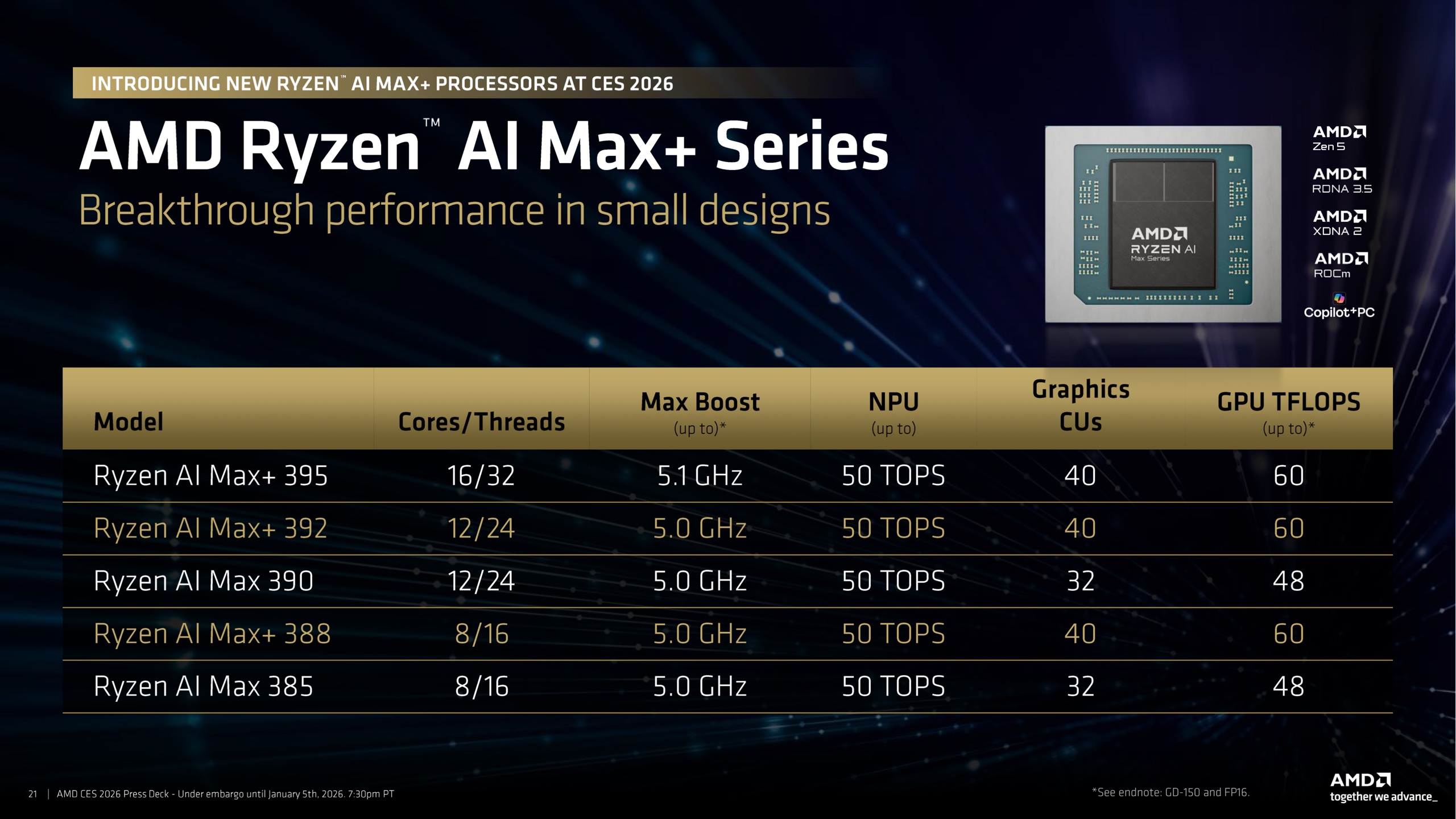
Two new Ryzen AI Max+ chips offer maxed-out integrated GPUs with fewer CPU cores.
Credit: AMD
AMD’s additions to the Ryzen AI Max+ 300 lineup are slightly more interesting, at least for gaming laptop and mini PC enthusiasts. These chips power some gaming laptops and a handful of desktop systems, including the Framework Desktop, and their claim to fame is a massive integrated Radeon GPU that can rival the performance of entry-level dedicated graphics cards.
Until now, getting a Ryzen AI Max+ CPU with all 40 of its RDNA 3.5 GPU cores enabled also meant buying a chip with all 16 of its CPU cores enabled. But AMD is adding new Ryzen AI Max+ 392 and 388 models to the lineup, which both have fully enabled GPUs but with partly enabled 12- and 8-core CPUs. The reduced CPU performance shouldn’t hurt game performance much, if at all, and the new models could lead to slightly cheaper options for people who want to maximize graphics performance without paying for extra CPU cores they don’t strictly need.
One side effect of soldiering on with existing architectures in all of these chips, particularly the RDNA 3 graphics architecture, is that none of these integrated GPUs will ever benefit from “FSR Redstone,” the basket of graphics upscaling and frame generation technologies that AMD just announced to try to close the gap between FSR and Nvidia’s competing DLSS features. The Redstone technologies all require hardware only available in the RDNA 4 architecture, which is used only in dedicated Radeon RX 9060 and 9070 series graphics cards. These “new” chips, while still capable of using older FSR versions, will miss out on all those improvements.
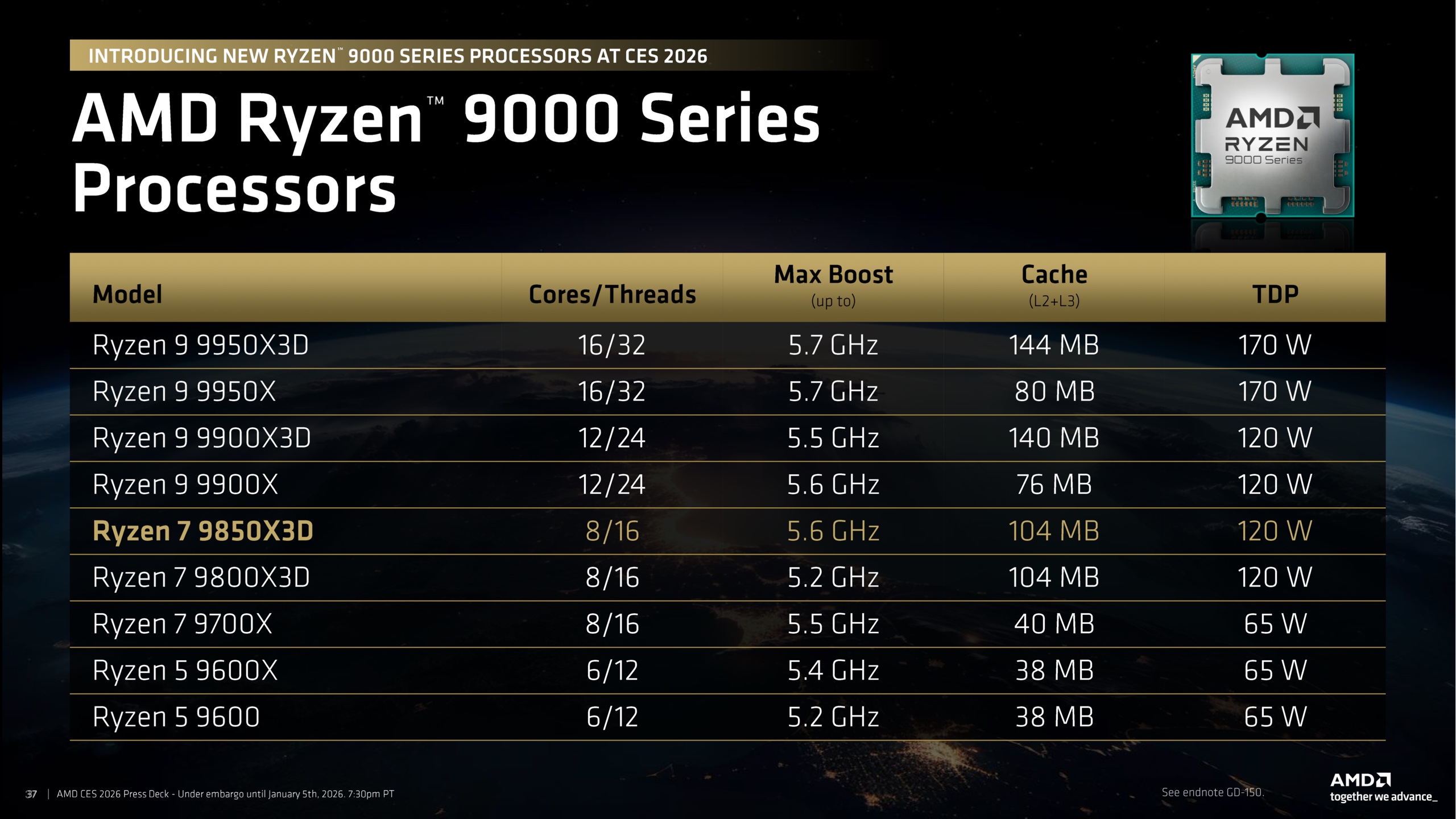
The Ryzen 7 9850X3D is slotting into the existing Ryzen 9000 desktop lineup, which otherwise isn’t changing from last year.
Credit: AMD
Desktop builders and buyers have just a single new socketed AM5 chip to consider: the Ryzen 7 9850X3D, a new 8-core Zen 5 chip with a 64 MB chunk of AMD’s 3D V-Cache. This chip is essentially the Ryzen 7 9800X3D with a clock speed boost—up to 5.6 GHz, compared to 5.2 GHz—and there’s not much else to say about it. Anyone hoping for Zen 6 or a more significant overhaul for the Ryzen desktop CPUs will need to keep waiting—though that may not be such a bad thing right now given today’s skyrocketing RAM and storage prices.

-
 C114 Communication Network
 -
 Communication Home
