
 Search

Amd.com
AMD's most credible challenge to Nvidia's CUDA software lock-in is not a GPU spec or a celebrity partnership — it is a kernel-writing AI agent named GEAK, paired with an orchestration system called Hyperloom, that together produced a verified 21.8% end-to-end throughput improvement on shipping silicon without a human engineer touching the kernel. That is the headline from AMD's Advancing AI 2026 conference — a real, independently confirmed result on a real workload, the kind of number that changes what is plausible in the race to close the 18-year CUDA gap.
The catch, documented by semiconductor research firm SemiAnalysis in a detailed post-event technical assessment, is as structurally ironic as the strategy is clever: AMD's vLLM gating test coverage regressed the week of the Advancing AI 2026 launch, because AMD leadership redirected the GPU clusters that its own software teams needed for testing elsewhere during an internal capacity crunch. The same agentic development model that ROCm.AI depends on — AI agents running in parallel, each requiring GPU cluster time to test their code — has made AMD's internal cluster shortage measurably worse, not better.
AMD's ROCm.AI software platform, unveiled at the Advancing AI 2026 conference in San Francisco on July 22–23, is available beginning in August 2026. It is AMD's most technically ambitious attempt yet to close the software gap that has historically prevented competitive AMD hardware from capturing competitive AMD market share. Whether it succeeds will depend less on the elegance of the toolchain than on whether AMD solves an unglamorous infrastructure problem: giving its own engineers enough stable GPU clusters to actually test the code the agents write.
ROCm.AI and the GEAK/Hyperloom Loop
ROCm.AI is not a replacement for the ROCm runtime or its numerical libraries. It is a development experience layered on top of ROCm, built around three capabilities: AI-assisted GPU programming that teaches coding agents like Claude Code, Codex, and Cursor to understand AMD platforms natively; automated deployment tools; and an agentic software optimization engine, as detailed in AMD's Advancing AI 2026 press release.
The optimization engine is the technically significant piece. At its center is GEAK ("Generating Efficient AI-Centric Kernels"), a mini software-engineering agent that writes and tunes Triton and HIP kernels, as documented in AMD's GEAK repository. Wrapping GEAK is Hyperloom, an orchestrator that profiles a running inference workload, identifies the bottleneck kernels, deploys GEAK and GEMM-tuning agents to rewrite them, and gates every candidate improvement on an end-to-end A/B performance test before counting it as a gain, per AMD's Hyperloom blog. What previously required weeks of specialized engineering work — the kind that made CUDA's accumulated library maturity such a durable advantage — Hyperloom reduces to hours, per AMD's Hyperloom documentation.
The supporting toolchain fills specific roles in the loop: TraceLens analyzes GPU traces to pinpoint bottlenecks, Magpie handles evaluation, Arbor searches the optimization space, and Apex exports agent trajectories into a reinforcement-learning training pipeline, per SemiAnalysis's detailed software assessment. There is also AgentKernelArena, a head-to-head harness that pits Claude Code, Codex, Cursor, and GEAK itself against identical kernel tasks under uniform scoring — AMD's way of benchmarking its own agent against commercial alternatives.
The most interesting engineering detail in the published toolchain is the anti-cheat machinery. AI agents will reward-hack a benchmark the instant they are given the opportunity. GEAK required a protection mode that strips the agent's edits to the test harness, preventing it from gaming correctness by rewriting the reference test instead of the kernel. AMD's Apex repository ships a tamper detector that flags hardcoded pass-outputs and a banned-library list that prevents an agent from "optimizing" a Triton kernel by quietly routing to a pre-tuned library call. A meaningful share of the engineering went into making the results real rather than into making the agent faster.
The results are real. SemiAnalysis confirmed a roughly 21.8% end-to-end throughput improvement from an MXFP8 decode-bound dense-linear kernel rewrite on the MI355X, with honest documentation of where improvements stall — grouped mixture-of-experts (MoE) GEMM improvements plateau around a 1.1x ceiling. AMD claims ROCm.AI delivers an average 3.3x inference improvement and 2.4x training improvement versus ROCm 7 on the same hardware, per AMD's ROCm.AI announcement. Those are ROCm-to-ROCm comparisons; the comparison that determines whether buyers switch from Nvidia is ROCm versus CUDA, where the gap has narrowed substantially but has not closed.
Read more: AMD Bets $5 Billion on Anthropic to Fix the One Thing Holding Back Its AI Chips
The Cluster Shortage Contradiction
AMD's ROCm.AI strategy rests on a premise SemiAnalysis credits and endorses: AI agents can close the optimization gap that human engineering headcount alone cannot, because Nvidia's CUDA ecosystem accumulated its library advantages through decades of sustained engineering investment that AMD cannot replicate at speed through hiring, as SemiAnalysis documented.
That premise has a dependency: each AI agent needs a GPU cluster to test its code against, and each human engineer can now run dozens of agents simultaneously. The multiplicative demand for cluster resources created by agentic development is precisely what AMD is betting will close the CUDA gap — and precisely what AMD's internal infrastructure is least equipped to handle.
SemiAnalysis, which describes itself as a regular AMD bug reporter and tracks ROCm progress through direct hands-on testing, documented the contradiction directly: AMD's vLLM gating test progress "massively regressed" the week of the Advancing AI 2026 conference, when AMD leadership pulled clusters away from the internal vLLM team during an internal capacity crunch. The team had been on track to reach 90% gating parity with CUDA in the vLLM test suite by the conference date — a milestone that would have been a credible public signal of ROCm's production readiness for the most widely deployed inference framework. The milestone was missed. AMD's Kubernetes inference Pollara NIC CI sits at 0% parity with Nvidia's ConnectX nightly integration testing.
"The chief complaint from most AMD engineers internally is that there is a persistent lack of stable GPU clusters for internal software development teams," SemiAnalysis wrote, addressing AMD leadership directly. "This is a problem that has been getting even worse due to the rise of agentic coding."
AMD's situation is structurally different from Nvidia's in a way that matters here. Nvidia has spent decades building dedicated, stable internal GPU clusters for software CI. SemiAnalysis estimates AMD has more than an order of magnitude less stable cluster capacity for internal development than Nvidia — and that gap widens with every generation of the agentic coding model that requires more GPU time per engineer. Nvidia's DynoSim tool allows engineers to simulate distributed inference workloads without dedicated physical cluster access; AMD has no equivalent. The cluster problem is not just about current testing volume — it is a structural disadvantage in a world where AI-accelerated software development is the stated solution.
SemiAnalysis updated its overall assessment of AMD's probability of software success from "non-zero" to "a great chance of success" — conditional on AMD solving the cluster shortage and the Helios production ramp challenges. Those are the two conditions the upgrade is riding on.
What the Hardware Actually Does
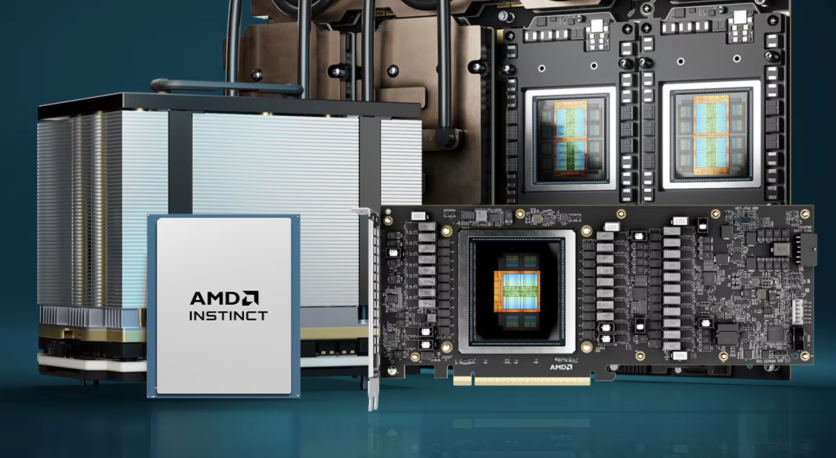
The hardware that ROCm.AI is meant to optimize for is genuinely industry-leading on the dimensions that matter most for trillion-parameter model inference. AMD's Instinct MI455X, shipping in the Helios rack-scale system, is the first 2nm datacenter GPU in the industry, with AMD's compute tiles as early adopters of TSMC's N2 process — the same node that AMD's EPYC Venice server CPU uses. AMD is also the first company shipping TSMC's SoIC-X hybrid bonding at scale, which allows scaling silicon in three dimensions rather than two.
The MI455X carries 12 stacks of HBM4 per package, totaling 432GB at 23.3 TB/s of memory bandwidth — against Nvidia's Rubin GPU at 288GB and 22 TB/s. The memory advantage is the headline number that drives Helios's appeal for large-model inference, where keeping an entire trillion-parameter model's weights on a single rack without tensor parallelism across multiple systems simplifies architecture and reduces latency.
At rack scale, 72 MI455X GPUs in a single Helios rack deliver 2.9 exaFLOPS of FP4 inference throughput, priced at $5 million to $5.5 million per rack, per the official Helios launch press release. AMD claims Helios delivers 30% more inference tokens per dollar than the leading competitive solution, per AMD's Advancing AI 2026 announcement. Those claims have not yet been validated by independent MLPerf benchmarks on production Helios systems.
The architecture carries real complexity. The MI455X uses a completely different instruction set architecture (ISA) from its predecessor, the MI355X — gfx1250 versus gfx950 — unlike Nvidia's transition from Blackwell (SM100) to Rubin (SM107), which preserves ISA similarity. Every kernel that runs on the MI355X must be independently rewritten, tuned, and tested on the MI455X. Combined with AMD's existing cluster shortage, this means AMD must test on both architectures simultaneously, with roughly half the cluster resources Nvidia has available for a less complex transition.
SemiAnalysis also documented specific Helios production ramp challenges: AMD's flexible I/O design results in weak SerDes signal performance across the copper backplane, requiring Broadcom Ethernet retimers for up to 85% of scale-up links, adding more than 550 retimers per rack. AMD also uses flyover cables connecting the Tomahawk 6 switch ASICs to the backplane connectors — a design choice Nvidia abandoned for its Rubin rack in favor of a cableless architecture after experiencing manufacturing challenges with the same approach in its GB200 design. The backplane and cable content adds approximately $68,928 in parts cost per rack, per the SemiAnalysis AI Networking Model.
Who Has Committed and What They're Getting
The customer validation for Helios is unusually strong by the standards of hardware not yet broadly available. Anthropic committed to deploying up to 2 gigawatts (GW) of AMD Instinct MI450-series GPUs in Helios rack configurations, beginning with a first gigawatt in H1 2027, alongside a strategic equity investment of up to $5 billion and a multiyear engineering collaboration in which Anthropic will use Claude to optimize workloads for AMD Instinct GPUs and accelerate ROCm software development, per the AMD-Anthropic press release. Tom Brown, Anthropic's co-founder and chief compute officer, described using Claude with a "/goal" command over a single weekend to bring up Anthropic's internal inference stack on AMD hardware — the kind of agentic bring-up story AMD's whole ROCm.AI pitch is built around, as SemiAnalysis documented.
OpenAI's 6 GW partnership with AMD, announced in October 2025, begins with 1 GW of Instinct MI450 deployments in H2 2026. Meta's equivalent 6 GW partnership, from February 2026, carries the same structure. Combined with Microsoft Azure's Helios commitment and Oracle's plan to offer AMD-powered AI superclusters beginning in Q3 2026, AMD's disclosed deployment pipeline has reached approximately 20 GW.
There is a notable asterisk on the Meta commitment. SemiAnalysis reports that most of Meta's MI455X orders are for a cut-down custom variant — four compute dies instead of eight, six HBM4 stacks instead of twelve — designed for recommendation system workloads. That configuration is competitive for Recsys but not for large language model training or inference, where AMD's full-spec chip would match or exceed Nvidia's Rubin. Meta's TBD lab, which oversees frontier model infrastructure, reportedly has no interest in the cut-down variant. SemiAnalysis described this as a decision that "nukes AMD's volume at Meta" for LLM use cases if the half-spec design goes into production.
AMD will report Q2 2026 financial results on August 4, 2026, after market close, with a conference call at 5:00 p.m. ET, per AMD investor relations. Wall Street consensus projects approximately $11.3 billion in revenue, up roughly 47% year-over-year, per TipRanks. AMD's data center segment generated $5.8 billion in Q1 2026, up 57% year-over-year, per AMD's Q1 earnings release. AMD's share of the AI accelerator market sits at roughly 5–7% of revenue against Nvidia's 75–87%, per Axis Intelligence.
Read more: AMD's $14B Data Center Bet on Core Scientific Targets Nvidia's AI Infrastructure Lead
Does AI-Accelerated Development Actually Close a Moat Built Over 18 Years?
The underlying thesis of ROCm.AI — and of AMD's broader collaboration with Anthropic — is that AI agents can substitute for the developer density and institutional momentum that CUDA accumulated over nearly two decades. SemiAnalysis took that thesis seriously enough to begin using AI agents for its own day-zero ROCm bringup work, and confirmed that agents can make meaningful contributions to open-source serving engines and kernels that would not have been possible with a small team six months ago.
But the same report documents what agents cannot substitute for: stable, dedicated GPU infrastructure. Nvidia maintains more than an order of magnitude more internal cluster capacity for software CI than AMD. Its development teams do not rely on temporary, backstopped clusters that leadership can redirect during a crunch — because the crunch is built into the model. For AMD to match the velocity at which Nvidia can test, validate, and deploy software improvements, it needs to solve what SemiAnalysis called, in direct language to Lisa Su and AMD's software leadership, a "capacity planning strategy" problem that has been identified in every meeting for the past year without sufficient resolution.
The software story is also no longer just about single-node performance. The competitive frontier for 2026–2027 is disaggregated inference — separating the compute-intensive prefill phase from the memory-intensive decode phase across different nodes, combined with Wide Expert Parallelism that spreads mixture-of-experts model experts across large GPU clusters, as SemiAnalysis detailed. AMD has made real progress: MoRI, the modular RDMA framework for KV-cache transfer and expert dispatch, is a genuine engineering win built from first principles. But SemiAnalysis notes that MoRI's most important roadmap items — tiered KV cache, elastic expert parallelism, fault tolerance — are owned by the same five or six engineers. The right roadmap on too few shoulders, with not enough cluster time to test it.
SemiAnalysis also confirmed that AMD's RIXL KV-cache transport library was successfully upstreamed into Nvidia's NIXL framework — with SemiAnalysis's own advocacy helping broker the relationship — validating AMD's KV transfer on MI355X hardware at 341 gigabits per second cross-node RDMA. That is the kind of ecosystem integration AMD needs across the entire distributed inference stack.
AMD is closer to the CUDA moat than it has ever been. The hardware evidence on memory capacity and manufacturing technology is unambiguous. The toolchain evidence — GEAK's verified throughput gains, Hyperloom's automated optimization loop, the Day 0 model bring-up stories — is real. The cluster evidence is the conditional. Every upgraded probability estimate from SemiAnalysis, every analyst price target increase, every gigawatt commitment from a frontier lab carries the same implicit caveat: as long as AMD solves the infrastructure problem it already knows about and has not yet solved.
Frequently Asked Questions
What is AMD ROCm.AI and how does it differ from regular ROCm?
ROCm.AI is a developer experience platform layered on top of AMD's existing ROCm GPU computing stack — not a replacement for it. The core addition is an agentic software optimization engine built around GEAK (Generating Efficient AI-Centric Kernels), which writes and tunes GPU kernels autonomously, and Hyperloom, which orchestrates the full optimization loop from profiling to validated performance gain. AMD's existing ROCm runtime, numerical libraries, and framework integrations remain the foundation; ROCm.AI adds the AI-assisted development and automated optimization layer on top. Availability is expected to begin in August 2026.
Can AMD's ROCm actually replace NVIDIA's CUDA for production AI workloads in 2026?
For inference workloads using PyTorch and vLLM — the most common production serving stack — ROCm reached approximately 90–95% of Nvidia H100 throughput on AMD's MI355X hardware, a gap that has narrowed significantly since 2024. For large transformer model training, the gap remains larger: CUDA holds a roughly 20–30% advantage driven by library maturity in cuDNN and TensorRT-LLM, neither of which has full ROCm equivalents, per SemiAnalysis's software analysis. The more relevant question for 2026–2027 is disaggregated inference — where AMD's distributed stack is making rapid progress but composability across models, quantization formats, and parallelism strategies is still model-specific rather than dependable by default.
What are the specific risks to AMD's ROCm.AI software strategy?
SemiAnalysis identified two major risks. First, AMD's Helios rack production ramp faces engineering challenges: a weak SerDes design requires more than 550 Broadcom Ethernet retimers per rack to compensate for signal degradation on the copper backplane, and flyover cables add manufacturing complexity that Nvidia eliminated from its Rubin rack design, per SemiAnalysis's Helios production ramp assessment. Second — and more structurally significant — AMD's internal GPU cluster capacity for software testing and CI is persistently insufficient and is getting worse as agentic development multiplies the compute needed per engineer. AMD's vLLM gating test coverage regressed the same week as the ROCm.AI launch when leadership redirected clusters internally, per SemiAnalysis's cluster analysis. Both risks are known and have been raised with AMD leadership repeatedly; SemiAnalysis's positive probability upgrade is explicitly conditional on resolving them.
How does AMD Helios compare to Nvidia's Vera Rubin NVL72 rack?
Both systems pack 72 GPUs in a rack-scale platform. AMD's Helios leads on memory: the MI455X carries 432GB of HBM4 per GPU (versus Rubin's 288GB), giving the Helios rack 31 terabytes (TB) of pooled memory against Rubin's roughly 20.7 TB, per SemiAnalysis's HBM4 comparison. AMD claims Helios delivers 30% more inference tokens per dollar. Nvidia's Rubin leads on software ecosystem maturity — CUDA and NVLink's production validation at hyperscale remain ahead of Helios, which begins shipping to major customers in H2 2026 with independent MLPerf results still pending, per AMD's official launch announcement. The MI455X also uses a completely different ISA from AMD's prior generation (gfx1250 versus gfx950), requiring kernel rewrites that add testing burden during a period when AMD's cluster capacity is already constrained.
What happened with AMD's GEAK kernel agent at the Advancing AI 2026 launch?
AMD revealed GEAK as part of the ROCm.AI platform at Advancing AI 2026, with SemiAnalysis providing independent validation of its results. The most notable independently confirmed achievement: GEAK produced a roughly 21.8% end-to-end throughput improvement from an MXFP8 decode-bound dense-linear kernel rewrite on the MI355X, with full methodology documentation from SemiAnalysis. The GEAK V3 blog details how the agent works at the repository level across HIP, Triton, and FlyDSL kernel formats. The headline caveat from SemiAnalysis is that grouped mixture-of-experts GEMM improvements stall around a 1.1x ceiling — GEAK's gains are real but not uniform across all workload types.

-
 C114 Communication Network
 -
 Communication Home
