
 Search

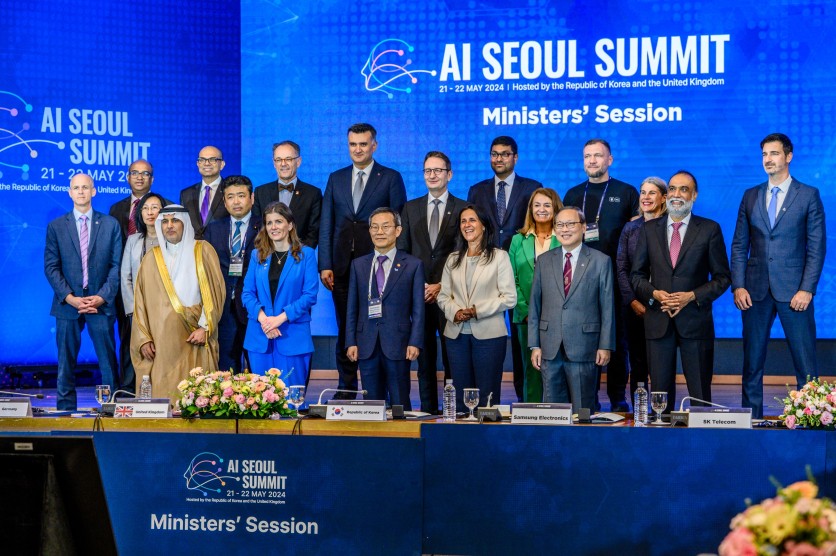
Guests gather for a group photo during the Ministers' Session of the AI Seoul Summit, at the Korea Institute of Science and Technology (KIST), in Seoul on May 22, 2024. ANTHONY WALLACE/AFP via Getty Images
South Korea assembled twelve of its largest technology, power, and cooling companies into a formal public-private alliance on Wednesday and gave that alliance a mandate no single nation has yet delivered on: build 18.4 gigawatts of AI data center capacity, then sell the blueprint to the world. The AIDC Alliance — short for AI Data Center Alliance — launched at a ceremony at Lotte Hotel in central Seoul that drew more than 400 participants from industry, government, and academia, formalizing an industrial campaign Seoul frames as existential.
The headline number alone is staggering. South Korea's full 18.4GW target, with 8.4 gigawatts due by 2029 and the remainder by 2035, would require a combined investment of over 1,000 trillion won (approximately $683 billion USD). For context, the United States — the world's largest data center market by a wide margin — added roughly 5 gigawatts of total new capacity across all of 2024. Seoul's plan, if executed, would represent one of the largest sovereign AI infrastructure commitments in history.
Whether that execution can keep pace with those ambitions depends almost entirely on a problem the alliance did not solve at its launch ceremony: the Korean power grid.
Alliance Governance: "One Team" from the Top Down
The AIDC Alliance operates under a joint public-private chairmanship. Jung Jae-heon, CEO of SK Telecom and president of the Korea Information and Communication Advancement Association, was named the inaugural private co-chair. Deputy Prime Minister and Ministry of Science and ICT (MSIT) Minister Bae Kyung-hoon serves as the public co-chair.
The steering board includes twelve corporate and institutional members: Naver Cloud, Samsung SDS, SK Telecom, NHN Cloud, LS Electric, LG Uplus, LG Electronics, GS, Kakao, KT, KTNF, and AI chip startup FuriosaAI. The governance structure is deliberately labeled 원팀 (won-tim, or "one team") — a term MSIT has used to signal top-down industrial mobilization of a kind not seen in Korea since the export-driven campaigns of the 1970s and 1980s.
Jung framed the stakes at the launch: AI competition is now country versus country, he said, and government and industry must operate as a single unit if Korea is to advance its competitive position. Bae called the next three to five years a "golden time" for AI infrastructure competition globally and pledged full government support across power procurement, land, and permitting.
Three Divisions and an Export Task Force
Below the steering board, the alliance is organized into three standing working divisions plus a dedicated export task force.
The Demand Division, led by Naver Cloud, is responsible for the operators who will actually build and run AI data centers. Its mandate covers raising the competitiveness of domestic AIDC solutions, developing large-scale testbeds for technical validation, and establishing procurement pathways that give Korean suppliers reference wins they can show foreign buyers.
The Supply Division, led by LG Electronics, is organized into four sub-groups: data center construction and fit-out; ICT equipment and software; power and cooling systems; and materials and components supply chains. Software and virtualization specialist NamuAX is among the companies represented in the ICT sub-group. LS Electric — a steering board member already expanding switchboard production in the United States — falls within this division's scope.
The Foundation Division, led by Kakao, handles regulatory reform, workforce development, and ecosystem-building, with the state-run Institute for Information and Communications Technology Promotion (IITP) acting as secretariat.
The Export Industrialization Task Force operates across all divisions. It is tasked with crafting differentiated strategies for training infrastructure (dominated by large Western hyperscalers) and inference infrastructure (built around open ecosystems). For markets like the United Arab Emirates, the task force is developing a full-package export model that bundles AIDC design, construction, equipment supply, and operations into a single offering. The UAE is currently one of the world's most active buyers of large-scale AI infrastructure packages; it competes directly for the same foreign capital being pitched to Seoul.
One company is in discussions to move between divisions. Vessel AI — a GPU cloud and MLOps firm initially placed in the Supply Division — is negotiating a transfer to the Demand Division after its CEO outlined plans to build a 10,000-GPU cluster this year scaling to 50,000 GPUs next year, requiring 100–200 megawatts of data center capacity.
FuriosaAI and the Domestic Chip Question
Among the alliance's twelve corporate members, FuriosaAI draws the most scrutiny — and the most strategic weight. The Seoul-based AI chip startup produces the RNGD neural processing unit (NPU), South Korea's primary domestically manufactured alternative to Nvidia GPU accelerators.
The RNGD — internally called "Renegade" — is built on TSMC's 5nm fabrication process and uses a custom architecture called the Tensor Contraction Processor, or TCP. Unlike a GPU, which maps AI workloads onto a general-purpose SIMD (Single Instruction, Multiple Data) compute grid, the TCP is designed to natively execute tensor contractions — the core mathematical operation underlying modern deep learning — directly in hardware. The result is a chip optimized specifically for inference workloads: high concurrency, low latency, low power relative to throughput. According to FuriosaAI's developer documentation, the RNGD delivers 512 TOPS at INT8 precision and 256 TFLOPS at BF16, packaged in a 180-watt PCIe card paired with 48 gigabytes of SK Hynix HBM3 memory.
Samsung SDS launched Korea's first domestic NPU-as-a-Service offering on July 16, 2026, running on RNGD inside the Samsung Cloud Platform, targeting government agencies and public-sector clients. The RNGD has also been deployed at Equinix's Lisbon data center, marking FuriosaAI's European commercial entry. FuriosaAI CEO Baek Jun-ho said at the AIDC Alliance launch that procurement and testbed discussions with alliance member companies are still being developed, with positive updates forthcoming.
Government officials explicitly framed the alliance as the largest coordinated domestic customer base the Korean chip industry has ever had access to. Bae said the government intends to develop GPU and domestic NPU pipelines in parallel, building toward a full-stack AI capability — models, infrastructure, platforms, and services — rather than simply importing foreign compute.
A ₩200 Trillion Financing Backstop
Funding an 18.4GW buildout requires capital on a scale commercial markets alone cannot readily supply on Korea's timeline. Financial Services Commission Vice Chairman Kwon Dae-young announced at the ceremony that the government's National Growth Fund would be expanded from 150 trillion won (approximately $102 billion USD) to 200 trillion won (approximately $137 billion USD) over five years, with annual deployment rising from 30 trillion to 40 trillion won (approximately $27 billion USD) per year starting next year.
Between 30% and 40% of that total — up to 80 trillion won (approximately $55 billion USD) — will be directed specifically toward AI, semiconductors, and power infrastructure. Kwon also stressed that the fund's reach would extend beyond the large conglomerates at the alliance's steering table: mid-sized firms, smaller companies, and ventures outside the Seoul metropolitan area will be eligible recipients.
The capital commitment has already begun to materialize at the project level. Nvidia announced approximately $1 billion in investment in Naver to support expansion of the GAK Sejong data center. The combined semiconductor and data-center deals announced by Samsung, SK Group, and Nvidia during President Lee Jae-myung's July trip to San Francisco reached roughly $700 billion. Anthropic CEO Dario Amodei, meeting directly with President Lee, called South Korea the best place at present to build an AI data center in a short period of time.
The Grid Problem Seoul Has Not Solved
The most consequential constraint on the AIDC Alliance's 18.4GW plan does not appear in its governance documents or financing announcements. It appears in a utility balance sheet.
Korea Electric Power Corporation (KEPCO), the state-owned monopoly that controls transmission, distribution, and retail electricity across South Korea, is carrying a debt load exceeding 202 trillion won (approximately $138 billion USD). That burden restricts the grid upgrade budgets needed to energize 100-megawatt-plus AI data center campuses. More than 55% of KEPCO's current transmission and substation projects were delayed as of late 2025. Between 2013 and 2023, South Korea's transmission infrastructure expanded by only 14%, while AI data center demand is now projected to rise sixfold by 2040 from the 5 terawatt-hours it consumed in all of 2024.
The scale of the power challenge becomes concrete in the numbers. The combined demand from the government's planned AI data center clusters and its parallel semiconductor fab megaprojects totals 24.7 gigawatts — the equivalent of 28 new nuclear power plants at 1.4 gigawatts each. That figure does not include existing industrial or residential load.
Modern AI data centers compound the grid problem at the facility level. Racks running the latest GPU accelerators require 40 to 140 kilowatts of power per rack, compared to 10 to 20 kilowatts for legacy enterprise infrastructure — and they require direct liquid cooling (coolant routed to cold plates mounted directly on chip packages) rather than the air cooling legacy facilities use. Facilities that cannot deliver liquid cooling at this density cannot run the hardware at rated performance.
The national AI strategy's answer to date — a May 2026 special law designating AI data centers as national strategic facilities to accelerate permitting — did not resolve the power access problem. A key provision that would have allowed operators to bypass KEPCO by signing direct liquefied natural gas power purchase agreements was removed from the final bill. That means the 18.4GW plan currently depends on KEPCO's ability to upgrade transmission infrastructure at a pace the utility has never achieved.
Son Yang-hoon, professor emeritus of economics at Incheon National University, put the constraint plainly in prior TechTimes reporting: "AI data centers absolutely require stable power, but power-equipment supply can't be increased quickly."
Community opposition adds a second physical constraint. Approximately half of permitted data center projects in the Seoul capital region have encountered delays due to local opposition over concerns including electromagnetic fields, noise, and heat pollution, according to industry analyses.
Implementation Roadmap
The alliance's phased rollout calendar runs through 2035:
By the end of the third quarter of 2026, each division and the export task force will finalize its detailed implementation roadmap. The fourth quarter will bring the first steering board meeting, the 2027 budget, and draft regulations for the forthcoming AIDC Special Act and cluster development plan. In the first quarter of 2027, a formal AIDC Project Agency will be established and cluster special economic zones will be designated under the Special Act. Steering board meetings will occur semi-annually; division committees monthly; working-level committees every other month.
The roadmap's first milestone — the 8.4GW Phase 1 target by 2029 — arrives in roughly 30 months. That window includes the time needed to finalize site selection, secure grid interconnections, complete construction, and energize the first clusters. The gap between those requirements and KEPCO's current delivery capacity is the plan's central execution risk.
South Korea's Place in the Global Infrastructure Race
The AIDC Alliance launch arrives at a moment of intensifying competition over AI compute supply. The United States, the European Union, Japan, India, and the Gulf states are all running parallel sovereign AI infrastructure programs. South Korea's approach is notable for its explicit integration of export policy from the outset. Seoul is not simply trying to build enough compute to serve domestic AI demand — it is positioning itself to sell "intelligence tokens," in Bae's phrase, to foreign buyers.
The export task force's UAE focus reflects a broader pattern. Gulf sovereign wealth funds and national AI programs have become the most active buyers of large-scale AI infrastructure packages globally, and the UAE data center market surpassed more than 376 megawatts of live capacity in 2025 with further expansions underway. South Korea is now formally in that sales race alongside the United States, France, and the United Kingdom.
For FuriosaAI specifically, the alliance represents the largest potential domestic customer base the Korean chip industry has accessed in a coordinated way. The company rejected a roughly $800 million acquisition offer from Meta in 2025 to remain independent. Whether the AIDC Alliance's testbed mechanism can convert alliance membership into sustained domestic procurement orders — rather than leaving FuriosaAI's commercial success dependent on foreign cloud adoption — is the question Baek Jun-ho's careful phrasing at the launch ceremony left deliberately open.
SK Telecom's 15GW data center commitment — including a cluster in Ulsan offering latency under 30 milliseconds to both Tokyo and Singapore — points to a strategic geography that matters beyond the megawatt count. A facility purpose-built for AI inference in Ulsan sidesteps the legal and geopolitical risks of hosting sensitive workloads in mainland China while sitting at the geographic center of Northeast Asia's principal AI markets.
Whether the alliance's governance model can translate that positioning into execution will depend on two variables neither the launch ceremony nor the financing announcements addressed: how quickly KEPCO can energize grid connections for projects whose financing is already in place, and whether the AIDC Special Act's streamlined permitting can overcome the community opposition that has stalled roughly half the capital region's pipeline already.
Exchange rate as of July 29, 2026; conversions are approximate.
Frequently Asked Questions
What is South Korea's AIDC Alliance?
The AIDC Alliance is a public-private body launched on July 29, 2026, by South Korea's Ministry of Science and ICT and twelve major companies — including SK Telecom, Naver Cloud, Samsung SDS, LG Electronics, Kakao, and AI chip startup FuriosaAI — to build 18.4 gigawatts of AI data centers by 2035 and turn South Korea into a global exporter of AI infrastructure. It is the operational implementation mechanism for the government's "AI Data Center National Strategic Industrialization" plan, one of three national megaprojects announced in late June 2026.
How big is 18.4 gigawatts, and why does that matter?
At full buildout, 18.4 gigawatts of AI data center capacity would represent one of the largest sovereign compute infrastructure programs ever assembled. A single gigawatt of AI data center capacity requires roughly 450,000 of the latest GPU accelerators and consumes approximately 8.76 terawatt-hours of electricity annually. By comparison, the United States — the current global leader in data center capacity — added approximately 5 gigawatts of total new data center capacity in all of 2024. South Korea's plan, backed by over 1,000 trillion won (approximately $683 billion USD), targets more than three times that figure.
What is the FuriosaAI RNGD chip, and why is it in the alliance?
FuriosaAI's RNGD — nicknamed "Renegade" — is South Korea's leading domestically made AI inference accelerator chip. Built on TSMC's 5nm process with a custom Tensor Contraction Processor architecture, it delivers 512 TOPS of INT8 performance and 256 TFLOPS at BF16, packaged with 48GB of SK Hynix HBM3 memory. The AIDC Alliance's large-scale testbeds are intended to give FuriosaAI (and other domestic chip makers) the validated deployment record they need to compete for orders alongside Nvidia's GPUs. Samsung SDS began offering RNGD-based NPU cloud services to government agencies on July 16, 2026.
Can South Korea actually deliver 18.4GW given its power grid constraints?
That is the plan's central unresolved question. The combined power demand from South Korea's planned AI data centers and semiconductor megaclusters totals approximately 24.7 gigawatts — equivalent to 28 new nuclear power plants at 1.4 gigawatts each. Korea Electric Power Corporation (KEPCO), the state utility responsible for all grid transmission and distribution, has seen more than 55% of its current transmission and substation projects delayed, and carries over 202 trillion won (approximately $138 billion USD) in debt that constrains its upgrade budgets. A legislative provision that would have let data center operators procure power directly from LNG generators — bypassing KEPCO entirely — was removed from the final version of the AIDC Special Act passed in May 2026. Until the grid problem is resolved, the financing and governance structures announced at the launch ceremony cannot fully convert into energized, operating data centers.

-
 C114 Communication Network
 -
 Communication Home
