
 Search

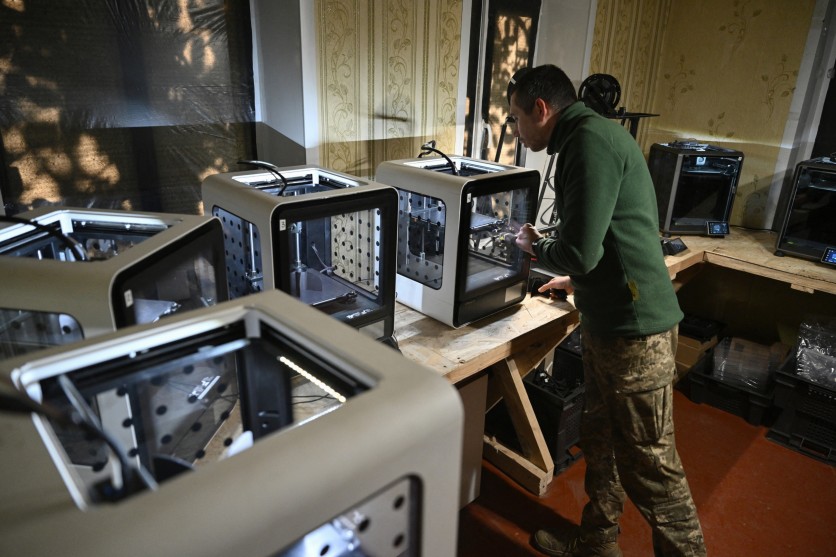
A Ukrainian serviceman of the 30th separate mechanized brigade checks on 3D printers used to make parts intended for drone equipment in a workshop in Donetsk region on October 22, 2024, amid the Russian invasion of Ukraine. GENYA SAVILOV/AFP via Getty Images
Buy three identical 3D printers — same brand, same model, near-matching serial numbers — run them with the same settings, and you will get three different outputs. Not obviously different, not catastrophically different, but measurably, statistically, consequentially different. Across a production run, those small divergences compound into real defects in part weight, surface texture, and dimensional accuracy. Researchers at Spain's IMDEA Materials Institute and the US Department of Energy's Lawrence Berkeley National Laboratory have now published an algorithm that treats that divergence not as noise to suppress but as information to use — profiling each machine's behavioral "personality" and deciding, automatically, whether the fleet should be optimized as a single unit or printer by printer. The same framework applies to any parallelized automated platform — materials discovery rigs, chemical synthesis arrays, sensor calibration setups — where nominally identical instruments quietly undermine reproducibility at scale.
Identical on Paper, Different in Practice
The standard assumption in production-scale additive manufacturing — and in automated laboratories more broadly — is that identical hardware produces equivalent results. It does not. Even machines built to the same specifications, in the same factory, with sequential serial numbers develop their own operational quirks through subtle manufacturing tolerances, component drift, wear patterns, and environmental exposure. Those quirks are invisible to a human operator running standard settings but statistically detectable in the distribution of outputs.
The IMDEA / Berkeley Lab system begins by addressing that detection problem directly. Before any optimization begins, it runs a diagnostic pass on each machine to build what the researchers call a performance signature — a statistical profile of that device's output distribution. It then computes pairwise divergence values between every pair of machines in the fleet, quantifying how far apart their behavioral signatures actually are. The divergence score is the routing decision: when it falls below a threshold, a shared Bayesian optimization strategy is applied to the whole fleet simultaneously; when it exceeds that threshold, the algorithm switches to individual Bayesian optimization for each device, tuning each machine on its own terms, as described in the underlying preprint.
That makes the system adaptive to the fleet's current state rather than to a fixed classification. A bank of printers freshly calibrated after a service visit might warrant collective optimization. The same bank six months later, after accumulating wear at different rates, might not. The algorithm reassesses from the output data each time rather than assuming the machines are still equivalent.
What Bayesian Optimization and Divergence Metrics Actually Do Here
The technical core of the algorithm combines two established mathematical tools in an application-specific way.
Bayesian optimization is a sequential strategy for tuning expensive-to-evaluate black-box systems — systems whose inner workings cannot be directly observed or analytically optimized, only probed through experiments. In manufacturing, a 3D printer's response to a given parameter combination (temperature, speed, material feed rate) is exactly this kind of black box: you can set parameters and measure the resulting part quality, but the relationship between the two is not a clean formula. Bayesian optimization builds a probabilistic model of that relationship, called a Gaussian process, and uses it to choose the next set of parameters to test — balancing exploration of untried settings against exploitation of promising ones. It finds good solutions with far fewer experimental runs than brute-force search.
Statistical divergence — specifically pairwise divergence metrics drawn from information geometry — measures how different two probability distributions are. In this context, the distributions are the output signatures of individual printers: what spread of pellet densities or part weights does printer A produce, and how does that compare to printer B? When two printers' output distributions are close, their divergence score is low. When one has drifted into a different regime, the score is high. KL divergence and related measures are zero only when two distributions are identical, making them a principled, quantitative trigger for the routing decision.
What the IMDEA team's paper contributes is the combination: a clustering step that uses divergence scores to group machines that are similar enough to share an optimization model, and then a routing step that sends each group to either joint or individual Bayesian optimization. The paper's formal title is "Noise-aware optimization in nominally identical manufacturing and measuring systems for high-throughput parallel workflows," published in Advanced Engineering Informatics (Elsevier, DOI: 10.1016/j.aei.2026.104960).
Three Printers, Three Distinct Regimes
To validate the approach, the team tested three nominally identical 3D printers — same brand, same model, close serial numbers. Statistical analysis of the density estimates of printed pellets and the pairwise divergence values between machines showed that all three were operating in meaningfully distinct output regimes. There was no practical sense in which they could be treated as equivalent.
The algorithm routed the fleet to individual optimization rather than a shared strategy. The researchers reported the result produced significantly faster convergence and a substantial reduction in errors in the weight of printed parts, compared with treating all machines equally and failing to correct for their individual biases. The specific percentage improvement was not publicly disclosed in the press materials; the paper's full quantitative results are available via the journal.
The research team was led by Dr. Christina Schenk, who heads the ML4Materials laboratory at IMDEA Materials Institute in Madrid, working with Miguel Hernández-del-Valle and Luis Calero-Lumbreras of IMDEA, Dr. Maciej Haranczyk of IMDEA, and Dr. Marcus Noack from the Applied Mathematics and Computational Research Division at Lawrence Berkeley National Laboratory. Funding came from the MAD2D-CM project backed by the Community of Madrid, Spain's Recovery, Transformation and Resilience Plan, and the EU's NextGenerationEU initiative, as well as from the US Department of Energy's Center for Advanced Mathematics for Energy Research Applications (CAMERA).
Where This Sits in the AI Manufacturing Toolkit
Most AI tools in additive manufacturing focus on a different problem: detecting defects as they form, layer by layer, inside a single machine's build chamber. Kansas State University researchers built an SVM-based vision system that uses a camera and image processing to catch completion failures and geometric defects mid-print. Commercial software like Printpal's PrintWatch monitors the build area in real time and can abort a job the moment something goes wrong. Both approaches treat each printer as a standalone problem; they have no concept of inter-machine comparison or fleet-level strategy.
A parallel line of research has established, more rigorously than intuition might suggest, just how distinct individual machines already are. In May 2025, researchers at the University of Illinois Urbana-Champaign led by Prof. Bill King trained a deep learning model that could identify which specific machine produced a given printed part with 98% accuracy — from just one square millimeter of the part's surface texture, using smartphone photographs. The model was trained on 9,192 photographs of parts from 21 machines built by six companies across four fabrication processes. "We are still amazed that this works," King said. That study confirmed the machine-personality effect; it just used it for traceability rather than correcting it.
The IMDEA and Berkeley Lab system occupies the space between these two threads: it does not watch for mid-print failures, and it does not simply fingerprint machines after the fact. It uses machine identity as an upstream input to determine how the fleet should be run in the first place.
Every Parallelized Lab Has the Same Problem
The researchers are explicit that the methodology extends far beyond additive manufacturing. Any high-throughput, parallelized workflow that depends on nominally identical hardware performing consistently faces the same underlying challenge: equipment that is assumed to be equivalent is behaving differently, and those differences erode reproducibility across the board. Materials discovery platforms, chemical synthesis rigs, and sensor calibration arrays all share this structural problem.
High-throughput experimentation — the use of miniaturized, parallelized reactions and measurements to accelerate scientific discovery — has become a cornerstone of modern materials science, pharmaceutical research, and synthetic chemistry. Its central assumption is that the parallel instruments running a given experiment are interchangeable. When they are not, and when no system exists to detect and correct for that non-equivalence, the resulting data is systematically biased in ways that are difficult to attribute or diagnose. The IMDEA framework, applied to laboratory instruments rather than print farms, addresses exactly that blind spot.
The paper frames this as a step toward fully automated laboratories and factories capable of self-correcting for hardware variability — removing the need for human engineers to identify and manually compensate for machine-to-machine drift one unit at a time. "This not only improves accuracy, but also saves resources by avoiding failed experiments," the researchers noted, describing the approach as "a key step towards the fully automated laboratories and factories of the future."
As labs scale up to dozens or hundreds of parallel instruments, manual drift compensation becomes untenable. An algorithm that automatically detects divergence and adjusts optimization strategy accordingly becomes a scalability tool as much as a quality-control one.
Constraints and Next Steps
The study is a proof-of-concept on a three-printer fleet. Key open questions include: how the divergence-based routing performs as fleet size grows to tens or hundreds of units; what computational overhead the diagnostic profiling phase imposes in real-time production environments; and how well the approach generalizes from the pellet-based extrusion process tested here to other additive manufacturing modalities such as powder bed fusion or directed energy deposition, which have different noise profiles and output distributions.
The researchers note that the framework is designed to be general rather than 3D-printing-specific. Whether it can be deployed as a drop-in addition to existing fleet management software — or requires a dedicated sensing infrastructure to collect the output data needed for distribution estimation — is a practical engineering question the paper does not fully address, and one that will determine whether the approach moves from laboratory validation to production deployment.
Frequently Asked Questions
Why do identical 3D printers produce different outputs?
Even machines built to the same specifications develop individual quirks through minor manufacturing tolerances, component wear, thermal environment, and material batch variation. These differences accumulate over time at different rates on each machine. They are typically too small to detect by eye or with standard pass/fail inspection, but statistically detectable in the distribution of output measurements — which is exactly what the IMDEA algorithm is designed to quantify.
What is Bayesian optimization, and why is it suited for this application?
Bayesian optimization is a method for tuning a system whose behavior cannot be described by a simple formula — you can only learn about it by running experiments and measuring results. It builds a probabilistic model of the relationship between input parameters and output quality, then uses that model to choose the most informative next experiment, finding good settings in far fewer runs than trial-and-error. A 3D printer's response to parameter changes is exactly this kind of opaque, expensive-to-evaluate system, which makes Bayesian optimization a natural fit. The IMDEA team's contribution is applying it at the fleet level, with a divergence-based routing step that determines whether machines share a model or each get their own.
Does this algorithm apply to lab equipment other than 3D printers?
Yes, and the researchers say that is the larger point. Any parallelized automated platform — materials synthesis robots, drug screening assay machines, sensor calibration arrays — where nominally identical instruments run the same protocol in parallel faces the same machine-personality problem. The divergence profiling and Bayesian optimization routing framework is general; the 3D printing case study is a demonstration, not a limitation.
What does "substantial reduction in part-weight errors" actually mean in practice?
The researchers confirmed that optimizing each of the three test printers individually, rather than applying a shared strategy, produced significantly faster convergence to good settings and a meaningful cut in part-weight deviations compared with the baseline uniform approach. The specific percentage improvement was not publicly disclosed in institutional press materials; the full quantitative results appear in the journal paper. For aerospace and defense manufacturers, where part-weight tolerances are tight and certification requirements strict, even small reductions in systematic inter-machine bias carry direct qualification and safety consequences.

-
 C114 Communication Network
 -
 Communication Home
