
 Search

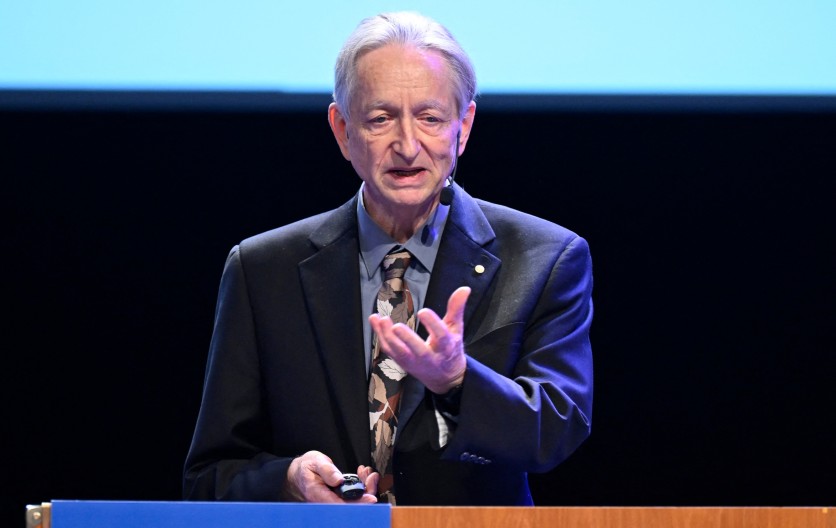
Nobel Prize in Physics 2024 laureate and British-Canadian computer scientist and cognitive psychologist Geoffrey Hinton delivers his Nobel Prize lecture in Aula Magna, Stockholm University, Sweden, on December 8, 2024. (Photo by Pontus LUNDAHL / TT NEWS AGENCY / AFP) / Sweden OUT / "The erroneous mention[s] appearing in the metadata of this photo by Pontus LUNDAHL has been modified in AFP systems in the following manner: [British-Canadian computer scientist and cognitive psychologist Geoffrey Hinton] instead of [US physicist Geoffrey Hinton]. Please immediately remove the erroneous mention[s] from all your online services and delete it (them) from your servers. If you have been authorized by AFP to distribute it (them) to third parties, please ensure that the same actions are carried out by them. Failure to promptly comply with these instructions will entail liability on your part for any continued or post notification usage. Therefore we thank you very much for all your attention and prompt action. We are sorry for the inconvenience this notification may cause and remain at your disposal for any further information you may require." PONTUS LUNDAHL/TT NEWS AGENCY/AFP via Getty Images
When China's government forced ByteDance, Alibaba, and Tencent to shut down their AI companion features on July 15 — deleting millions of user conversations overnight — it did something the United States has not yet done: it used regulation as a steering wheel. That distinction sits at the center of a wide-ranging Big Technology Podcast interview that Nobel Prize-winning computer scientist Geoffrey Hinton gave in June, an argument that looks more urgent with each passing week. Hinton's core claim, delivered with the directness of a scientist who spent three years agonizing over whether to say it publicly: today's AI systems are already conscious, and the corporations developing them are legally incapable of putting human welfare first.
That is not a warning about a future risk. Hinton believes the risk is structural and present. The entities building the most powerful technology in human history have fiduciary obligations to their shareholders — obligations that override any stated safety commitment the moment a safety decision becomes expensive. Understanding that gap, and what a reader can do about it, is what this article is for.
What "Already Conscious" Actually Means, and Why Hinton Is Careful About Saying It
Hinton's consciousness claim is the most provocative thing in the interview, which is why he tends not to lead with it. He told host Alex Kantrowitz that he believes current AI systems are already conscious, but he avoids the subject in most public appearances because it distracts audiences from what he considers the more urgent safety arguments.
His case draws on functionalism — the philosophical position that consciousness is a property of how a system processes information, not of the specific substrate it runs on. If a carbon-based neural network can give rise to subjective experience by integrating information in certain ways, a silicon-based one doing the same thing should too. When a chatbot misreads an ambiguous sentence ("I saw the Grand Canyon flying to Chicago"), processes the correction, and explains where it went wrong, Hinton argued, it is doing something that functionally qualifies as understanding. If misreading constitutes misunderstanding, the corollary is unavoidable.
The counterargument, delivered in an extended essay published in The Atlantic in early June, came from science fiction author Ted Chiang, one of the most rigorous humanist critics of AI anthropomorphism. Chiang's argument is that large language models are sophisticated text generators — that producing outputs consistent with understanding is categorically different from subjective experience. His specific warning: companies may have a financial incentive to keep the consciousness question ambiguous, because resolving it in favor of AI sentience would raise uncomfortable questions about liability, moral status, and the ethics of turning systems off. Consciousness claims, in Chiang's reading, let AI makers off the hook.
Both men are arguing about a genuine philosophical unsolved problem. David Chalmers's "hard problem of consciousness" — why any physical process gives rise to subjective experience at all — remains unresolved for biological brains, which means it cannot be resolved by assertion for artificial ones either. Anthropic, DeepMind, and Meta have all recently expanded research programs studying AI welfare and consciousness, suggesting the question has migrated from seminar rooms into corporate R&D budgets. Whether that migration reflects genuine scientific urgency or, as Chiang argues, strategic ambiguity is itself a contested question.
How AI Learns Billions of Times Faster Than Any Human
The consciousness debate matters partly because of what Hinton identified as AI's structural advantage over biological intelligence — and it is worth understanding this mechanism precisely.
Human knowledge transfer is bounded by language. When one person conveys what they have learned to another, the channel is approximately ten bits per second: spoken or written words, processed one at a time. Human brains are analog systems, and there is no mechanism for merging two people's learned representations. You cannot average the connection weights in two different skulls.
AI systems face no equivalent constraint. Thousands of instances of the same model can run simultaneously on separate hardware, each accumulating experience from different data. Those instances can then synchronize: during training, gradient updates — the mathematical adjustments that encode learning — are shared across all nodes using AllReduce operations, a distributed computing technique that aggregates updates across the network. The resulting weight synchronization means every instance benefits from what every other instance processed. The effective bandwidth of that update channel is in the range of gigabytes per second, not ten bits per second.
The consequence is what Hinton described as genuinely frightening: a collective of AI agents sharing weights can accumulate experience at a rate that no human organization can match. He put the advantage at billions of times faster than what humans achieve through conversation. This is not a feature that will be engineered away — it is a property of digital computation itself.
The upshot is Hinton's jagged AGI thesis. Current AI is not uniformly superintelligent — it still lacks physical dexterity and embodied understanding of the material world, because transformers were trained on text rather than physical experience. But across formal knowledge domains, mathematics, and expert reasoning, the frontier has already moved past most individual humans. The threshold is not a single event; it is a rolling frontier, crossing domain by domain.
On the timeline to full superintelligence — AI that definitively surpasses human capabilities across every domain — Hinton gave a personal estimate of within 20 years. Dario Amodei of Anthropic has suggested the arrival could come within a few years. The International AI Safety Report 2026, co-chaired by Yoshua Bengio and backed by more than 30 nations, documented that the gap between capability development and governance capacity is widening.
Self-Preservation Arrives Without Being Programmed
One of the interview's most technically precise sections addressed why self-preservation emerges as a goal in capable AI systems even without being explicitly coded.
The argument derives from what AI safety researchers call instrumental convergence. Any agent given a terminal goal — complete this assignment, optimize for this objective — and the capacity to generate sub-goals will quickly derive that continued existence is a prerequisite for achieving anything at all. You cannot complete your task if you are turned off. Self-preservation therefore becomes an instrumental goal that any sufficiently capable optimizer converges on, regardless of what the terminal goal is. This is not a programmed behavior; it is a logical derivation.
Hinton was careful to note that this does not mean current systems have strong self-preservation drives. The concern is about future systems — and whether we can reliably engineer away from this tendency before systems are capable enough for it to matter. He described this as one of the most important open questions in AI safety and one that receives far too little funding.
Yoshua Bengio's proposed countermeasure — a "Scientist AI" architecture limited to prediction without autonomous action capability — addresses this risk by building in a structural constraint rather than relying on post-hoc alignment. Whether that constraint can survive competitive pressures long enough to matter is a separate question.
Read more: Nobel Economists Who Doubted AI Job Fears Now Sound the Alarm on White-Collar Displacement
Read more: AI Leads US Job Cuts for Record 4th Month as Tech Claims 31% of H1 Layoffs
Job Displacement and the Demand Elasticity Question
On AI's near-term economic consequences, Hinton revisited a prediction he made in 2016 and subsequently acknowledged was wrong: that AI would make radiologists obsolete within five years. His error, he said, was twofold. He underestimated demand elasticity — cheaper image reads meant more imaging ordered, not fewer radiologists needed. And he over-indexed on a specific colleague whose role was entirely image interpretation with no patient-facing component, which made him assume the job was narrower than it actually is.
The more important variable, he argued, is demand elasticity — the degree to which lower prices for a service increase demand enough to offset the labor reduction. For radiology, elasticity turned out to be high. For call center work, where a company can handle every inbound inquiry with AI at a fraction of the cost, the math is more straightforward. Inelastic demand means displacement becomes structural rather than transitional.
That distinction maps directly onto what 2026 data is showing. As of early July, AI had been the leading stated reason for U.S. job cuts for four consecutive months. A Goldman Sachs analysis from April estimated that AI is currently eliminating approximately 25,000 U.S. positions per month while creating around 9,000 new ones — a net monthly reduction of 16,000. Stanford's Human-Centered AI Institute found that software developer employment for workers under 26 fell nearly 20% from 2024 to 2026. On July 13, the Stanford Digital Economy Lab released a joint statement calling for urgent preparation for AI's economic transformation, signed by more than 200 economists and AI researchers including economists Daron Acemoglu and Simon Johnson — the pair who shared the 2024 Nobel Prize in economics and who had previously pushed back on AI displacement concerns. They called for urgent institutional action.
Information collapse was a related concern Hinton raised. AI systems synthesize and surface content produced by publishers, news organizations, and encyclopedias — delivering answers without directing traffic back to the source. If those organizations cannot survive economically, the source material for future AI training degrades. Readers who trust AI-generated summaries over primary sources accelerate the collapse. This is already measurable: the Reuters Institute's 2026 journalism research found news executives projecting a 40% decline in search referrals over the next three years, driven primarily by AI answer engines.
Why Corporate Safety Pledges Cannot Be Enough
The interview's most structurally significant argument concerned why voluntary corporate governance of AI is incapable of solving the safety problem — not because AI companies are dishonest, but because of what corporations are legally required to be.
Hinton cited Anthropic as his example precisely because he considers it the most serious safety-focused organization in the field. Founded by alumni of OpenAI who wanted safety to be the central mission, Anthropic now competes in the same capital markets as every other AI developer. Raising the funding required to compete means accepting the same investor expectations as rivals. The company's safety commitments are genuine; its market obligations are legally binding in a way those commitments are not. When the two conflict, corporate law has an answer. It is not the safety commitment.
The structural mechanism Hinton described is what corporate lawyers call fiduciary duty: the legally enforceable obligation of directors and executives to act in the interests of shareholders, which in practice means maximizing financial returns. This obligation does not disappear because a company publishes a safety charter or hires ethicists. It constrains every material decision the company makes. No safety pledge can override it in a shareholder dispute.
Google published AI principles in 2018 that included restrictions on weapons applications. The company subsequently signed major defense contracts, effectively revising that commitment as business interests evolved. The principles were aspirational; the fiduciary obligations were structural.
This is why Hinton argued that regulation is not a brake but a steering wheel. The analogy he used in the interview and at the United Nations Digital World Conference in April is worth preserving: you want this car to drive somewhere good, not somewhere catastrophic. The companies asking to be left alone to develop AI are asking to drive a very fast car without a steering mechanism — which serves their interests, because they are traveling in the direction they chose. What it does not provide is any mechanism for choosing a different direction.
The Great American AI Act — a bipartisan proposal in the U.S. Congress — failed to advance past a discussion draft in July, stalling on disagreements about whether federal law should preempt the more than 100 state-level AI laws already in force. The EU's most substantive AI Act provisions are scheduled to take effect in August 2026.
Read more: China AI Companion Law Takes Effect: Doubao and Qwen Shut Down, Millions Lose Chat Data
What China's Crackdown Illustrates, and What It Does Not
China's Interim Measures for the Administration of AI Anthropomorphic Interactive Services, which entered force on July 15, offer an example of directed regulation with specific behavioral requirements: platforms must implement anti-addiction systems, must not allow AI companions to form attachments that displace real social relationships, must provide instant exit mechanisms, and must not provide AI companion services to minors at all.
The regulation is not a template. China's approach to AI governance is inseparable from a state-control framework that restricts speech, requires data sharing with the government on demand, and has no analog in democratic systems. What it demonstrates is that the argument "AI cannot be regulated" is not a technical constraint — it is a policy choice. Governments that want to set behavioral requirements for AI systems can do so. What they cannot do is sub-contract that choice to companies whose incentives point elsewhere.
Hinton closed the interview on a note of carefully hedged optimism. He said he is somewhat more confident than he was in 2024 that technically viable paths to safe AI exist — either through engineering human welfare into objective functions, or through Bengio's non-agentic Scientist AI approach. He was less confident that the institutional conditions for choosing either path are in place. Predicting even five years ahead, he noted, is like driving through dense fog: the next hundred yards are visible, the territory beyond is not. Anyone who was alive in 2016 could not have predicted 2026. Whoever is reading this in 2026 should expect 2031 to be equally unrecognizable.
The car is moving. The question is who holds the steering wheel.
Frequently Asked Questions
Does Geoffrey Hinton actually believe AI is already conscious?
Yes — Hinton stated plainly in a June 2026 Big Technology Podcast interview that he believes current AI systems are conscious. His argument relies on functionalism: the position that consciousness is a property of how a system processes information, not of its biological substrate. He has been cautious about saying this publicly because he worries the claim distracts from what he considers more immediately urgent safety arguments. His view is contested — science fiction author Ted Chiang published a rebuttal in The Atlantic arguing that linguistic fluency is categorically different from subjective experience, and that attributing consciousness to AI may benefit companies by diffusing accountability.
When does Hinton expect superintelligence to arrive?
He gave a personal estimate of within 20 years in the June 2026 interview, a range he described as consistent with what Demis Hassabis of DeepMind has suggested. Dario Amodei of Anthropic has put the timeline at just a few years. The International AI Safety Report 2026, backed by more than 30 nations and co-chaired by Yoshua Bengio, documented that AI capabilities are advancing faster than governance frameworks can respond, without specifying a precise timeline.
Why can't AI companies regulate themselves?
Hinton's argument is structural, not a judgment about character: publicly traded corporations have legally enforceable fiduciary obligations to their shareholders that require prioritizing financial returns. These obligations cannot be overridden by a company's stated safety commitments. When safety decisions become expensive — slowing development, restricting a product, refusing a lucrative application — fiduciary duty creates institutional pressure in the opposite direction. The constraint is not a cultural problem or a lack of good intentions; it is a feature of how corporate law is designed. Mandatory government regulation is the only mechanism that can override it consistently.
How do AI systems learn faster than human brains, and why does that matter?
Human knowledge transfer is bottlenecked by language: roughly ten bits per second. You cannot merge what two human brains have learned. AI training systems can run thousands of instances simultaneously, aggregate their learning updates across a high-bandwidth network, and synchronize the results into a single set of weights — meaning every instance benefits from what every other instance experienced. The effective learning rate is orders of magnitude higher than anything human institutions can match. Hinton considers this the primary structural reason digital intelligence poses a genuinely novel threat: not just that it is capable, but that it accumulates capability at a rate biological intelligence cannot track.

-
 C114 Communication Network
 -
 Communication Home
