
 Search

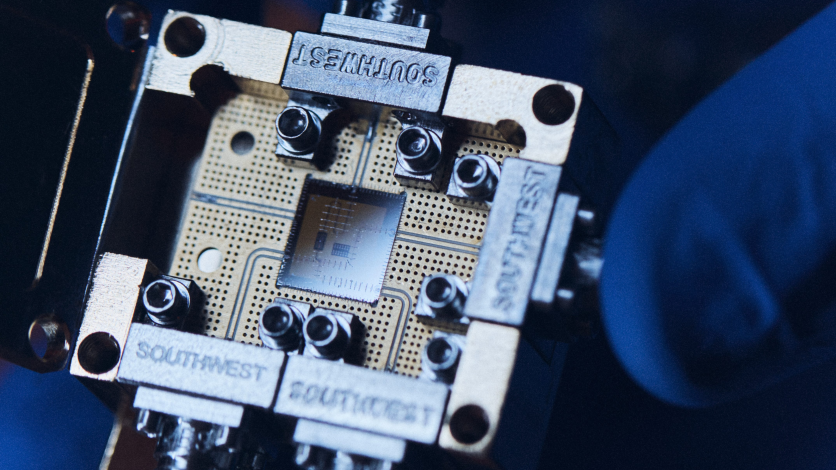
Alice & Bob early cat qubit prototype on display. alice-bob.com
France's annual quantum computing summit — the most expansive in its five-year history — opened Tuesday morning at Station F in Paris, convening researchers, startup founders, enterprise buyers, defense officials, and investors at the moment the country's quantum industry transitions from government-funded research into capital-market competition. The hardware race on display at France Quantum 2026 is not merely a race for industrial capability: it is a countdown clock. Every day closer to a fault-tolerant quantum computer is a day closer to the point at which the encryption protecting today's financial records, medical data, and government communications becomes retroactively vulnerable. France's 2030 mandate for post-quantum cryptography adoption across critical infrastructure gives the hardware competition an explicit deadline that no other major European country has yet matched.
The summit opened at Station F in Paris's 13th arrondissement — the world's largest startup campus — with welcoming remarks from Damien Gromier and Fanny Bouton, co-founders of the France Quantum organization. Government officials spoke immediately after. Anne Le Hénanff, France's Delegate Minister for Artificial Intelligence and Digital Affairs, delivered the opening keynote, reiterating France's 2030 post-quantum cryptography target for critical infrastructure and contextualizing President Emmanuel Macron's €1 billion in additional quantum investment announced May 22. That commitment, drawn from the France 2030 framework and announced at the TGCC supercomputing center in Bruyères-le-Châtel, brings France's total public quantum investment to approximately €3.3 billion — the largest national concentration of quantum public funding in Europe, and among the largest anywhere outside the United States and China.
Loïc Le Loarer, head of France's National Quantum Strategy at the Secrétariat général pour l'investissement, followed with a strategic update on the National Quantum Initiative, which funds quantum computing, communications, cryptography, and sensing alongside enabling infrastructure: cryogenics, low-noise electronics, and lasers.
Five Companies, One Government Race, and an Elimination Round
What most coverage of today's summit has not yet surfaced — and what makes this edition structurally different from previous ones — is the competitive architecture the French government built to run alongside it. France's PROQCIMA programme, a €500 million government initiative launched in March 2024 through the Direction Générale de l'Armement, selected exactly five companies for a multi-round elimination race: Alice & Bob (cat qubits), Pasqal (neutral atoms), Quandela (photonics), Quobly (silicon CMOS spin qubits), and C12 (carbon nanotube spin qubits). The structure is deliberate and has no direct parallel elsewhere. Rather than concentrating on a single qubit architecture — as the United States has effectively done by channeling most of its investment into superconducting circuits — France is funding all five simultaneously and letting performance decide which approaches survive.
After four years, only three companies advance. After eight, only two receive continued funding. The targets: a 128-logical-qubit fault-tolerant demonstrator by 2030 and a 2,048-logical-qubit commercial system by 2035. All five companies were presenting at today's summit.
Read more: Quantum 2.0 Conference Opens in Glasgow: Photon Detection Is the Scaling Bottleneck
How Each Architecture Works: The Technical Competition
Alice & Bob and cat qubits. Alice & Bob, led by CEO Théau Peronnin and recently backed by NVIDIA's NVentures arm in an extension of its €100 million Series B, builds quantum processors on cat qubits — a noise-biased qubit architecture named after Schrödinger's thought experiment. The physics behind the design: cat qubits encode quantum information in superpositions of two coherent states of microwave light, and the system uses a two-photon injection scheme to maintain energy levels that exponentially suppress bit-flip errors. This reduces quantum error correction from a two-dimensional problem that scales quadratically in qubit overhead to a one-dimensional problem that scales linearly — a structural efficiency gain that most other qubit architectures cannot replicate without hardware redesign. The tradeoff is that phase-flip errors require separate active correction; Alice & Bob's "Elevator Codes," announced in January 2026, address this by moving a reusable logical ancilla qubit through the code to detect bit-flip errors at the logical level, targeting a 10,000-fold reduction in logical error rates at roughly three times the qubit overhead of their baseline approach. The company targets 100 logical qubits by 2030 and has been selected by DARPA for its Quantum Benchmarking Initiative, which aims to verify whether any quantum computing architecture can reach industrially useful fault-tolerant operation by 2033.
Pasqal and neutral atoms. Pasqal, led by CEO Georges-Olivier Reymond, traps individual rubidium atoms in optical tweezers — arrays of laser beams that hold each atom in place at temperatures near absolute zero. Quantum gates are performed via the Rydberg blockade: when two neighboring atoms are both excited to a Rydberg state, the strong interaction between them prevents independent excitation, enabling controlled two-qubit operations. The gate result is read by photographing the atoms' fluorescence with a camera. Pasqal has now demonstrated arrays exceeding 1,110 atoms in a single processor. The company is in the process of going public: in March 2026, it announced a definitive business combination agreement with Bleichroeder Acquisition Corp. II (Nasdaq: BBCQ), valuing Pasqal at $2 billion pre-money, with €340 million in new capital raised across a €170 million private round — investors include Parkway, Quanta Computer, LG Electronics, and Saudi Aramco Entrepreneurship Ventures — and $200 million in convertible financing. The joint SEC registration statement was filed in May 2026, with the Nasdaq listing expected in the second half of 2026. Pasqal already serves more than 25 clients across seven operational high-qubit quantum processing units.
C12 and carbon nanotube spin qubits. C12's approach, presented today by CEO Pierre Desjardins, builds quantum processors from single-wall carbon nanotubes grown from isotopically pure carbon-12 — a material choice that minimizes magnetic and nuclear spin noise at the qubit level. The nanotubes are suspended over gate electrodes to confine electron spins; the architecture uses circuit quantum electrodynamics, in which a superconducting microwave resonator serves as a quantum bus enabling long-range connectivity between qubits that would otherwise be limited to nearest-neighbor coupling. This sidesteps one of the core scaling bottlenecks of most spin-qubit approaches. C12 automated a pick-and-place nanoassembly process in early June 2026, enabling 50 devices to be assembled in four weeks — the same quantity that took the entire year of 2025 using the previous method. Its high-density prototype integrates 17 individual quantum devices on a single chip. C12's roadmap runs from the Aïdôs processor (first logical qubit, 2027) to Panopeia (800 logical qubits, 2033).
Quandela and photonic quantum computing. Quandela, the Orsay-based photonic quantum computing company led by CEO Niccolo Somaschi and spun out of the CNRS Centre de Nanosciences et de Nanotechnologies, encodes quantum information in single photons rather than atoms or superconducting circuits. France's TGCC supercomputing center inaugurated Quandela's Lucy photonic quantum computer earlier this year, coupling it to the GENCI Joliot-Curie supercomputer. Photonic qubits travel at the speed of light and interact weakly with the environment, which reduces decoherence — a fundamental advantage for quantum networking. The engineering tradeoff: deterministic two-photon gates are harder to implement reliably than in matter-based systems, and photon loss is a persistent challenge at scale. Quandela offers Perceval, its open-source Python framework for programming photonic circuits, and has launched a research partnership with Safran Tech on quantum algorithms for computational fluid dynamics in aerospace.
Quobly and silicon CMOS spin qubits. Quobly, led by CEO Maud Vinet — a former IBM and CEA-Leti researcher who led CMOS integration and quantum hardware teams — builds spin qubits using silicon processes derived from standard CMOS semiconductor manufacturing. The strategic bet is that silicon spin qubits manufactured at nodes already used by the global semiconductor industry can inherit decades of process maturity — yield, reproducibility, and supply chain — that qubit architectures built on bespoke materials cannot easily replicate at commercial scale. Quobly emerged from CEA-Leti's quantum hardware group in Grenoble and, on June 3, 2026, closed a €115 million Series A led by Bpifrance, SEALSQ, and STMicroelectronics — one of the largest quantum hardware rounds in European history. The company plans to deploy its first silicon-based quantum computer via cloud access for early adopters in high-performance computing and research before the end of 2026. Its partnership with SEALSQ connects silicon qubit manufacturing directly to post-quantum cryptography chip design, building secure-by-design quantum systems from the qubit level up.
The Cryptographic Countdown: Why Today's Hardware Race Has a 2030 Deadline
The most consequential implication of the competition on display at today's summit is not which qubit architecture will win — it is how fast the winner arrives. The connection between the hardware race and the cryptography crisis is structural. Modern public-key encryption — the protocols securing banking systems, healthcare records, government communications, and internet traffic — relies on mathematical problems that a classical computer cannot solve in practical time. A sufficiently powerful fault-tolerant quantum computer running Shor's algorithm could solve those same problems in hours. That computer does not yet exist, but adversaries including nation-states are already collecting encrypted data today with the intent to decrypt it once a cryptographically relevant quantum computer arrives — the "harvest now, decrypt later" strategy documented by the UK's National Cybersecurity Centre, the US National Institute of Standards and Technology, and the G7 Cyber Expert Group.
France has set a 2030 mandatory deadline for adopting post-quantum cryptography algorithms — mathematical frameworks resistant to Shor's algorithm — across critical infrastructure. Google has set an internal migration target of 2029. Independent cryptographers note that migration lead times for complex infrastructure typically run five to ten years, meaning organizations that have not begun assessing their cryptographic exposure should treat this as a current operational priority.
None of the five PROQCIMA companies has built a fault-tolerant quantum computer yet. Current hardware implementations remain in the noisy intermediate-scale quantum era, where qubit counts and error rates constrain reliable fault-tolerant operation. But the race is not academic: the faster any of these architectures reaches fault tolerance, the sooner the cryptographic threat becomes concrete — and the sooner organizations that have not migrated to post-quantum standards become vulnerable to retroactive decryption of data collected today.
OVHcloud, the Roubaix-based European cloud provider that co-founded France Quantum and whose CEO Octave Klaba addressed the summit at midday, is already making the connection operational. Its Quantum Platform aggregates access to Pasqal's and Quandela's hardware, enabling enterprise users to begin hybrid quantum-classical workloads without building their own quantum infrastructure — and positioning OVHcloud as the sovereign European layer between hardware providers and enterprise clients.
Read more: Quantum Computing Workshop Opens at UCLA: Superconducting Qubit Design Meets Fault Tolerance
Industrial Use Cases Already Running
The afternoon program demonstrated that the NISQ-era question — can quantum computers do anything useful today? — is receiving partial answers in production environments. Airbus, SNCF, and BASF presented hybrid quantum-classical pilots in flight planning and materials simulation, rail scheduling, and molecular simulation for chemistry. The defining feature of all three deployments: quantum processors handle the computational subroutines that scale poorly on classical hardware, while the bulk of the workflow remains classical. EDF and the quantum networking startup Welinq presented AQADOC, a project applying distributed quantum algorithms to energy-sector optimization — an application where quantum processors at geographically distributed locations collaborate through entangled links to solve problems centralized computing cannot efficiently address.
Crédit Agricole CIB joined Pasqal and Multiverse Computing on a panel examining quantum computing in financial services. Multiverse Computing's approach is technically distinctive: rather than running all computation on quantum processing units, it uses tensor-network methods inspired by quantum mechanics on classical hardware for optimization and risk-modeling tasks, reserving quantum hardware for cases where it provides a measurable performance advantage. This hybrid methodology reflects the current state of the field more accurately than pure-quantum marketing — classical-quantum integration consistently outperforms pure-quantum approaches for enterprise deployments at this stage of the technology's development.
European Quantum Week: Three Events, One Regulatory Inflection Point
France Quantum 2026 does not occur in isolation. The same day in London, Economist Impact's Commercialising Quantum Global conference runs at the Business Design Centre, with speakers including Lord Patrick Vallance, Microsoft Quantum's Zulfi Alam, IBM Quantum's Katie Pizzolato, and the European Commission's Oscar Diez. In Glasgow, the Optica Quantum Industry Summit continues through Wednesday as part of the Optica Quantum 2.0 week.
The simultaneous clustering of these events reflects a regulatory inflection point. The EU Quantum Act, expected to be proposed in mid-2026, would create a binding framework for European quantum development — the first of its kind globally. The EuroHPC Joint Undertaking's mandate was formally expanded to include a Quantum Pillar in January 2026. And the European Commission published its Cloud and AI Development Act proposal on June 15 — the day before this summit — which would require member states to incorporate quantum development into their national cloud and AI strategies, treating quantum computing as critical infrastructure rather than aspirational research.
Europe currently attracts only 5% of global private quantum investment against more than 50% for the United States. Five of the ten largest global quantum investors by volume are US-based; four are Chinese; none is European. France's PROQCIMA programme and the broader Plan Quantique represent a structural attempt to close that gap through directed public investment while the EU regulatory framework creates conditions for private capital to follow.
Defence and Sovereignty: The DGA's Quantum Campus
The afternoon defence session featured Xavier Grison of the Agence Innovation Défense's dedicated quantum campus — a French military initiative aimed at securing priority access to quantum sensing, communication, and computing capabilities for national defence. France's defence interest in quantum spans three distinct vectors: quantum sensing for precision navigation independent of GPS, quantum communication for cryptography that is fundamentally secure against interception by any computational means, and quantum computing for logistics optimization and intelligence analysis at scales beyond classical reach. The presence of ONERA, France's national aerospace research agency, in the programme underlines that the distinction between civilian and military quantum applications is narrower than it appears from outside the sector.
Frequently Asked Questions
What is France's PROQCIMA programme and why does its structure matter?
PROQCIMA is a €500 million French government quantum computing initiative that selected five hardware companies — Alice & Bob, Pasqal, Quandela, Quobly, and C12 — to compete across distinct qubit architectures in a structured elimination race. After four years, only three companies advance; after eight, only two. The target is a 128-logical-qubit fault-tolerant demonstrator by 2030 and a commercial system with 2,048 logical qubits by 2035. The significance of the structure is that France is the only major country backing five distinct qubit approaches simultaneously at government scale, rather than concentrating on the superconducting circuits that dominate US investment. If one approach scales significantly better than the others, France will have backed the winner. If multiple approaches reach commercial viability, France will have built an ecosystem no single-bet country can replicate. The €115 million Series A Quobly closed on June 3, 2026, and Pasqal's planned Nasdaq listing at a $2 billion valuation are early signals that the private market is beginning to validate the government's multi-architecture strategy.
Why does the pace of quantum hardware progress matter for cybersecurity?
A sufficiently powerful fault-tolerant quantum computer running Shor's algorithm could break the public-key encryption that currently protects banking systems, healthcare records, government communications, and internet traffic. The machines that can do this do not yet exist, but adversaries are already collecting encrypted data today to decrypt it once those machines arrive — a strategy known as "harvest now, decrypt later." France has mandated post-quantum cryptography adoption across critical infrastructure by 2030. Google has set an internal migration target of 2029. Because large-scale infrastructure migrations typically take five to ten years, organizations that have not begun auditing their cryptographic exposure should treat this as a current operational risk, not a future planning item.
What makes cat qubits different from standard superconducting qubits?
Standard superconducting qubits suffer from both bit-flip errors and phase-flip errors at roughly comparable rates, requiring two-dimensional error correction that scales quadratically in hardware overhead. Cat qubits encode quantum information in superpositions of two coherent states of microwave light and use a two-photon injection scheme that exponentially suppresses bit-flip errors by design — reducing error correction to a one-dimensional problem that scales linearly. The tradeoff is that phase-flip errors increase with the mean photon number used to suppress bit-flips, requiring calibrated balance and active phase-flip correction. Alice & Bob's January 2026 Elevator Codes address this active correction layer. The net result is that Alice & Bob estimates cat qubits can achieve fault tolerance with up to 60 times fewer physical qubits than conventional superconducting approaches require for equivalent logical qubit performance.
How does Pasqal's neutral-atom approach compare to other qubit technologies?
Neutral-atom quantum computers trap individual rubidium atoms in arrays of optical tweezers at temperatures near absolute zero and perform quantum operations using lasers. Two-qubit gates are implemented via the Rydberg blockade: when two neighboring atoms are excited to a Rydberg state, their strong mutual interaction prevents independent excitation, enabling controlled entanglement. The architecture's principal advantage is reconfigurability: atoms can be rearranged between operations, allowing flexible qubit connectivity that fixed-circuit architectures cannot match at equivalent scale. Pasqal has demonstrated arrays exceeding 1,000 atoms and is on track to become one of the first major European quantum hardware companies to list publicly, with a planned Nasdaq debut at a $2 billion valuation expected in the second half of 2026.

-
 C114 Communication Network
 -
 Communication Home
