
 Search

12Go
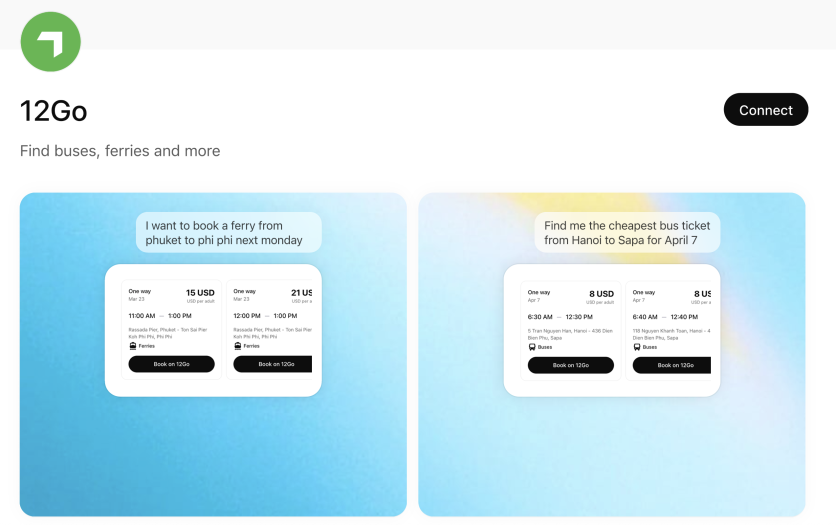
For travellers who navigate Southeast Asia's network of ferries, night buses, and regional rail, planning becomes part of a logistics puzzle, and part leap of faith. Singapore‑registered 12Go has spent more than a decade stitching together inventory from thousands of small, often offline operators into a single marketplace. In April 2026, the company moved from aggregation to conversation: it launched a ChatGPT App that connects 12Go's ground‑and‑sea network inside OpenAI's conversational interface, letting users ask natural‑language questions about routes, trade‑offs, and travel constraints before converting intent into bookings on 12Go platform.
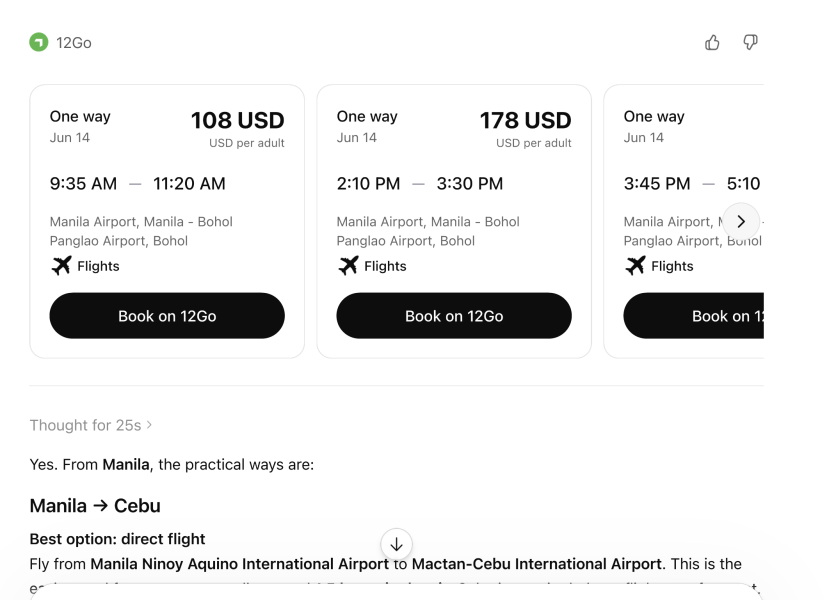
The integration is deceptively simple: 12Go supplies live inventory and booking endpoints; ChatGPT provides a generative front end that translates schedules, layovers, and transfer points into readable, comparative guidance. For travellers, that means asking "best way from Bangkok to Koh Tao in the evening" yields not just a list of options but ranked trade‑offs — overnight bus plus ferry versus day train plus speedboat, likely transfer times, recommended piers, and where luggage or customs might complicate a tight connection. The real value is contextualization, not novelty: 12Go's dataset has long existed, but generative AI reframes it as a conversation rather than a static search result.
Travel companies moving into generative AI are responding to three converging pressures. First, traveller expectations have shifted toward instant, conversational planning; people want a crisp recommendation with rationale, not a page‑by‑page slog. Second, Asia's surface‑transport ecosystem remains highly fragmented, and many routes are invisible to global aggregators, exposing that inventory to AI surfaces options that would otherwise remain buried. Third, generative models can synthesize constraints — time windows, budgets, transfer risk, accessibility — and prioritize options, reducing decision friction and booking abandonment. 12Go's ChatGPT App sits squarely at that intersection: it's a discovery engine for niche inventory coupled to a decision layer that speaks human.
Operational and Commercial Implications
Beyond consumer UX, generative AI offers measurable gains for operations. Conversational agents can triage routine queries (schedules, boarding points, baggage rules), freeing agents to handle exceptions like irregular schedules or cross‑border documentation issues. Internally, similar models can accelerate data reconciliation — flagging inconsistent feeds from small operators, predicting likely disruptions from pattern changes, or drafting customer messages tailored to specific itineraries. For a marketplace aggregating thousands of carriers, automating detection and templated responses can materially reduce cost‑to‑serve while improving response speed.
Commercially, the integration can increase qualified traffic to booking funnels. A contextual recommendation delivered conversationally is more likely to produce a high‑intent click than a generic search result. But the economics depend on tight coupling between the AI interface and live inventory; if the conversational output isn't grounded in current availability and price data, the user experience collapses into frustration.
Accuracy, provenance, and guardrails Generative AI excels at fluency, not guaranteed fidelity. That mismatch is the core risk for travel: conversational answers can sound authoritative while omitting critical caveats — seat availability, terminal changes, visa or customs requirements, or last‑minute operator cancellations. 12Go mitigates this risk by using the ChatGPT App as an interface backed by its live dataset and routing bookings through its own site, which preserves transactional integrity. Still, responsible deployment requires clear provenance (showing when data was last refreshed), explicit uncertainty signaling (e.g., "subject to availability"), and easy escalation paths to humans for edge cases.
For travel companies broadly, the lesson is that generative layers must be stitched onto robust, machine‑readable operational data. The benefits of conversational discovery collapse if inventory is stale or poorly structured. Conversely, operators willing to publish clean, real‑time feeds will be rewarded with higher visibility across AI ecosystems.
12Go
What Travellers Actually Gain
Practically, travellers get faster ideation and clearer decisions. Backpackers, families, and regional itinerants benefit most: the AI helps stitch multimodal journeys (bus plus ferry plus local transfer) and flags transfer points that often cause missed connections. The UX is particularly powerful for regional corridors where flights are scarce or prohibitively expensive and surface options dominate.
But travellers should treat AI recommendations as a well‑informed draft. Always verify exact departure locations, buffer times for transfers, luggage restrictions, and cancellation terms before finalizing plans — especially across borders or when relying on small operators with variable reliability.
And the tendency doesn't stop at 12Go. Generative‑AI interfaces become more and more embedded into daily lives, trip planning will increasingly blur the lines between discovery, explanation, and transaction. Companies that expose trustworthy, realtime data to AI platforms can capture the demand wave; those that remain opaque will cede visibility. The new imperative for operators is not only to digitize inventory, but to publish it in machine‑readable forms that support conversational summarization and decisioning.
Imagine planning island hops in southern Thailand: instead of juggling several operator websites and forum threads, you open a chat, ask for noon departures from Koh Samui to Koh Phangan, and receive a ranked set of options with pier recommendations, estimated transfer times, and luggage notes. You tap to book on 12Go with the confidence that the conversational layer reflects live availability. That smooth handoff — natural language to reliable transaction — is the practical outcome travel tech companies are chasing.
12Go's ChatGPT App is a pragmatic test of how generative AI can unclog discovery bottlenecks in overloaded transport markets. It underscores a simple truth for the travel industry: AI's conversational power only scales when built on disciplined operational plumbing. Done right, these integrations turn logistical friction into accessible advice; done poorly, they trade speed for misinformation. For travellers navigating Asia's complex surface networks, the promise is significant — clearer choices, faster planning, and fewer unpleasant surprises — but only if the data and guardrails behind the chat are as real‑time and precise as the conversation is fluent.

-
 C114 Communication Network
 -
 Communication Home
