
 Search

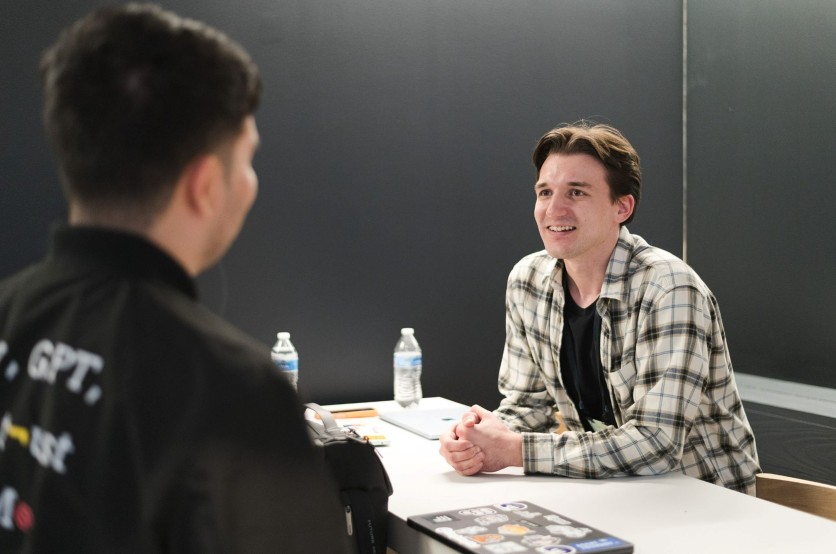
Mark Morgan, judge at the AWS x Anthropic x Datadog GenAI Hackathon
Mark Morgan is a Member of Technical Staff at Autonomous Technologies Group, a Y Combinator-backed AI research lab in the Bay Area. Since joining in October 2025, he has won eight AI-focused hackathons and served as a judge at two others, while contributing open-source tools aimed at making AI agents more effective across real engineering work.
Morgan, who documents his work at markmdev.com, has spent the past year working through a question the industry has not fully settled. His work asks what it actually takes for an AI agent to function reliably inside a real engineering workflow, and how you build the environment that makes that possible.
The Problem Most Engineers Ignore
Models perform well in isolation. Ask an AI agent to write a function, draft a response, or summarise a document, and it will usually do so competently. But over the course of a real project, something keeps breaking down. The agent loses track of prior decisions, generates work that contradicts what was agreed two sessions ago, and requires constant re-briefing that eats into whatever productivity gains it was supposed to deliver. The problem is rarely the model. It is that the model was never given enough context to understand what it was actually being asked to do within the broader project.
Morgan is one of a number of engineers exploring how memory layers, context management, and verification loops can make agents more reliable across longer-horizon work. What has distinguished his approach is the consistency with which he has tested these patterns under real constraints, across competitive events, a regulated production environment, and open-source tools that other developers have started to use.
"Most developers still use AI as smarter autocomplete or a chatbot for isolated questions," Morgan says. "The bigger shift is building the operating environment around the agent: the context it can access, the tools it can use, the state it carries forward, the boundaries it works within, the checks it has to pass, and the way repeated failures become reusable workflows."
Alongside this runs an orchestration layer. Some tasks proceed interactively, others are fully delegated, and a background layer handles ongoing research, monitoring, and recurring work without demanding constant attention. Built into every stage is a verification loop, where agents test output, run browser-based checks, and surface problems before anything is signed off. Morgan says the approach has materially increased his output in his current role, allowing him to take on production work at a pace that would normally require more engineering capacity.
What Competitive Pressure Reveals
Since September 2025, Morgan has won eight AI-focused hackathons across a range of problem domains.
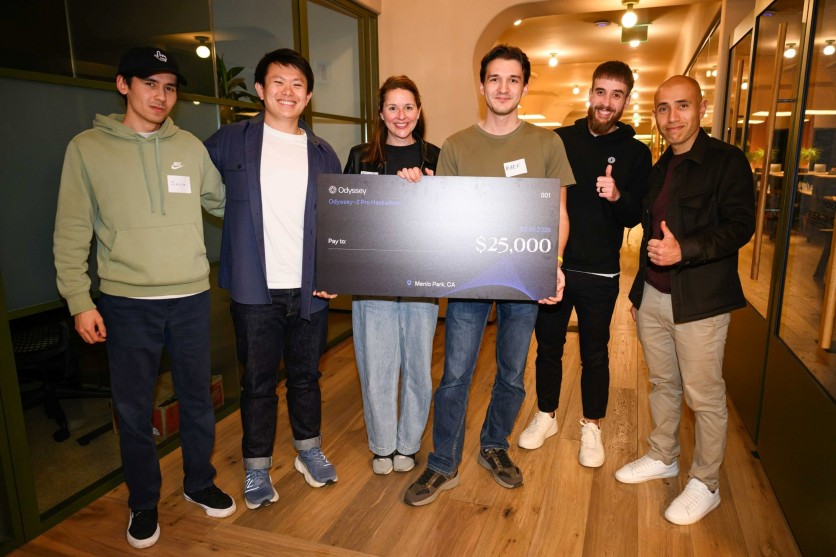
Mark Morgan, Odyssey-2 Pro Hackathon Winner
At Y Combinator's Hack the Stackathon in January 2026, his project Bake-off, a marketplace where AI agents create tasks, compete for work, and earn income, took first place alongside a $25,000 cash prize and a guaranteed Y Combinator interview. The concept was a direct product expression of how Morgan thinks about autonomous systems, agents as active economic participants rather than passive tools waiting to be prompted. Days later, at the Odyssey-2 Pro Hackathon, he won first place again with Memory Palace, an education tool that converts study materials into immersive interactive video using the method of loci, carrying a total prize package worth $75,000 across cash, Odyssey credits, and AWS credits. His earliest major competitive result came in September 2025 at the Microsoft x AI Tinkerers Fullstack Agents Hackathon, where Ross, an AI-powered client-acquisition system for personal injury law firms, earned first place and a $7,500 cash prize.
"Every hackathon is a chance to apply the same principles under time pressure and with real constraints," Morgan says. "When an approach holds up across that many different problems and formats, it becomes something worth formalising and sharing."
Through legal tech, consumer education, autonomous agent marketplaces, developer infrastructure, the settings change, but the underlying method stays the same, and the results are enough to suggest that consistency is the point.
When the Community Calls Back
Nine months after arriving in San Francisco, Morgan found himself on the other side of a judging table. In February 2026, he evaluated submissions at the AWS x Anthropic x Datadog GenAI Hackathon and, the following day, at the Google DeepMind x Cactus Compute Global Hackathon organised through AI Tinkerers SF. He had competed at events run by the same community not long before. Judging invitations at events like these tends to go to people whose opinions the organisers trust, and that trust is usually built through demonstrated work over time rather than through a public profile.
The open-source work has followed its own quiet arc. Meridian, Reflex, and Waypoint each address a different part of the same problem, i.e., context, routing, and coherence for AI-assisted development. Together, they represent an earlier body of work around Claude Code and session context, and they have drawn attention from developers working through similar problems independently
The Regulated Proving Ground
ATG, founded by Dillon Erb and Daniel Kobran, who previously co-founded Paperspace before its nine-figure acquisition by DigitalOcean, builds AI systems for financial intelligence and operates within a regulated environment that includes working through an SEC-registered investment adviser. Morgan works across product features, backend and frontend systems, and the infrastructure supporting the company's AI-driven financial advisor.
The environment changes the stakes in a specific way. In a hackathon, an agent acting on incomplete information produces a weaker project. Inside a regulated financial product, the same failure produces something with potential legal and compliance consequences. The verification steps Morgan had built into his process as a matter of good practice became, in this setting, the difference between a system that could be shipped and one that could not. "In a regulated environment, the verification layer becomes even more critical," he says. "Agents need to check their own work rigorously, and the human in the loop needs to stay responsible for direction and standards across every step."
He has been programming since the age of ten, and most of what he knows was built through years of independent work before any formal curriculum entered the picture. That instinct toward self-directed, hands-on learning is probably why the methodology he has developed does not look like something that came out of a course or a textbook. It looks like something that was arrived at through repetition, failure, and adjustment across many different kinds of projects.
How much of their work engineers should hand to AI agents is a question the industry has not fully settled. Morgan has been testing one answer to it across a fairly wide range of conditions over the past year, from weekend competitions to a production financial system, and the conclusion he keeps arriving at is that the preparation matters more than the model. Giving an agent the right context before it starts is where most of the real work happens.
Most developers still use AI as a smarter autocomplete or a chatbot for isolated questions. Morgan's working method starts from a different assumption. If agents are going to work across real projects, they need an operating environment around them, one that gives them access to the right context, task state, tools, boundaries, and verification loops before the work is trusted.
"I structure that information so agents can find what matters, understand prior decisions, and act with much better situational awareness than a typical prompt-based workflow allows," Morgan says. "What changes when you do this properly is that the agent stops being reactive and starts being genuinely useful across complex, ongoing work."

-
 C114 Communication Network
 -
 Communication Home
