
 Search

Kami Vision
Millions of older adults live independently or in care settings where falls happen without warning and, often, without a witness. For family members managing the responsibilities of work, parenting, and daily life alongside the care of an aging relative, the gap between an incident and a response can stretch into hours. Traditional safety tools have largely depended on active participation from the person at risk, and while those solutions have served important roles, a growing number of families and senior care operators are asking whether artificial intelligence can close the gap in new ways. Kami Vision is one company building toward an answer, and the technology it has developed is attracting attention from care providers, strategic partners, and investors across the senior health and home safety sectors.
From Home Security to Global Senior Safety Mission
Kami Vision (parent to KamiCare) traces its origins to 2014, when the company began developing computer vision technology for the home security market. Over time, a pattern emerged in consumer feedback. Families using cloud-connected camera systems wanted to know whether the technology could detect a fall, not just record one. That demand pointed toward a significant and underserved opportunity. The company shifted its focus toward AI-powered fall detection and began deploying its technology in senior care environments, including assisted living communities, skilled nursing facilities, and memory care centers. Today, KamiVision holds over 60 patents and serves millions of users globally with a suite of products designed for both professional care settings and private residences.
Kami Vision
The AI That Watches So Caregivers Do Not Have to Do It Alone
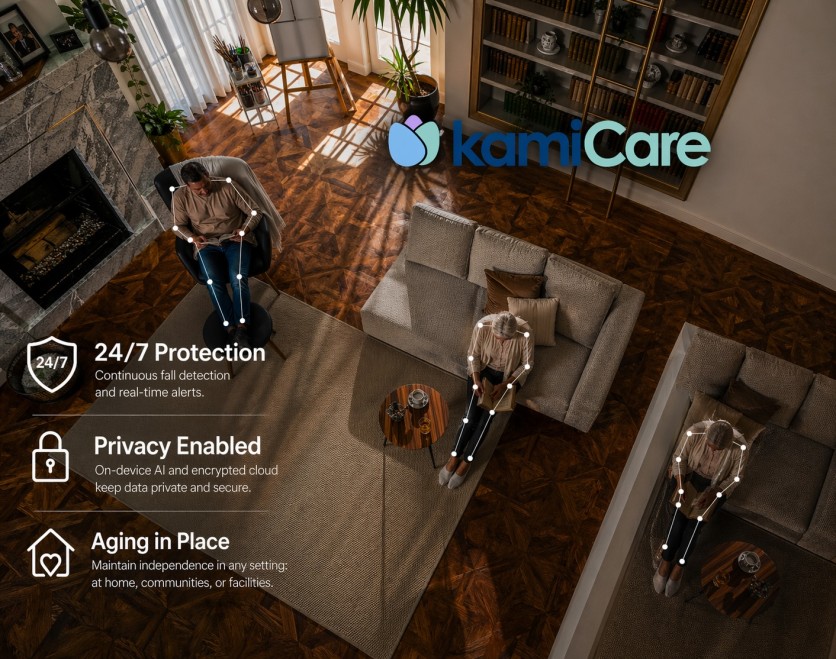
At the core of Kami Vision's product line is what is known as Vision AI, a set of computer vision algorithms that see through the lens and make judgment calls so that humans don't have to. The system does not require the person being monitored to initiate anything. It operates passively and continuously, identifying the physical characteristics of a fall through the camera's field of view and triggering an alert to designated contacts when one is detected.
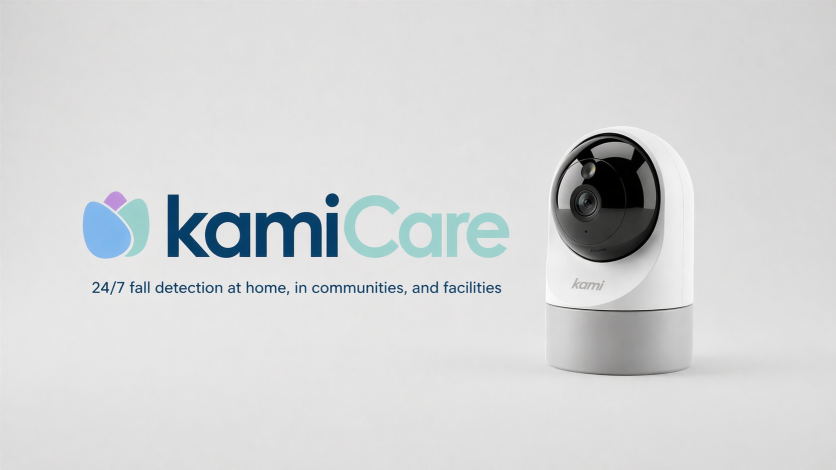
The hardware setup is notably accessible. Devices mount to the wall with standard screws, connect to a conventional electrical outlet, and can be fully installed and configured in under thirty minutes. For larger homes, communities, or facilities, multiple units cover different zones of a living space and may take an hour or so to install and configure.
Once active for someone at home, the platform provides a live stream and two-way audio feature accessible only to the end user and any contacts they explicitly authorize, such as a home care provider or family member. Privacy is built into the permission structure rather than treated as a secondary consideration. In residential living settings, i.e., assisted living, memory care, and skilled nursing, there is no live stream or audio capability to adhere to strict state regulations imposed on nursing homes.
One Platform, Two Products, and a Smarter Approach to Where People Age
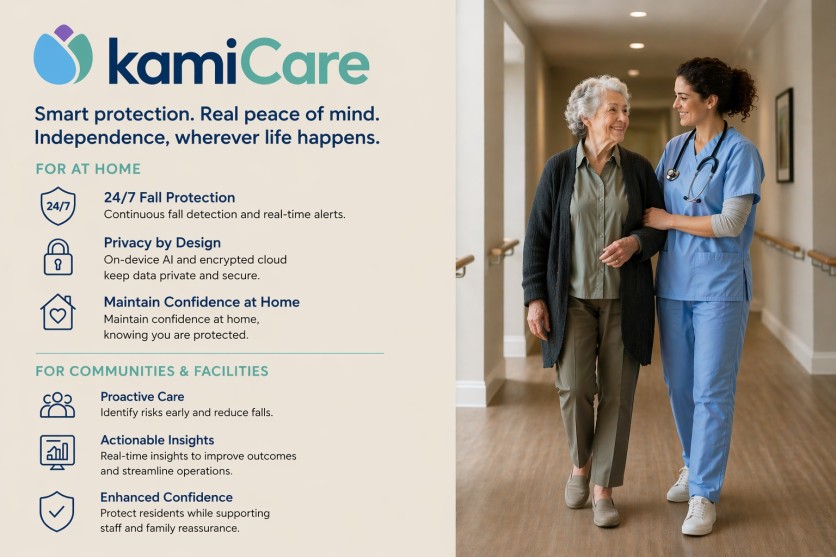
KamiVision's fall detection technology is packaged into two distinct products serving different contexts. KamiCare has one solution designed for professional care environments, giving staff at assisted living communities and skilled nursing facilities the ability to respond to unwitnessed falls faster and with more confidence. For private residences, KamiCare extends the same core capability into the home, alerting a pre-selected network of trusted contacts when a fall occurs. The only difference is that in-home consumers are able to get a live view and use two-way audio to ensure their loved ones are ok.
When an alert is triggered, notifications move through a tiered system of trusted human contacts, ensuring that the right people are reached in the right order. The design keeps human judgment and personal relationships at the center of every response rather than removing them from the equation.
Why KamiVision Is Building the KamiCare Ecosystem Instead of Just Selling a Device
One of the more distinctive aspects of Kami Vision's go-to-market strategy is its emphasis on partnerships over direct consumer sales. The company has observed that adoption rates improve significantly when installation and ongoing support are handled by a professional rather than left to the family. In response, Kami Vision is building relationships with nurse call companies, home care companies, medical alert providers, home security, and other tech providers for the nursing home and consumer market. These partner companies can deliver the technology as part of a managed service offering, all powered by Kami Vision.
This model carries meaningful implications for the business. Rather than relying on individual consumer subscriptions that may only last one to two years at home as a person's care needs evolve, partnering with established care organizations connected to consumer and enterprise markets creates longer-term stable revenue. For investors and operators evaluating the senior care technology space, that structure represents a meaningfully different risk profile than a traditional direct-to-consumer hardware play.
Kami Vision
The Wearable Compatibility Play That Could Reshape Senior Health Data
Kami Vision is exploring how its KamiCare platform can work alongside the wearable devices many older adults already own and use daily. Rather than introducing another piece of hardware into an already complex care routine, the company is looking at compatibility with popular consumer fitness trackers and smartwatches, allowing health and activity data from those devices to feed directly into the KamiVision platform. The strategy reflects a broader philosophy of meeting users where they are rather than requiring them to adopt new habits or purchase additional equipment. Although Kami Vision is exploring its own wearable devices to measure health, the belief is that if older adults already have a device, they should be able to use this within the KamiCare ecosystem.
On the international front, KamiVision has established an entity in Japan with several initial implementations and is preparing for expansion into Mexico through a partner network that mirrors the white-glove service model being developed in the United States. Canada is also on the company's roadmap as it continues identifying regional operators equipped to carry its technology into new markets.
For a tech sector increasingly focused on how AI can address real-world healthcare challenges, Kami Vision offers a concrete and evolving case study in what that application looks like at the intersection of computer vision, senior care, and consumer technology.

-
 C114 Communication Network
 -
 Communication Home
