
 Search

iAsk
Answers are easy to get. Understanding them isn't. When an AI spits out a solution without showing the thinking behind it, students are left guessing at the part that actually matters.
That gap is exactly what iAsk is trying to close.
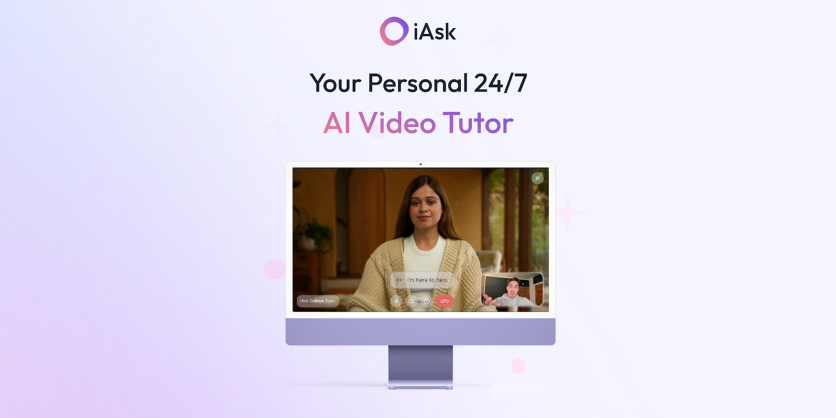
iAsk has introduced an AI Video Tutor, a real-time, video-based tutor designed to help students work through problems rather than skim solutions. It talks. It explains. It pauses when you interrupt. Sometimes it even backs up and tries again.
That alone changes the experience.
iAsk's Video Tutor supports math, science, writing, and research. Students ask a question and get an on-screen explanation that unfolds step by step. They can jump in with follow-ups, ask for clarification, or push deeper into a topic without starting over. It feels closer to sitting with a tutor than opening another browser tab.
And yes, it's available 24/7, which, for students, is kind of the whole point.
Most AI tools still feel transactional: You ask something. Get an answer. Close the tab.
iAsk's Video Tutor shifts that dynamic. When explanations are provided verbally and visually, students slow down and follow along. You hear how the idea is built, not just the final answer. For visual and auditory learners, that difference shows up quickly.
It also removes some of the pressure. There's no fear of asking a "dumb" follow-up. You just ask it. The tutor responds. You keep going.
That back-and-forth matters more than it sounds.
iAsk's user base skews young. About 75% of users are Gen Z, many of whom rely on the platform for homework, studying, and research. This group has a short patience window and a low tolerance for errors.
Accuracy has become table stakes. Students notice when explanations don't line up. They notice when steps are skipped. They notice when something feels off.
That's why iAsk has focused heavily on reasoning and reliability across its tools. The AI Video Tutor follows the same philosophy. Explain the work. Show how you got there. Don't guess and move on.
Sometimes that means longer answers. Sometimes it means revisiting the basics. Students seem OK with that.
Over the past quarter, more than 22,000 students have interacted with the AI Video Tutor. Usage patterns vary. Some students pop in for a quick clarification before class. Others stay longer, working through practice problems or rewriting parts of an essay.
One thing stands out. Students who use video tend to stick around longer.
That shouldn't be surprising. People learn better when they feel like someone is actually walking them through the material, even if that "someone" happens to be AI.
The video tutor is included in iAsk Pro, which is currently free for students. Soon, it will be available for everyone to try. When a student is already struggling with a concept, price shouldn't be another barrier.
Not everyone will prefer video. Some students still want text. Others switch between both depending on the task. iAsk isn't forcing a single path. The video tutor simply gives learners another option, one that feels more natural for a lot of people.
Zooming out, this is a shift in how educational AI is being used.
Instead of optimizing for faster answers, tools like the AI Video Tutor are leaning toward better explanations. Less "here's the result," more "here's how to think about it." That approach isn't flashy, but it sticks.
And for students juggling deadlines, exams, and late-night study sessions, that kind of help is hard to replace.
Want to try it yourself?
Join 22,000 monthly students using iAsk's AI Video Tutor to get clear, reliable help whenever they need it.
Ask AI anything.

-
 C114 Communication Network
 -
 Communication Home
