
 Search

Iren.com
IREN Limited closed Monday with its order book fuller than its construction schedule can satisfy. The AI cloud provider announced $2.8 billion in new multi-year contracts with a roster of leading AI developers — and disclosed, almost as a footnote, that demand from hyperscalers, enterprises, and frontier labs now exceeds every megawatt of capacity the company has planned to build.
That demand signal matters beyond IREN's own stock price. At 480 megawatts of commissioned capacity targeted by year-end 2026 — roughly the electrical draw of 400,000 American homes — a company running out of room to sell is a concrete data point in a debate that has consumed Wall Street all year: whether the AI infrastructure buildout has overshot demand, or whether demand is still running harder than anyone can build.
Monday's answer, at least from one of the largest independent AI cloud providers, was unambiguous. Shares surged between 17% and 20% on the day, recovering a substantial portion of the losses the stock had sustained since a controversial executive compensation disclosure in late June, per the SEC Form 8-K filing. The stock had closed the prior week near $33; it traded around $40 on Monday.
Read more: Meta Enters AI Cloud Market: Neocloud Rivals CoreWeave and Nebius Crater
IREN Signs Microsoft, NVIDIA, Perplexity and Seven More AI Builders
IREN's customer base now includes Microsoft, NVIDIA, Perplexity, Figure AI, Together AI, Fluidstack, Fireworks AI, Fal AI, Hume AI, and one as-yet-unnamed AI developer, across both bare-metal and managed cloud service tiers.
Roughly 85% of the revised $4 billion-plus annualized run-rate revenue (ARR) target is now under contract, giving investors an unusually high degree of forward visibility for a company still in the middle of a multi-gigawatt build-out. Contracted pricing "continues to strengthen," per the press release, suggesting that available GPU capacity remains scarce relative to what potential customers want to buy.
A structural detail buried in the announcement's footnotes deserves attention from anyone evaluating IREN's capital requirements: customer prepayments covering approximately 45% of the GPU capital expenditure for those specific deployments, under contracts signed since June 1, 2026. That arrangement, if sustained, meaningfully reduces how much IREN must raise externally for each new tranche of hardware — effectively shifting a portion of the capex burden to customers who want guaranteed compute access.
The weighted average contract term of approximately four years across the full portfolio gives the company multi-year revenue visibility that most infrastructure operators would envy.
How IREN's Infrastructure Actually Delivers AI at Petawatt Scale
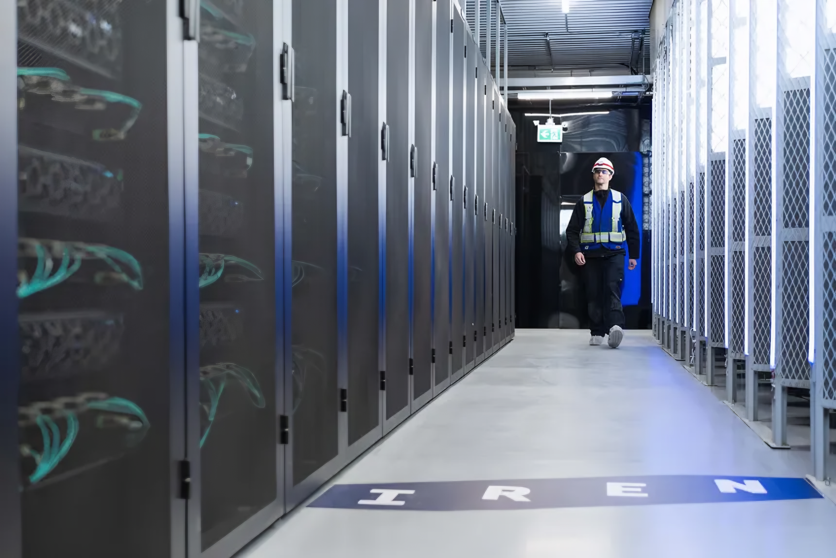
What IREN is building is not a software platform. It is a vertically integrated physical stack: grid-connected land, power infrastructure, data center buildings, liquid cooling systems, and GPU hardware — all owned and operated by the company rather than rented from others.
The GPU hardware at the core of the Microsoft deployment is the NVIDIA GB300 NVL72, a rack-scale system that integrates 72 NVIDIA Blackwell Ultra GPUs and 36 Grace CPUs in a single liquid-cooled chassis. Each rack draws approximately 120 kilowatts of power — equivalent to 80 average American homes — and requires direct liquid cooling to the chip to manage that thermal load. What makes the architecture distinctive is the interconnect: all 72 GPUs in each rack are linked via NVLink at 1.8 terabytes per second of GPU-to-GPU bandwidth, allowing trillion-parameter AI models to be trained or served as if they occupy a single massive memory space. A single rack delivers 1.1 exaFLOPS of FP4 compute and 20.7 terabytes of unified HBM3e memory.
IREN's two service tiers serve different customer needs. Bare-metal delivery gives customers direct access to that hardware with no virtualization layer between their software and the GPU — meaning a customer's PyTorch training job runs on the physical GPU without the 15% to 25% performance penalty that a hypervisor imposes. IREN's NVIDIA InfiniBand networking operates at 3.2 terabytes per second of full non-blocking bandwidth across the cluster, enabling distributed training across hundreds of GPUs without interconnect becoming the bottleneck. The managed cloud tier, strengthened through IREN's acquisition of Kubernetes platform Mirantis earlier in 2026, abstracts the hardware management so customers can deploy AI workloads without configuring drivers, networking, and storage pipelines directly.
IREN's competitive position rests partly on the speed advantage of vertical integration. Building a new data center from land acquisition to energization has stretched to more than four years in the United States, where electrical grid connection queues now run years-long. IREN entered the AI era already holding permitted, energized substations at its Childress, Texas campus (750 megawatts, expandable), and similar sites across British Columbia, Canada, and now Spain (following the June 2026 acquisition of Nostrum Group, which added approximately 490 megawatts of secured, grid-connected power in Spain). Total secured power now reaches 5 gigawatts across North America, Europe, and Asia-Pacific.
What "Demand Exceeds Capacity" Means for AI Cloud Buyers
The most consequential sentence in Monday's announcement was one of its quietest: "Demand from hyperscalers, enterprises, AI developers and frontier labs continues to exceed IREN's available and planned capacity."
For companies building frontier AI applications, securing multi-year GPU compute commitments has become a strategic necessity rather than a procurement decision. Training a large language model at the scale required to compete with the frontier requires predictable, long-horizon access to GPU clusters that cannot be bought on demand when needed — the market simply does not work that way. The hyperscale public clouds (AWS, Azure, Google Cloud) offer flexibility and broad service ecosystems, but historically at prices that run 50% to 66% above what neocloud providers charge for equivalent bare-metal GPU performance. IREN's model allows customers who know their multi-year compute needs to contract for it at scale, with guaranteed capacity allocation, at rates the company says are currently moving higher rather than lower.
The customer list from Monday's announcement reflects that dynamic. Perplexity (AI-native search), Figure AI (physical AI and robotics), and Hume AI (emotional intelligence for AI interfaces) represent some of the most compute-intensive applications in applied AI — companies whose business models are directly dependent on GPU throughput and whose investors expect them to secure infrastructure rather than rent it opportunistically. Together AI and Fluidstack operate GPU clouds of their own and are acquiring capacity wholesale to resell, suggesting that even infrastructure intermediaries are supply-constrained at IREN's scale.
Co-CEO Daniel Roberts framed the portfolio this way: "We are proud to support leading companies building frontier applications across design, physical AI and robotics, generative media, AI search and model development."
Read more: Bitcoin Mining Pivots to AI Compute: AiOnX Acquires 1.3 GW in $500M Deal
Is GPU Demand Cooling, or Still Accelerating?
IREN's announcement lands in a market where some investors have spent months debating whether the AI infrastructure buildout has overshot real demand. Monday's contract disclosure offers a data point on one side of that debate — but it is worth being precise about what it proves and what it does not.
What it proves: At IREN's specific price, customer list, and contract terms, demand for contracted GPU compute capacity exceeds what IREN has planned to build through 2027. That is a real demand signal from a company with direct commercial relationships with Microsoft, NVIDIA, Perplexity, and seven other named AI developers.
What it does not prove: Whether the broader GPU rental market is supply-constrained or heading toward oversupply as hyperscalers bring their own massive internal GPU fleets online. Bloomberg reported on July 1 that Meta Platforms is developing plans to sell its surplus GPU capacity to outside customers — a move that sent neocloud stocks (including IREN, which fell roughly 6.5% that day) lower on fears of a new, debt-free competitor entering the market with hyperscale GPU inventory.
The question is structural. Meta, Microsoft, Google, and Amazon are collectively on pace to spend roughly $700 billion on AI infrastructure capital expenditures in 2026. If even a fraction of that capacity eventually becomes available to external customers, the neocloud pricing environment could shift materially. IREN's multi-year contracts, with an average term of four years, provide substantial insulation from that risk for existing contracted capacity — but approximately 15% of the $4 billion-plus ARR target remains to be contracted, and that tranche will be priced in whatever market exists when the capacity comes online.
From CEO Pay Controversy to Contract Confidence
Monday's stock surge also carries context: IREN had declined sharply from its highs following the June 29 disclosure of an 18.2 million restricted stock unit grant to co-founders and co-CEOs Daniel Roberts and William Roberts. The package — valued at roughly $700 million to $800 million at prevailing prices, representing approximately 5% dilution — drew immediate criticism from short-seller Jim Chanos, who argued it would consume the equivalent of 17% of the company's estimated cumulative Adjusted Net Income from fiscal 2027 through 2030.
Independent board chair David Bartholomew responded in a July 8 shareholder letter defending the structure: the RSUs vest across four years in equal annual tranches, with each tranche locked up for an additional two years before the co-CEOs can sell, meaning neither will liquidate the final tranche until fiscal 2033. The board also committed to no further equity incentive grants to the co-CEOs before fiscal 2031.
The stock had fallen from a prior-week close near $41 on July 13 to approximately $33 by Friday, before Monday's contract announcement sent it back toward $40. While several analysts remain broadly constructive — Bernstein reiterated its Buy at a $100 price target on July 7, Cantor Fitzgerald holds an Overweight rating at $99, BTIG holds a Buy at $80, and Freedom Capital upgraded to Strong Buy earlier this month — JPMorgan stands as a dissenting voice with an Underweight rating.
What Needs to Happen Next
Signing contracts is one deliverable. Commissioning 480 megawatts of GPU capacity by December 31, 2026 — while building toward 1.2 gigawatts in 2027 across North America, Europe, and Asia-Pacific — is another category of challenge entirely. Power interconnection timelines, GPU hardware delivery schedules, and the commissioning and customer-acceptance process that must occur before revenue is recognized are all execution variables that no contract can guarantee.
IREN reported approximately $7.6 billion in cash and cash equivalents as of June 30, 2026, including $1.7 billion in restricted cash tied to GPU financing for the Microsoft deployment. The company closed a $3.65 billion investment-grade GPU financing facility on June 1, adding another major capital structure element to complement existing customer prepayments and operating cash flows.
Whether IREN executes its capacity ramp on schedule — and whether the demand signal it described on Monday holds through the commissioning process — will be visible for the first time in the earnings report currently scheduled for August 27, 2026.
Frequently Asked Questions
Who are IREN's new AI cloud customers, and what do these contracts mean?
IREN's announced customer base now includes Microsoft, NVIDIA, Perplexity, Figure AI, Together AI, Fluidstack, Fireworks AI, Fal AI, Hume AI, and one undisclosed AI developer. The $2.8 billion in new contracts, combined with prior agreements, puts approximately 85% of IREN's revised $4 billion-plus annualized run-rate revenue target under contract — giving investors a high degree of forward visibility on revenue that will flow once the underlying GPU capacity is commissioned and accepted by customers.
What does it mean that demand "exceeds" IREN's planned capacity?
IREN's press release stated that demand from hyperscalers, enterprises, AI developers, and frontier labs "continues to exceed IREN's available and planned capacity" and that IREN is "engaged with customers across its entire 2026 and 2027 expansion program." In practical terms, this means customers want more GPU compute capacity than IREN has built, is building, or has announced plans to build through 2027 — and IREN is in active commercial discussions about what it can offer beyond those plans. It signals that the company is not struggling to fill its build-out with paying customers; the constraint is how fast it can build, not whether demand exists.
How does IREN's bare-metal GPU cloud differ from AWS or Microsoft Azure?
When a developer rents GPU capacity from AWS or Azure, the workload typically runs on a virtual machine — a software layer sits between the application and the physical GPU, absorbing 15% to 25% of raw GPU performance. IREN's bare-metal service eliminates that layer: the customer's software runs directly on the physical NVIDIA GPU hardware, with access to the full NVLink interconnect and InfiniBand networking stack. This matters most for large-scale AI training workloads, where milliseconds of interconnect latency and percentage points of GPU utilization determine how long — and how much — a model training run costs. The tradeoff is that bare-metal customers manage their own software stack; IREN's managed cloud tier, strengthened through its Mirantis acquisition, handles that management layer for customers who want it.
Is IREN's $4 billion revenue target the same as the revenue investors will see in financial statements?
No — and this distinction matters. IREN's annualized run-rate revenue (ARR) is a non-GAAP operating metric calculated as GPU/hour pricing for commissioned GPUs as of December 31, 2026, multiplied by 8,760 hours per year, plus storage and ancillary revenue. It represents what revenue would be at a given moment if run at that rate for a full year — not actual revenue recognized. Actual GAAP revenue depends on when each tranche of GPU capacity is commissioned, tested, and formally accepted by the customer. If any commissioning milestones slip into 2027, the revenue recognition follows. The August 27, 2026 earnings report will be the first checkpoint on how the commission timeline is tracking against the ARR target.

-
 C114 Communication Network
 -
 Communication Home
