
 Search

Flughafen-zuerich.ch
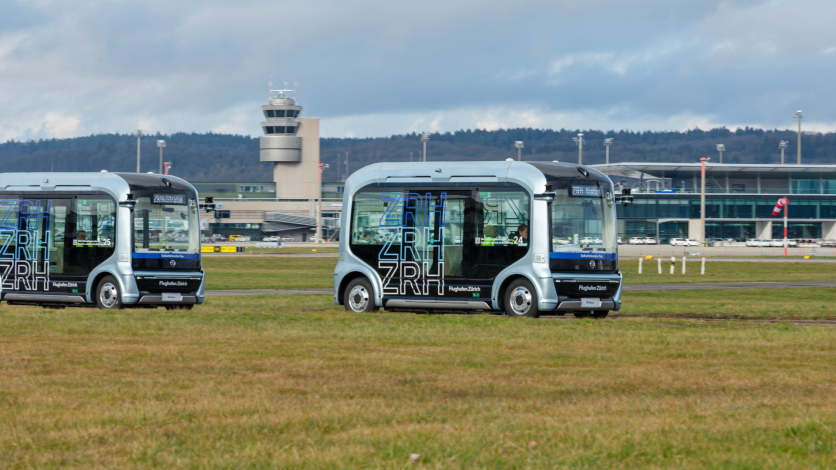
Two autonomous electric buses have been rolling across Zürich Airport's apron since early September 2026 with no one physically inside them — not a driver, not a safety monitor, not a backup operator. Remote workers at two partner companies watch from a cockpit elsewhere on the airport grounds and can intervene if needed, but the vehicles themselves handle every aspect of driving without any human in the seat. Zürich Airport has become one of the first airports in Europe to run SAE Level 4 autonomous vehicles in a live operational setting, and the path it took to get there is as significant as the milestone itself.
Eighteen Months, 15,000 Kilometers, One Route
The driverless operation did not happen quickly. Flughafen Zürich AG began working with Chinese autonomous driving company WeRide in March 2025, deploying two Robobus electric shuttles — co-developed with Renault — with a human safety driver in the vehicle. Over the following eighteen months, the two vehicles accumulated more than 15,000 km (approximately 9,321 miles) on the airport's airside roads, keeping to a defined route that runs from the staff entrance to the maintenance area without crossing any aircraft taxiways. Engineers used that period to build out safety processes, test technical and operational procedures, and document every edge case the airport's complex environment produced.
The airport followed the same protocol at each stage of the project: a passenger-free testing period before any employees were permitted to board. The same principle now governs the transition to full driverless operation. The first runs without a driver are being conducted without passengers, and the airport does not expect to allow staff aboard for approximately four weeks. "Safety was and remains our top priority at all times," said Raphaël Glaesener, Senior Innovation Manager at Zurich Airport Ltd. "That is why the first Level 4 trips will once again be carried out without passengers. However, we expect that after around four weeks of test operation, employees will be able to use the now fully automated shuttle."
What Level 4 Without a Monitor Means — and How the Sensor Stack Makes It Possible
SAE Level 4 (High Driving Automation, as defined in SAE J3016) means a vehicle's automated driving system handles all aspects of the dynamic driving task within its Operational Design Domain, even if no human responds to a request to intervene. The critical distinction from Level 3 is that the vehicle does not require a human fallback: within its defined ODD, it is responsible for its own operation. At Zürich Airport, the ODD is narrow and precisely mapped — a specific apron route, a defined set of environmental conditions, a bounded physical space. That narrowness is exactly what made regulatory approval tractable.
The sensor architecture that enables this operation on the airport apron is built around redundancy and fusion. WeRide's platform uses a combination of 128-channel LiDAR units, solid-state LiDAR modules, 12-plus cameras of varying fields of view, and a 77 GHz millimeter-wave radar. The cameras serve distinct functions: fisheye lenses handle close-range obstacle detection around the bus body; narrow 30-degree field-of-view cameras identify distant objects such as ground vehicles and personnel; 100-degree cameras provide the balance of width and range needed for full-perimeter awareness. The sensor fusion algorithms operate at two levels simultaneously — low-level fusion combines raw sensor data streams directly, while mid-level fusion integrates the object detections each sensor produces independently. The resulting unified output achieves an object contour accuracy of less than 5 centimeters (approximately 2 inches) and a detection accuracy of 99 percent.
The radar is used sparingly — it serves as a final fallback if both the cameras and LiDAR should fail simultaneously. In normal operation, the airport's electromagnetic environment (airports generate intense and variable RF signals from navigation, radar, and communication systems) poses the largest technical challenge. WeRide addressed this through sensor design choices that reduce dependence on any single modality and through extensive validation of perception performance in the airport's specific signal environment over the 18-month testing period.
Drivers Did Not Disappear: The Remote Cockpit Model
The shift that makes the Zürich deployment notable is not simply the absence of a driver. It is the specific model that replaced the driver. Employees of the partner companies Swissport and Krummen Kerzers now sit in a remote operations cockpit and monitor both vehicles, able to intervene and provide support at any moment. Crucially, these operators are the former onboard safety drivers, retrained for the new role.
"Automated driving does not mean that people disappear," said Glaesener. "But the tasks change. Operations will also become more efficient, because in the future one employee will be able to monitor several buses."
This reframing matters operationally. Coralie Klaus Boecker, Head of the ZRH Innovation Hub at Flughafen Zürich AG, has been explicit about the workforce pressure driving the program: the gradual automation of ground vehicles can make an important contribution at airports given the emerging shortage of skilled workers. The remote cockpit model does not simply replace drivers — it concentrates oversight, allowing a smaller number of trained operators to cover a larger fleet than would be possible with one driver per vehicle. That efficiency argument is the clearest pathway to commercial scale for airport AV deployment across Europe.
Under SAE's definitions (updated in 2021 to incorporate remote driving provisions), the remote cockpit operators are not considered "drivers" in the L4 context — the vehicle's automated system remains responsible for all dynamic driving decisions within its ODD. The remote operators provide emergency oversight and situation awareness, not driving inputs during normal operation.
Why Airports First: The Bounded-Environment Strategy
Zürich's success is partly a product of where the deployment is taking place. Airport aprons represent one of the most favorable environments for an L4 pilot: the ODD is narrow, the route is precisely mapped, the space is physically controlled, and the regulatory approval process is structured around aviation-grade safety standards that the airport authority already maintains. There are no unexpected pedestrians, no on-ramp merges, no construction zones.
At the same time, airports are not trivially simple. Zürich's apron involves tow trucks, mobile boarding bridge vehicles, luggage transport vehicles, large snow removal equipment, high pedestrian traffic in high-visibility gear, narrow operational roads, variable weather that can shift from sun to snow within a single day, and an intense electromagnetic signal environment generated by navigation and communications infrastructure. WeRide has operated autonomous vehicles in more than 60 cities, 13 countries, but the company's own materials describe Zürich as among the more technically demanding of its European deployments.
The pilot is scheduled to run through the end of 2026. A potential continuation with the two current vehicles is under review with project partners, and regardless of the outcome, Flughafen Zürich AG has stated the findings will directly inform future deployments of additional automated vehicles across the airport estate.
WeRide's European Footprint Is Growing Rapidly
For WeRide, Zürich is the visible tip of a much larger European push. Founded in 2017 in Silicon Valley by Tony Han, a former chief scientist at Baidu's autonomous driving unit, the company built its initial business around L4 robotaxis in Guangzhou and rapidly expanded globally after its Nasdaq IPO in October 2024 and subsequent dual-primary listing on the Hong Kong Stock Exchange in November 2025.
The Robobus's European trajectory follows a recognizable pattern: the shuttle made its continental debut at the 2024 French Open in Paris, providing services across a 5 km (approximately 3.1 miles) route at Roland-Garros in partnership with Renault. The Zürich deployment followed, moving from a safety-driver configuration in March 2025 to full driverless operation in September 2026. In June 2026, WeRide and Uber separately announced plans to launch a commercial Robotaxi service in Zürich's Furttal region on public roads — a distinct program from the airport shuttle, enabled by a Swiss FEDRO driverless permit in 2025.
As of July 31, 2026, WeRide's global L4 fleet comprised approximately 3,400 vehicles, including more than 1,800 Robotaxis, with autonomous driving businesses in more than 60 cities across 13 countries. In April 2026, the company announced a partnership with Lenovo to deploy 200,000 autonomous vehicles worldwide over the next five years — one of the most ambitious scaling targets in the industry. That partnership integrates WeRide's driving stack with Lenovo's HPC 3.0 computing platform, built on the NVIDIA DRIVE AGX Thor system-on-chip and delivering over 2,000 TOPS of AI compute — while reportedly cutting autonomous driving suite costs by 50 percent compared with the previous generation.
What European Airports Must Understand About WeRide's Legal Obligations
The Zürich deployment raises a question that airport operators across Europe evaluating similar programs will need to address directly: what legal obligations does WeRide's Chinese headquarters create for the data its vehicles generate?
The vehicles operating on Zürich's apron are sensor platforms. Their LiDAR units continuously generate high-resolution 3D point clouds of the airport's operational infrastructure. Their cameras record employee movement, ground vehicle patterns, and the geometry of maintenance areas. This data is operationally necessary for L4 autonomy — it is how the vehicle knows where it is and what is around it.
WeRide Inc. is headquartered in Guangzhou, China, and listed on both Nasdaq and the Hong Kong Stock Exchange. Under China's National Intelligence Law (2017), Article 7, all organizations and citizens are legally required to "support, assist, and cooperate with national intelligence efforts in accordance with law." Article 10 states that these intelligence operations extend "domestically and abroad." These obligations apply to WeRide regardless of where its data servers are located, what its privacy policy states, or where its vehicles physically operate. Flughafen Zürich AG has stated that WeRide "guarantees that it will meet the data protection requirements set out" — but Swiss data protection law and GDPR do not override a Chinese legal mandate that applies to the company itself.
In November 2023, a bipartisan group of US lawmakers specifically named WeRide among ten Chinese autonomous vehicle companies they queried about data collection practices during US road testing. In September 2024, the US Commerce Department proposed banning Chinese software and hardware in connected and autonomous vehicles operating at Level 3 and above on American roads — a rule that would effectively prevent WeRide from US operations in those vehicle categories. WeRide's own SEC filing acknowledged the company "has been closely monitoring policies in the United States that are aimed at restricting U.S. persons from investing in or supplying certain Chinese companies."
WeRide has stated it has "not engaged in any cross-border data transfers that would violate applicable laws and regulations." That statement is accurate on its own terms — cooperation compelled under the National Intelligence Law would not violate Chinese law. No independent third-party security audit of the Robobus's data handling for the European deployment has been made public, which is itself a gap that airport operators accepting this technology should address contractually.
This is not a reason to dismiss the technology. The Zürich deployment is a genuinely significant milestone, and the phased regulatory pathway the airport used is a model worth studying. But the authoritative context for European airport operators considering similar programs is: you are deploying sensing infrastructure built and operated by a company legally subject to Chinese intelligence law, in a sensitive operational environment, with no publicly available independent audit of data handling. Brussels Airport and Amsterdam Airport, both currently conducting parallel AV trials with WeRide's technology, face the same question.
Zürich's Template for the Rest of Europe
The pilot's significance for the broader AV industry in Europe is regulatory as much as technical. European regulators have proceeded cautiously with L4 deployment, requiring phased testing with clearly documented safety evidence at each stage. The Zürich pathway — safety driver, then onboard monitor, then remote cockpit only — shows that this cautious approach can actually reach full driverless operation if the engineering timeline and documentation are treated seriously.
The remote cockpit model is also commercially important. The persistent objection to autonomous ground vehicles in labor-constrained environments like airports is not technical — it is economic and political: what happens to the workers? Zürich's answer is that former drivers become remote monitors capable of overseeing multiple vehicles simultaneously, allowing airports to stretch a constrained workforce further. Whether that model satisfies labor stakeholders more broadly is a question European airports will negotiate as deployments scale.
For WeRide, the significance is reputational and commercial: a live L4 driverless operation at a major European hub, without a safety incident in 18 months of testing and its first weeks of driverless running, is the demonstration record that regulatory bodies in Brussels, Amsterdam, and beyond will evaluate as they consider their own approvals. A small shuttle running between two gates at a Swiss airport is, for the autonomous vehicle industry, the most credible argument that phased L4 airport deployment is operationally real.
Frequently Asked Questions
What is SAE Level 4 autonomy, and why does it matter that the Zürich buses have no one on board?
SAE Level 4, defined in the SAE J3016 standard, means the vehicle's automated system handles all aspects of driving within its defined Operational Design Domain without requiring a human fallback. The distinction from Level 3 is that no human needs to respond to an intervention request — if the vehicle cannot handle a situation, it stops safely rather than handing control to a driver. At Zürich, the buses now meet this standard for real operational use, not just testing. The absence of any human physically inside the vehicle is significant because it eliminates the safety-driver cost, changes the liability model, and demonstrates that European regulators can approve L4 hardware for live service in a bounded but genuinely complex environment.
What data does WeRide's Robobus actually collect, and who can access it?
Each Robobus continuously generates high-resolution 3D LiDAR point clouds of its surroundings, real-time camera footage across multiple fields of view, and precise GPS/IMU movement data. In the airport context, this includes detailed mapping of the apron infrastructure, employee movement patterns, and ground vehicle operations. WeRide is headquartered in China and is subject to China's National Intelligence Law (2017), which requires all Chinese organizations and citizens to support intelligence work — domestically and abroad. WeRide states it has not violated applicable data laws, and Flughafen Zürich AG confirms the company meets Swiss data protection requirements. No independent third-party security audit of the Robobus's data handling has been made public. Airport operators deploying this technology should require such an audit as a contractual condition.
How does the remote cockpit model change the safety picture compared to having a driver in the vehicle?
Under SAE L4, the remote cockpit operators at Swissport and Krummen Kerzers do not perform driving inputs during normal operation — the vehicle drives itself. The operators monitor for anomalies, can trigger emergency stops, and handle edge cases the system flags. The key difference from an onboard safety driver is response time: remote intervention involves network latency and display processing time that a seated driver does not. The safety case for remote-only monitoring depends on demonstrating that the vehicle can handle all plausible scenarios within its ODD autonomously, and that the scenarios requiring remote intervention are rare enough that latency is acceptable. The 15,000 km (approximately 9,321 miles) of testing Zürich conducted before removing the driver was explicitly intended to validate that safety case.
Will this technology eventually extend to passenger terminals and public roads in Zürich?
WeRide's Zürich deployment is already expanding in parallel. In November 2025, WeRide received a driverless permit from Switzerland's Federal Roads Office (FEDRO) for public road operations in the Furttal region. In June 2026, WeRide and Uber announced plans to launch commercial Robotaxi service in the Greater Zurich Region on public roads, with operations expected to begin later in 2026 pending regulatory approval. The airport shuttle and the public-road Robotaxi service are separate programs, with different regulatory frameworks and operational parameters, but both are WeRide deployments in Switzerland and both are moving toward commercial-scale driverless operation in the same period.

-
 C114 Communication Network
 -
 Communication Home
