
 Search

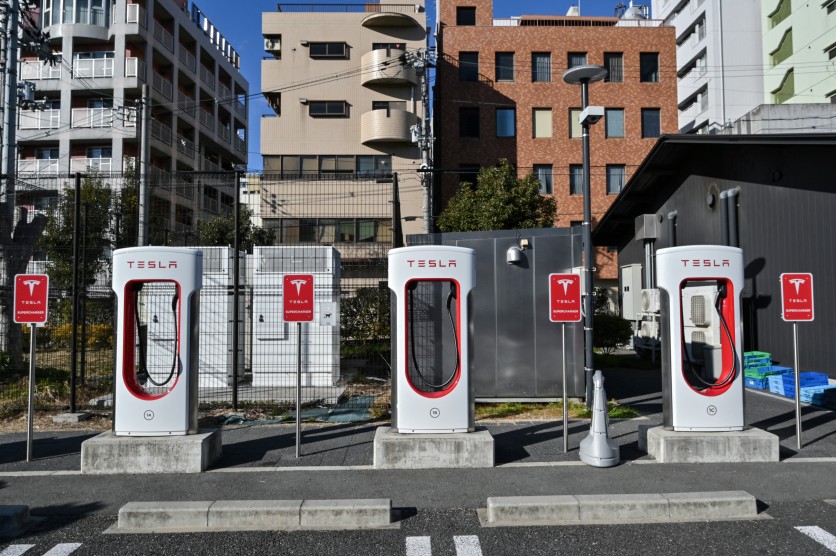
This general view shows a Tesla charging station in the Tennoji area of Osaka on February 24, 2025. RICHARD A. BROOKS/AFP via Getty Images
The day after a magnitude-7.1 earthquake tore through Kumamoto Prefecture and killed at least 34 people, Japan's EV charging industry had already quietly mobilized in a way no one had to order: five separate operators, acting on their own, opened their networks to anyone in Kyushu who needed power. By the time Japan's automotive publication Response.jp compiled a consolidated list on July 30, more than 108 charging locations had been made free across the disaster zone — a response that arrived faster than any fuel tanker could reach the region, and without a single phone call between the five companies involved.
The earthquake, formally named the Reiwa 8 Kumamoto Earthquake (令和8年熊本地震) by the Japan Meteorological Agency, struck on July 28 at 4:27 p.m. local time, registering shindo 7 — the maximum intensity on the JMA's scale — in Uki City and Hikawa Town. At least 34 people were confirmed dead as of July 30, including seven killed when a gas explosion brought down part of the Aeon Mall in Kashima Town and eight more at the Nippon Paper Industries plant in Yatsushiro. Rescue operations were continuing. Hundreds of thousands of residents had been advised to shelter at evacuation centers, and roughly 48,000 households in Kumamoto Prefecture lost electricity.
Five Operators, Five Decisions, One Outcome
The five networks that opened their chargers are as different as five companies in the same industry can be:
Tesla announced free access on July 29 for 10 Supercharger sites across five Kyushu prefectures — one each in Kumamoto, Miyazaki, Oita, and Kagoshima, plus six sites in Fukuoka — through August 4, covering anyone who needed to charge, not only Tesla owners. Critically, the offer explicitly extended to non-Tesla vehicles compatible with the NACS (North American Charging Standard) connector, the same plug standard Tesla uses. As of end-May 2026, Tesla operated 150 stations with 744 Supercharger stalls across Japan — making it the largest rapid-charging network in the country.
Terra Charge, a rapidly growing Japanese charging operator, made the largest and longest commitment in the response: 71 charging locations across Kumamoto Prefecture, free through September 30. That is a nearly two-month relief window — a recognition that recovery from a major earthquake is measured not in days but in months. EV drivers can access the free service via a coupon code (KUMAMOTO) in Terra Charge's app.
e-Mobility Power, one of Japan's largest public charging operators and a joint venture backed by Toyota, Nissan, Honda, and other domestic automakers, opened eight rapid chargers in Kumamoto Prefecture through August 5.
FLASH, a rapid-charging service, opened five locations in Kumamoto Prefecture on a flexible timeline — the company said its access period would be adjusted based on conditions on the ground, an acknowledgment that disaster timelines resist fixed end dates.
DMM EV ON, the charging arm of Japan's diversified tech and entertainment company DMM, opened 14 facilities in Kumamoto Prefecture through August 5.
Read more: Kumamoto Quake Silences 168 Base Stations as JAPAN Roaming Faces First Test
Why This Works: Grid-Embedded Energy vs. Supply Chains
The most important thing the five-network response reveals is architectural rather than logistical. When a major earthquake disrupts a region, gasoline supply chains fail for a straightforward reason: liquid fuel must be physically delivered by tanker trucks, and the same seismic event that creates the need for fuel also closes roads, damages fuel depots, and disrupts the delivery network. A gas station with no delivery trucks to fill it is a metal building with empty tanks.
An EV charging station operates differently. The energy it delivers — electricity — travels through underground and overhead cables that are already embedded in the infrastructure of the region. When grid power is available at a location, the charger works. When carriers like Kyushu Electric Power restore partial grid service to priority infrastructure, charging stations benefit immediately.
This does not mean EV charging is immune to earthquake disruption. The same 48,000-household blackout that affected Kumamoto residents also cut power to some charging locations. Grid restoration priority — which facilities get power first — shapes which chargers are usable and when. But the asymmetry between the two energy delivery systems holds: a charger that loses grid power can come back online the moment power is restored, with no additional supply chain step required. A gas station whose tanker couldn't reach it during the crisis remains empty until a tanker does.
The five operators' decisions were independent. There was no coordinating body, no joint announcement, no shared press conference. Each company made its own calculation and set its own terms. The combined effect — more than 108 locations across a disaster zone — arrived within 24 hours of the earthquake.
NACS Standardization Gets Its First Disaster Test
Tesla's decision to extend its free offer to all NACS-compatible vehicles, not just Teslas, carries significance beyond the immediate response.
Japan's EV charging landscape has historically been fragmented between CHAdeMO — a Japanese-developed standard with approximately 12,600 remaining public installations, but effectively legacy for new vehicles — and NACS, which Toyota, Honda/Sony, Nissan, Mazda, and Stellantis have all announced plans to adopt for Japan from 2026-2027. Tesla had 744 Supercharger stalls at 150 stations as of end-May 2026, with the network continuing to expand through ongoing partnerships.
By making all 10 Kyushu Supercharger sites available to any NACS-compatible vehicle in an emergency — regardless of brand — Tesla demonstrated in a real-world crisis scenario exactly what charging standardization is supposed to deliver: network access that does not depend on who manufactured your car. A driver displaced by the earthquake, charging at a Tesla Supercharger in a Mazda or Nissan, is a policy argument made visible.
The Broader Industrial Context
The earthquake's industrial footprint in Kumamoto extends well beyond EV charging. Honda announced it was halting operations at its Kumamoto motorcycle plant through at least July 31. Semiconductor facilities in the region, including some that supply global electronics supply chains, also reported production stoppages, with knock-on effects for camera sensors and automotive chips already being tracked by analysts.
The Aeon Mall in Kashima Town, which had only reopened on June 13, 2026, after being rebuilt following the 2016 Kumamoto earthquakes, suffered a gas explosion that brought down part of its second floor and killed at least seven people. The same building that symbolized the region's recovery from one disaster had become a casualty of the next.
For residents trying to evacuate, reach family, or find temporary housing, the ability to charge an EV for free — at a network that was free by choice, not by policy mandate — was not an abstraction.
What Terra Charge's September 30 Window Signals
Terra Charge's decision to keep its 71 stations free through September 30 is the detail in this story that deserves more attention than it has received.
Every other operator in this response set an end date of August 4 or August 5. That is a week out, which tracks the typical "acute crisis" horizon for infrastructure emergency responses. Terra Charge extended its window to September 30 — a full two months beyond the earthquake. That decision reflects a different understanding of what earthquake recovery actually looks like: it is not a week's crisis followed by normal life. It is months of rebuilding, insurance claims, temporary housing, daily logistics under disrupted conditions, and continued reliance on vehicles as mobile infrastructure for people whose homes may not be habitable.
For EV drivers in that situation — displaced, running on savings, commuting from temporary shelter — free charging through the end of September is not a courtesy. It is a meaningful material support.
Read more: Japan Quake Halts Sony Camera Sensor Factory: History Says Shortages Hit in Months
(Exchange rate as of July 30, 2026; all conversions in this article are approximate at ¥163.51 per $1 USD.)
Frequently Asked Questions
Where can EV drivers charge for free after the 2026 Kumamoto earthquake?
Five operators have opened free charging as of July 30, 2026: Tesla (10 Supercharger sites across Kumamoto, Miyazaki, Oita, Kagoshima, and Fukuoka prefectures, free through August 4); Terra Charge (71 locations in Kumamoto Prefecture, free through September 30 via the coupon code KUMAMOTO in the app); e-Mobility Power (8 rapid chargers in Kumamoto Prefecture, free through August 5); FLASH (5 Kumamoto Prefecture locations, flexible duration); and DMM EV ON (14 Kumamoto facilities, free through August 5). A consolidated spot list covering all five is available through Response.jp and each operator's official channels.
Is Tesla's free Kyushu charging available for non-Tesla EVs?
Yes. Tesla explicitly extended its free-access announcement to non-Tesla vehicles compatible with the NACS (North American Charging Standard) connector, also known as SAE J3400. As Japanese automakers including Mazda, Nissan, Toyota, Honda, and Stellantis brands roll out NACS-equipped models through 2026-2027, an increasing share of EVs on the road in Japan will be able to use Tesla Superchargers natively. This disaster response is the first time that cross-brand compatibility has been exercised at scale during a crisis.
How does EV charging compare to gasoline supply during earthquakes?
EV charging stations depend on the electricity grid, which is already embedded in the region's infrastructure — when partial grid power is restored to priority locations, chargers can function immediately. Gasoline supply chains depend on physical tanker-truck delivery, which requires passable roads and undamaged fuel depots; the same seismic event that creates urgent fuel demand also disrupts the delivery mechanism. Neither system is fully immune to earthquake disruption, but EV charging's recovery time from grid restoration is measured in minutes, whereas gasoline supply chain recovery requires coordinating physical logistics that may take days.
What happened to the Aeon Mall that reopened in June 2026?
The Aeon Mall in Kashima Town, Kumamoto Prefecture, had reopened on June 13, 2026 after being rebuilt following the 2016 Kumamoto earthquake damage. During the July 28 earthquake, the mall was evacuated by staff who helped approximately 3,000 customers exit. About an hour after the quake, a suspected gas explosion brought down part of the second floor. At least seven people were confirmed dead at the site as of July 30, 2026, and rescue operations were ongoing, according to Al Jazeera's coverage of the earthquake and its aftermath.

-
 C114 Communication Network
 -
 Communication Home
