
 Search

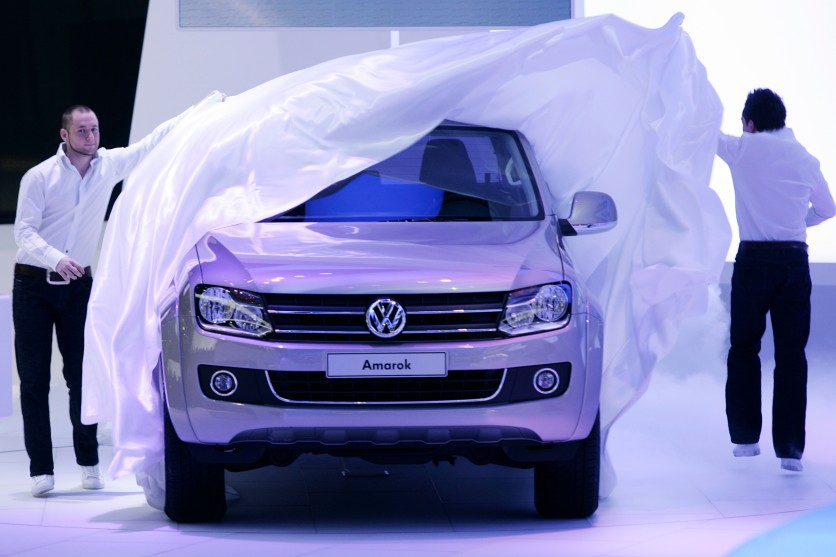
Models present the new VW Amarok during a press conference of Volkswagen on March 2, 2010 during the second press day at the 80th Geneva International Motor Show at Palexpo in Geneva. SEBASTIAN DERUNGS/AFP via Getty Images
Volkswagen Commercial Vehicles chief executive Stefan Mecha has done something his company has spent years avoiding: put a number on the electric Amarok. In an interview with Australian automotive outlet Chasing Cars published Tuesday, Mecha confirmed that the third-generation Amarok — expected around 2029 or 2030 — will be offered with both plug-in hybrid and fully electric powertrains alongside combustion engines. The current diesel-and-petrol lineup, he made clear, will not change.
"For the competitiveness of this product, you need this flexible drivetrain strategy, which comprises PHEVs and also electric vehicles," Mecha told Chasing Cars. "We have a clear plan for this. But it's not now. It's for the next generation. For the existing model, it's not going to change."
The statement is the most specific, on-the-record commitment VW has ever made to electrifying the Amarok nameplate, which has carried only diesel and petrol engines across its first two generations. What it does not answer — and what carries real consequences for what kind of electric pickup the Amarok III actually becomes — is what it will be built on.
From Green Light to No-Show to Green Light Again
The path to today's announcement has been as indirect as a recovery road in low range. Volkswagen first signaled an electric Amarok in 2022, when senior commercial vehicles executives described the eAmarok as actively in development. Three years later, those plans were gone. As global EV sales growth softened in 2023 and 2024, VW concluded the second-generation model's modest global volume could not justify the engineering cost of an additional powertrain.
The reversal landed with uncomfortable clarity in November 2025, when Volkswagen Commercial Vehicles' Australian brand director Nathan Johnson told outlet CarExpert that CEO Mecha had "made it clear the PHEV and BEV Amarok is no longer being discussed at this point in time, in this generation," calling it a global-level decision. The Mecha quote offered separately — "no. At this stage, no" — aligned with that position.
Today's reversal isn't a contradiction of what Johnson said in November. It's a clarification of scope. What VW cancelled in 2023-24 was electrification of the current model. What Mecha has now confirmed is electrification of the next model — with the current diesel Amarok serving out the remainder of its contract with Ford's manufacturing facilities in Silverton, South Africa, unchanged.
That distinction matters for buyers: nothing is arriving in the near term. But the direction — which had been genuinely uncertain — is no longer in doubt.
What the Platform Decision Really Means
What goes largely unspoken in VW's announcement is that the platform decision for Amarok III is not simply a commercial question about who manufactures the next truck. It is an engineering decision that will determine what kind of electrification the third-generation Amarok can actually achieve.
The current Amarok rides on Ford's T6.2 ladder-frame, body-on-frame architecture — a construction method where a separate body sits on a rigid chassis, with the powertrain, suspension, and cab assembled independently. Body-on-frame designs are durable under heavy commercial use, but they present a particular challenge for large-format electrification: battery packs in modern EVs are most efficiently packaged as integrated floor assemblies in monocoque (unibody) designs. In a body-on-frame truck, accommodating a large battery requires fitting it within or below a separate frame, which creates mass distribution and packaging trade-offs that affect both payload and towing capacity.
Ford has already navigated this problem for the Ranger PHEV by using a relatively compact 11.8kWh battery tucked beneath the rear bench seat, producing combined outputs of 207kW and 697Nm while preserving 3,500kg braked towing capacity and approximately 973kg of payload. The trade-off is electric-only range: the Ranger PHEV delivers up to 45km of electric driving in Australian specification — useful for urban commuting, but not suited to long outback runs between charges.
A continuation of the Ford partnership for Amarok III would give VW access to a next-generation Ranger platform where this PHEV packaging problem has already been engineered to commercial-grade standards. That is a significant technical head start, and it is why Ford remains, in Mecha's own words, the "frontrunning candidate" for the third generation's underpinnings.
The alternative — the SAIC Maxus Terron 9 architecture, which already underpins the new VW Amarok destined for South American markets from 2027 following a US$580 million investment in Argentina — opens a different technical path. SAIC is a Chinese state-owned enterprise, and the Terron 9's available electric drivetrain variants mean VW could potentially source a platform with purpose-designed EV battery integration rather than retrofitting a PHEV into an ICE-first architecture. The trade-off is supply chain complexity: engineering and manufacturing a globally distributed truck on underpinnings controlled by a company subject to Chinese state oversight introduces geopolitical dependencies distinct from the established Ford partnership. The platform decision, whichever way it falls, sets the electrification ceiling for the Amarok III — it is not simply about manufacturing geography.
"We have a fixed duration with Ford on the (second-generation) Amarok, and so there's no finality on the next generation underpinnings," Mecha acknowledged to Chasing Cars. "We are busy talking to Ford to see how we can bring the Amarok into the future."
Australia's CO2 Math Makes an Electric Amarok Non-Optional
The deeper reason Mecha is making this commitment today rather than deferring it further is arithmetic. The Amarok's diesel emissions profile is incompatible with the regulatory road ahead, and the window to fix it is closing.
Australia's New Vehicle Efficiency Standard (NVES) sets a tightening average CO2 target for Type 2 vehicles — the category covering utes and vans — across each manufacturer's fleet: 180g/km in 2026, dropping to 150g/km in 2027, 122g/km in 2028, and 110g/km by 2029. The current Amarok V6 diesel produces 222g/km, as confirmed in the same Chasing Cars interview. That is 112g/km above the 2029 target — meaning VW's commercial vehicle fleet must sell enough electrified models to offset the diesel Amaroks still moving off dealer lots.
Even if PHEV and BEV Amaroks account for only a fraction of total third-generation sales, their near-zero emissions in the NVES calculation can dramatically reduce the regulatory penalty on the diesel variants sold alongside them. "For the future, you need to have alternative drivetrains like PHEVs. The Chinese are coming with this. You need full electric vehicles also in the pickup segment. We are fully aware of this," Mecha told Chasing Cars.
The NVES mechanism matters for buyers too, because it determines which vehicles Australian consumers actually get access to. Manufacturers who fail to meet fleet targets face financial penalties — and may respond by limiting supply of high-CO2 vehicles or by prioritizing markets with easier regulatory conditions. An electrified Amarok III available in 2029 is not just a product decision; it is the mechanism by which VW keeps a full-range commercial pickup in the Australian and European markets through the end of the decade.
A Market That Isn't Waiting
While VW deliberates, the segment has moved on without it. Ford launched the Ranger PHEV into Australia in 2025, pairing a 2.3-litre turbocharged petrol engine with an 11.8kWh battery and delivering up to 45km of electric-only range without sacrificing the 3,500kg towing capacity working-vehicle buyers require. A full review confirms the truck also features a 6.9kW Pro Power Onboard inverter system — effectively a mobile worksite generator — which has proven particularly compelling for mining, agriculture, and tradies needing AC power away from the grid.
Toyota launched the ninth-generation Hilux BEV in Australian showrooms in May 2026, priced from AU$74,990 before on-road costs. The truck pairs a 59.2kWh lithium-ion battery with a dual-motor all-wheel drive system — 82kW/206Nm at the front, 129kW/269Nm at the rear, for combined outputs of 144kW and 468Nm delivered through a single-speed reduction gear. The trade-off is capability at the extreme end: braked towing is approximately 2,000kg, compared to the 3,500kg offered by the diesel Hilux — a meaningful gap for heavy-trailer operators. Toyota has consequently positioned the BEV squarely at fleet and mining buyers, with fewer than 10 private individuals among around 300 early purchasers, and a sales forecast of just 500 units for the full 2026 year.
Chinese competitors are adding pressure from below. BYD opened UK and European orders for the SHARK PHEV pickup on July 8, 2026 at £47,290, offering 55.9 miles of electric-only range and 2,500kg towing capacity powered by a dual-motor system producing 436PS. In Australia, the BYD Shark 6 became the top-selling PHEV ute in 2025 and gained a new Performance variant in 2026 with 3,500kg towing capacity at AU$62,900. Mecha's acknowledgment — "the Chinese are coming with this" — captures the competitive dynamic accurately: Chinese manufacturers are not waiting for Western OEMs to define what an electrified pickup looks like.
What Amarok III Could Look Like
Mecha's comments sketch the outline of what VW calls a "flexible drivetrain strategy": diesel, PHEV, and BEV variants planned simultaneously for the third-generation Amarok, with combustion engines likely remaining the volume seller in commercial and export markets while PHEVs and BEVs serve compliance needs and premium segments in regulated markets.
The 2029–2030 launch window aligns precisely with the expiration of VW's current production contract with Ford and the final tightening step of Australian CO2 targets. A related interview published alongside Tuesday's announcement also confirmed VW's interest in developing a ladder-frame SUV to rival the Ford Everest and Toyota Land Cruiser Prado — potentially on the same next-generation platform as the Amarok III — though no production decision has been made.
The platform question will resolve itself as VW's Ford contract nears expiry. The electrification commitment is now on record. What remains to be determined is whether the Amarok III becomes a PHEV-optimized successor to an existing architecture or a purpose-engineered electric truck for the decade ahead — a difference the announced timeline won't make visible until 2027 at the earliest.
Frequently Asked Questions
When will the electric VW Amarok be available to buy?
VW has confirmed PHEV and BEV powertrains for the third-generation Amarok, expected to arrive in 2029 or 2030. The current second-generation model, including all current diesel variants, will not gain electrified powertrains. Buyers seeking an electric or hybrid pickup truck from VW must wait for the next generation.
Why can't VW simply add a PHEV to the current Amarok like Ford did with the Ranger?
Ford developed the Ranger PHEV battery packaging — an 11.8kWh unit fitted beneath the rear bench seat — as part of the Ranger's own evolution, and VW's agreement with Ford covers only the core vehicle configuration, not powertrain additions. Adding a PHEV to the current Amarok would have required a separate engineering program on modest global volume. VW concluded in 2023–24 that the volume math didn't justify the cost, unlike Ford, which had the Ranger's own electrification roadmap to amortize the investment against.
What is the best electric ute you can buy in Australia right now?
As of July 2026, the Toyota Hilux BEV (from AU$74,990) is the most recognized full-battery electric ute on the Australian market, but its approximately 2,000kg braked towing limit makes it most suitable for fleet and light-commercial use rather than heavy-trailer operations. The Ford Ranger PHEV (PHEV, not full BEV) offers 45km of electric range with 3,500kg towing retained, making it a better choice for buyers who need both electrification and full working-vehicle capability. The BYD Shark 6 offers competitive PHEV performance from approximately AU$57,900. No full BEV ute in Australia currently matches the 3,500kg towing standard set by diesel dual-cabs.
Does the platform VW chooses for Amarok III actually affect how electric it can be?
Yes — more than most coverage of the platform question acknowledges. Body-on-frame truck architectures require fitting large battery packs within or below a rigid chassis frame, which creates packaging and mass distribution trade-offs that directly affect payload capacity and towing ratings. A continuation of the Ford T6 architecture gives VW a validated PHEV solution but may limit the size of the battery pack achievable without sacrificing commercial capability. An alternative architecture — such as SAIC's Terron 9 platform, which supports purpose-designed EV battery integration — could enable a larger battery and greater electric range, but introduces supply chain dependencies on Chinese state-owned manufacturing. The platform decision sets the electrification ceiling for the Amarok III.

-
 C114 Communication Network
 -
 Communication Home
