
 Search

Credit: Stephen Edelstein
In 1968, having achieved a modicum of stability through the introduction of its seminal Neue Klasse (or “new class”) models, BMW scaled up its styling and used the company’s M10 four-cylinder engine as the basis for a new inline-six in a larger sedan known by chassis code E3, the ancestor to today’s BMW 7 Series. History repeats itself with the latest version of BMW’s flagship sedan.
The 2027 BMW 7 Series is a refresh of the seventh-generation G70 version that arrived in the United States as a 2023 model. But the changes are much more extensive than the typical refresh, or “life cycle impulse” (LCI) in BMW-speak. That’s because the updated 7 Series borrows tech and styling elements from the new Neue Klasse—the family of EVs that so far includes the iX3 crossover and i3 sedan.
This hulking sedan still lacks the grace of its E3 and E23 ancestors, but the infusion of Neue Klasse details and other tweaks definitely help. The rear bumper has a cleaner look, as does the front end, which has a simplified version of the previous split-lighting arrangement of daytime running lights above rectangular headlights nestled in coves that also house the intakes for the front-wheel air curtains.
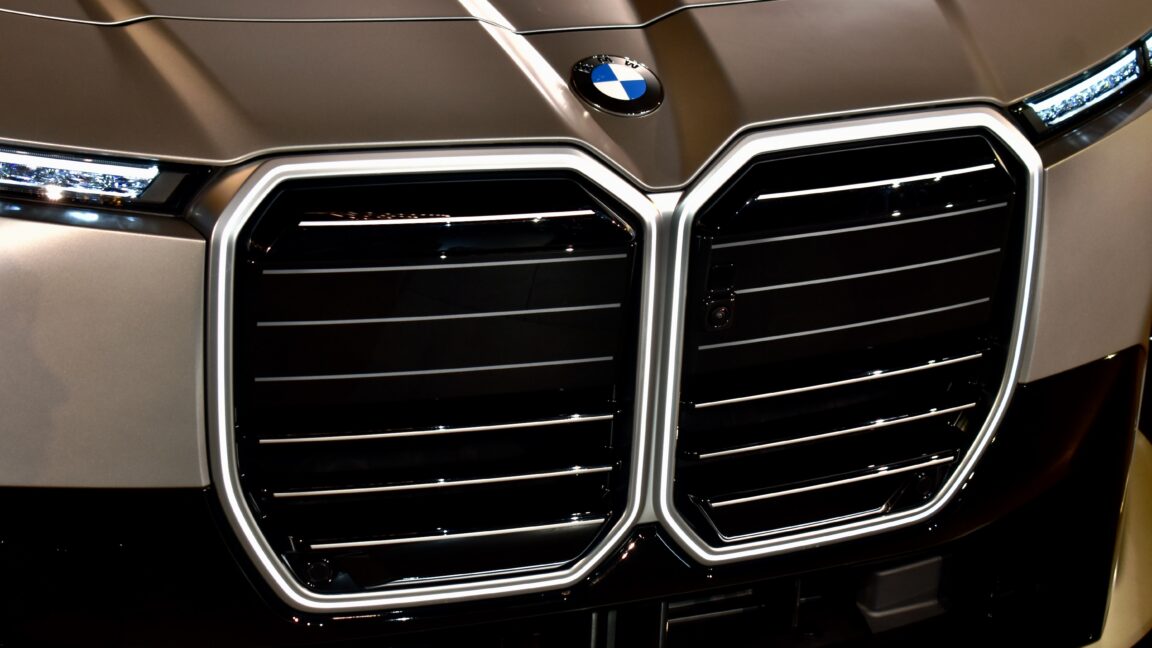
The 7 Series has been comprehensively reworked, inside and out. That valley down the hood is new…
Credit: Stephen Edelstein
A ridged hood similar to the iX3 and i3 better frames the enormous twin-kidney grille. It’s as ungainly as before, but Maximilian Missoni, the ex-Polestar designer in charge of midsize and large-car styling at BMW, pointed out that the kidneys are perhaps the only brand-specific styling feature in the auto industry that hasn’t been copied, so it’s worth flaunting them. Plus, they provide extra room for sensors that will enable SAE Level 2 driver assistance.
More screens inside
The Panoramic iDrive Display that debuted in the Neue Klasse EVs makes an appearance here as well. The door-to-door screen is mounted high to keep it in the driver’s line of sight, with a gauge cluster on one side and secondary widgets (you can even display photos of old BMW Art Cars if you like) to the right. It’s accompanied by a 17.9-inch central touchscreen and 14.6-inch front-passenger touchscreen below. You can use the screens to open and close the available automatic doors, which have integrated servos and dedicated radars to ensure reliable operation. Flush handles on the outside open the doors with only a touch.
The latest BMW Operating System X continues to incorporate wireless Apple CarPlay and Android Auto, and it interfaces with a simplified zonal electrical architecture similar to the Neue Klasse EVs that eliminates 2,000 feet of wiring. BMW includes four years of free data and plans to offer over-the-air updates. Michael Keller, vice president of product management for BMW of North America, wouldn’t say how long OTA support would be offered but noted that the current hardware set offers substantial headroom for future updates.
The 31.3-inch Theater Screen for rear-seat passengers returns, too. It’s now a touchscreen that can run Zoom calls, but small touchscreens in the rear doors are still included. It can be paired with a 1,925-watt Bowers & Wilkins Diamond surround sound system with 36 speakers that can send bass vibrations through the seats (an 18-speaker/575-watt Bowers & Wilkins system is standard). A newly available digital rearview mirror also ensures the driver can now see what’s behind when the fold-down screen is deployed.
i7 gets Neue Klasse hardware
The 7 Series re-ups gasoline, plug-in hybrid, and all-electric powertrain options, reflecting strong customer demand for all three, Keller said.
With the rest of the car borrowing conspicuously from the Neue Klasse, it makes sense that the all-electric i7 sees the biggest changes under the skin. It adopts cylindrical battery cells from the Neue Klasse EVs that are 20 percent more energy-dense than the prismatic cells in the outgoing car, BMW says. That, along with a boost in usable battery capacity to 112.5 kWh (up from 101.7 kWh), increases maximum EPA range from 314 miles (505 km) to over 350 miles (563 km), BMW claims.
The i7 retains a 400 V electrical architecture but switches to a NACS port and sees an increase in maximum charging power from 195 kW to 250 kW thanks to the new cells. That should be enough for a 10–80 percent charge in 28 minutes, according to BMW. Tesla Supercharger access is included, and adapters will be available for charging at CCS stations.
At launch, the i7 will be available in 50 xDrive and 60 xDrive strengths, with dual-motor powertrains tuned for 449 hp (335 kW) and 487 lb-ft (660 Nm) and 536 hp (400 kW) and 549 lb-ft (745 Nm), respectively. BMW reckons the i7 60 xDrive will do zero to 60 mph (97 km/h) in 4.6 seconds, while the 50 xDrive will do the same in 5.3 seconds.
BMW continues to offer adaptive regenerative braking that varies the level of regen based on navigation data and the speed of cars ahead, as well as a coasting feature for increased efficiency at highway speeds. Drivers can also manually select low, medium, and high settings.
Combustion engines continue
The 740 makes about 400 hp.
Credit: Stephen Edelstein
A V8 option will return in an M-badged variant at a future date, but for now, the rear-wheel-drive 740 and all-wheel-drive 740 xDrive have a turbocharged 3.0-liter inline-six producing 394 hp (294 kW) and 398 lb-ft (540 Nm) of torque. BMW says the xDrive version will do zero to 60 mph in less than five seconds.
A 750e xDrive plug-in hybrid model adds an electric motor to the inline-six. It’s rated at 483 hp (360 kW) and 516 lb-ft (700 Nm) of torque, with zero to 60 mph in an estimated 4.6 seconds, like the i7 60 xDrive. Those figures are unchanged from the current 7 Series plug-in hybrid, as is the usable battery capacity of 18.7 kWh. That yields 34 miles (55 km) of EPA-rated electric range in the current car. And yes, the amount of customers who actually charge their plug-in hybrids is “quite significant,” Keller said, although he didn’t have specific numbers to quote.
Pricing increases by just $500 for the 740 and 740 xDrive, which start at $101,350 and $104,350, respectively, including the $1,550 destination charge. The i7 models see bigger increases, but the $106,200 starting price for the i7 50 xDrive and $126,250 starting price for the i7 60 xDrive (again, with destination) probably won’t trouble the target audience. These models should reach the US before the end of the year, while the 750e xDrive will follow in 2027, with pricing to be announced closer to that time.

-
 C114 Communication Network
 -
 Communication Home
