
 Search

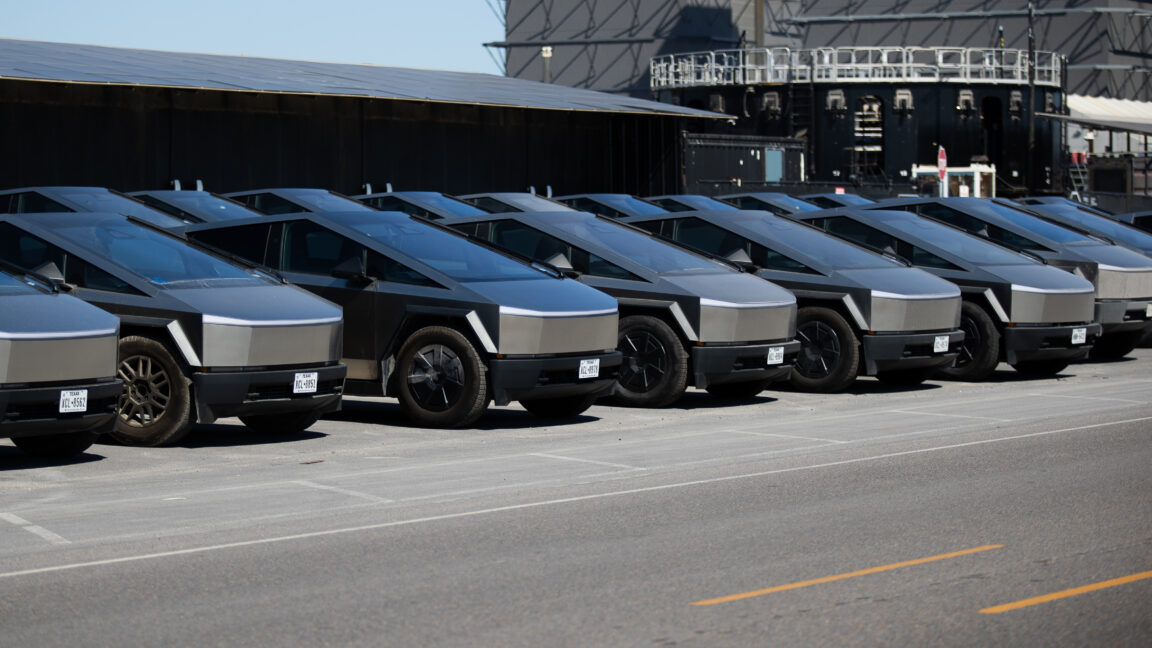
Credit: Reginald Mathalone/NurPhoto via Getty Images
Last night, Tesla made some hefty cuts to Cybertruck pricing in an effort to stimulate some sales. The bombastic tri-motor “Cyberbeast” is $15,000 cheaper at $99,990, albeit by dropping some previously free features like supercharging and FSD. And there’s now a new $59,990 entry-level model, a dual-motor configuration with a range of 325 miles (523 km) and the same 4.1-second 0–60 mph (0-97 km/h) time as the $79,990 premium all-wheel drive version.
That actually makes the new entry-level model a good deal, at least in terms of Cybertrucks. Last year, the company introduced and then eliminated a single-motor rear-wheel drive variant, which found few takers when priced at $69,990; an extra motor for $10,000 less is quite a savings, and actually slightly cheaper than the price originally advertised for the RWD truck.
As you might expect, Tesla has made some changes to get down to the new price. The range and 0–60 mph time might be the same as the more expensive dual-motor Cybertruck, but towing capacity is reduced from 11,000 lbs (4,990 kg) to 7,000 lbs (3,175kg), and cargo capacity drops from 2,500 lbs (1,134 kg) to 2,006 lbs (910 kg).
Steel springs and adaptive dampers replace the air suspension. There are different tail lights. The inside features textile seats—maybe someone there reads Ars—but the cheapest Cybertruck does without seat ventilation for the front row or seat heaters for the second row. There’s also a different console, no AC outlets in the cabin, and fewer speakers, with no active noise-cancellation system.
But it’s still $20,000 more expensive than Elon Musk told us it would be during the angular, unpainted vehicle’s reveal back in 2019. Back then, Musk promised a $39,900 price tag, as well as a few other things that never saw the light of day, like a true monocoque construction.
Designing and building the odd-looking vehicle proved particularly troublesome for Tesla, which has never found those processes particularly easy. While other new Tesla models found themselves mired in “production hell,” in 2023 Musk said that “we dug our own grave with the Cybertruck.”
Indeed, if the company based its business plans on the public sales projections of 250,000 trucks a year—something Musk said would happen by 2025—that certainly would be a problem.
Appealing to neither traditional pickup truck buyers, who have largely rejected going to electric vehicles, as well as the majority of EV enthusiasts even before Musk’s politics further soured things, fewer than 39,000 Cybertrucks were sold in 2024, and just over 20,000 found homes in 2025. The Edsel might be Ford’s most famous failure, but even it posted superior sales numbers during its relatively brief life.

-
 C114 Communication Network
 -
 Communication Home
