
 Search

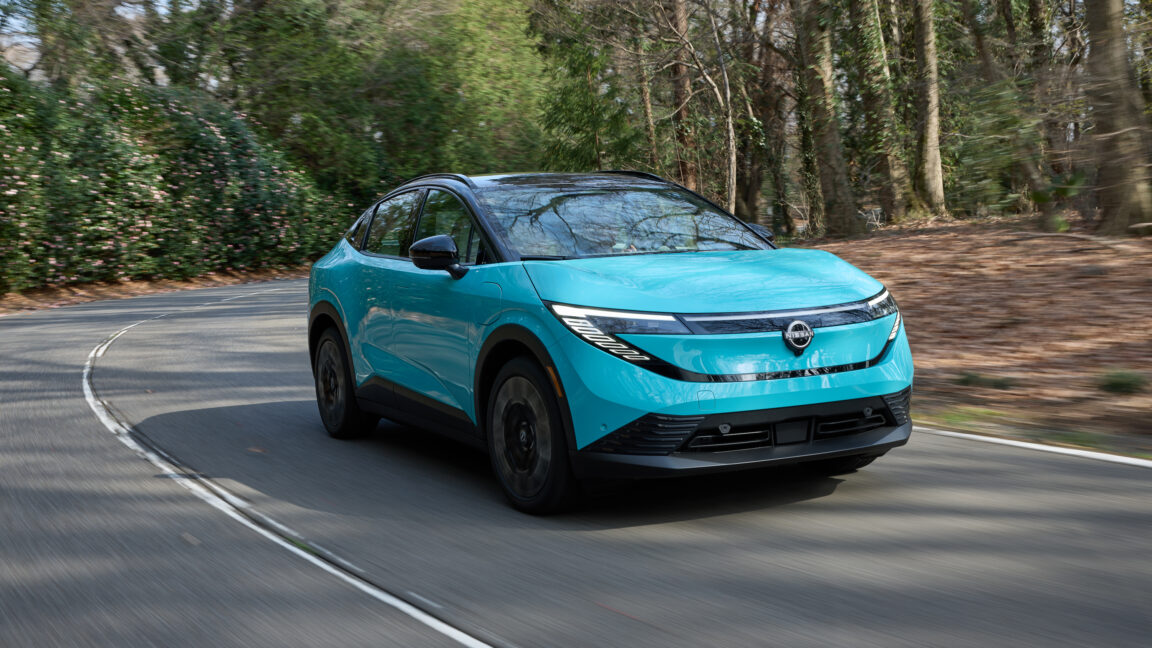
Credit: Nissan
Years before the Chevrolet Bolt or Tesla Model 3, the Nissan Leaf was a good-faith attempt by a major automaker to bring electric vehicles to the mass market. But even in its second-generation, the Leaf was hamstrung by poor battery management and was soon left behind. For its third take on the Leaf, Nissan fixed the earlier cars’ key flaw by adding liquid-cooling for the battery pack. Better yet, the new Leaf is built on a dedicated EV platform that offers better interior space and range efficiency than the hatchback it replaces, despite taking up less road space.
Our first drive of the car took place last year in San Diego, a region where the roads tend to flatter a car. Our first impression was positive enough to place the Leaf first among the cars we drove in 2025. Sure, if money were no object, I’d take that hybrid Porsche 911 that came in second, but you could buy five fully loaded Leafs for the same price as a bare-bones Carrera GTS. And for those of us in the real world, money usually is an object. But a longer test with the Leaf was in order to see how the electric Nissan held up in the day-to-day grind.
Price and specs
In time, Nissan will offer an entry-level Leaf with a 52 kWh battery pack and a bit less power. For now, though, the company is only importing cars with a 75 kWh (usable) pack and a 214 hp (160 kW), 262 lb-ft (355 Nm) electric motor, which drives the front wheels. Nissan has managed to keep the price sensible, too; the S+ trim starts at $29,990. Riding on the smallest 18-inch wheels, the S+ has the longest range at 303 miles (488 km), but this version does without some of the features many EV drivers may consider essential, like heated front seats and a heat pump.
Those come as standard with the $34,230 SV+, along with a larger infotainment system, more USB-C ports, wireless phone charging, LED turn signals, the ability to use the J1772 charge port as a 120 V “vehicle to load” outlet, and a wider range of optional colors, including the bright Seabreeze Blue Pearl (an $800 option) you see in these photos. Our test car was the $38,990 Leaf Platinum+, which comes with all the above, plus larger 19-inch alloy wheels, heated front and rear seats, a 10-speaker sound system, a heads-up display, a powered hatchback, an interior vehicle-to-load AC socket, and a panoramic roof with electrochromic dimming.
The Platinum+’s larger wheels and extra couple of hundred pounds of curb weight take their toll on overall range, which comes in at an EPA-estimated 259 miles (417 km), at least when the temperature is above freezing. It was very much below freezing during our test, which explains the so-so 2.9 miles/kWh average. I could probably have pushed that number higher by turning off things like the heater, but no one is paying me to perform hair-shirt economy runs during winter. Those seat heaters warm up commendably quickly—much faster than in some cars costing twice or three times as much.
And what’s the point, unless you’re on a deadline and have a long drive ahead? With more than 200 miles of range in frozen temperatures, there’s more than enough mileage for commuting and errands as long as you can charge it reliably at home or work—a necessary condition that applies to any plug-in vehicle. The J1772 AC port is on the driver’s side, but since Nissan still hasn’t published a 0–100 percent time for level 2 charging, we can’t tell you how long it will take to fully replenish the battery with 240 V (up to 7.2 kW).
Thank you, Ted!
After moving the rubber bump stop (visible just in front of the tire) a little closer to the charger, I was able to connect.
Credit: Jonathan Gitlin
On the passenger side, you’ll find the NACS port, which supports DC fast-charging at up to 150 kW. That means this Leaf will fast-charge at Tesla Superchargers without needing an adapter—assuming the cable reaches, that is. Upon reaching my local Supercharger station, I started to sweat a little when it looked like the cable was about a half-inch too short. Big shout out to Ted, the friendly Model Y owner who was charging next to me, who figured out the rubber bump stop wasn’t bolted to the ground. After moving it a little, I could inch the Leaf close enough to connect.
Poor prior planning on my part meant I couldn’t test whether the Leaf’s plug-and-charge feature worked with Tesla Superchargers, but it was simple enough to get the session started with the Tesla iOS app. Nissan quotes a 10–80 percent charge time of 35 minutes; in practice, it took 37 minutes to charge from 29 to 80 percent (44.6 kWh) with a preconditioned battery. Charging started at 74 kW, peaked at 90 kW when the pack was at 54 percent, then dropped back down.
As I found during last year’s first drive, the ride quality on the 235/45 profile tires is firm, even tending toward bouncy. With a curb weight of 4,369 lbs (1,981 kg), the Leaf might be compact—at just 173.4 inches (4,404 mm) long, 71.3 inches (1,811 mm) wide, and 61.3 inches (1,557 mm) tall, it’s most definitely that. But it’s also dense, and at this price point, there’s no fancy air suspension to hide its mass.
The Leaf is not a large car by anyone’s standards. In fact, it’s smaller than the old one, at least on the outside. It’s roomier on the inside.
Credit: Jonathan Gitlin
I had evidently forgotten how quickly the front tires find their adhesion limit. Don’t ask much of them when cornering and accelerating at the same time. Even in a straight line, you can chirp the tires or trigger traction control with too much throttle, and vigorous cornering is discouraged due to plenty of understeer. Grippier tires may solve much of that, probably at the cost of a percent or two of range, but if you don’t approach driving a Leaf like it’s an autocross, everything should be fine.
The steering is light, and it’s easy to maneuver at low speed. If it’s painted Seabreeze Blue, you’ll be visible to other road users. I do miss the inclusion of true one-pedal driving, though; Nissan dropped that feature due to regulatory concerns in Japan and China, so even set to the highest level of regenerative braking, the car will only slow to a crawl when you take your foot off the throttle pedal, not come to a complete stop.
Push my buttons
Slightly confusingly, there are two ways to get to the maximum lift-off regen (about 0.3 G before the friction brakes take over). You can use the paddles behind the steering wheel to toggle lift-off regen through four levels or use the e-Step button on the center stack. Annoyingly, in e-Step, the brake pedal moves toward the firewall as the car decelerates, which the engineers will say is appropriate because that’s how much the pedal would have moved if you’d pressed it, an answer I never find satisfying.
At least the e-Step button is a real plastic button, as are the ones you use to select drive, reverse, park, and neutral. The Leaf has good physical controls, and you don’t need to use the infotainment system to adjust the climate. The onboard infotainment system uses Android Automotive OS and comes with Google Automotive Services (or whatever its current name is), though I spent almost all my time using Apple CarPlay. I was very impressed with the picture quality from the backup cameras, even in low-light situations. Again, some much more expensive EVs might as well be using a potato to show you what’s behind when you select reverse, so kudos to Nissan here.
So it seems our first impressions were broadly correct. The new Leaf is not the last word in driving dynamics, nor is it the most cosseting ride available, but it’s easy to live with, its technology is up to date, and it’s one of the cheapest EVs you can buy. The Chevrolet Equinox will probably be the Leaf’s stiffest competition, especially for those looking for a bigger car or an actual crossover rather than the Leaf’s smaller fastback sedan form factor.
The Leaf comes with a native NACS port, which will be important for some, and it supports phone casting with both CarPlay and Android Auto, something we know from the comments is definitely important for others. This solid and affordable EV was indeed the right choice for our car of the year.

-
 C114 Communication Network
 -
 Communication Home
