
 Search

Credit: Kia
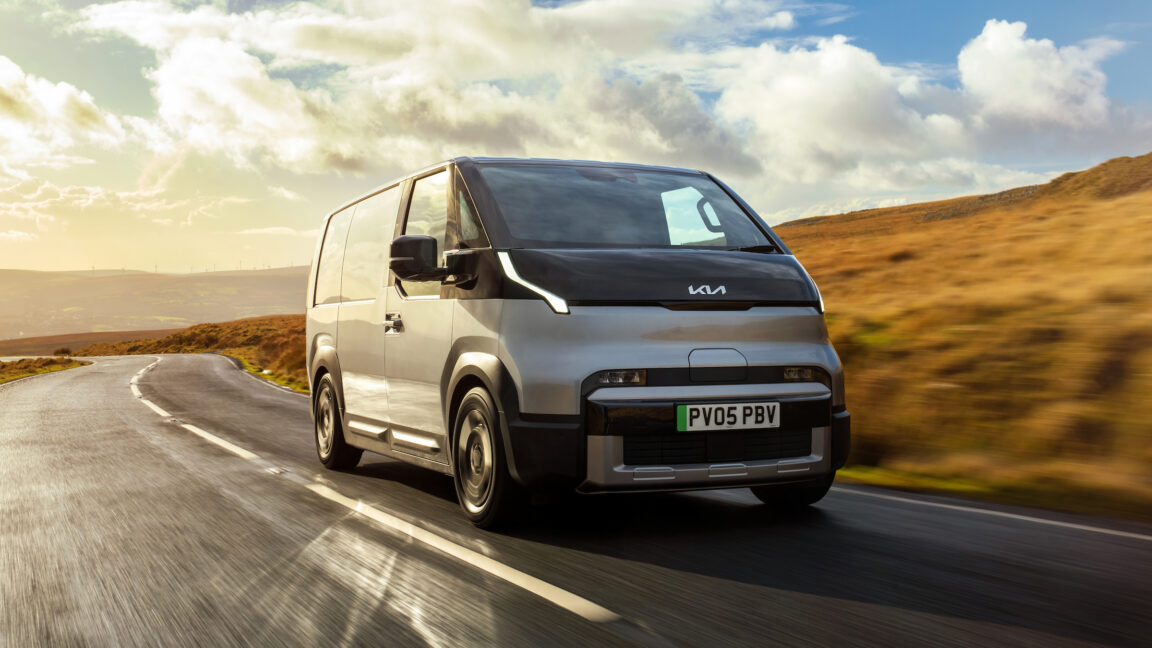
Vans are something most of us don’t think about much, since we rarely interact with them directly in our day-to-day lives. But the van is an unseen hero that keeps the world moving, delivering packages all over the country and transporting food from farm to stores. They haven’t changed much in decades, though. A van is generally a big box with a gas or diesel engine (depending on where you are in the world), and that’s… kinda it, bar a dent or two in the bodywork. Kia’s engineers, riding high on the success of their recent electric vehicles, took notice and did some new things with the PV5, the company’s first electric van.
You can spec your PV5 in a number of configurations, and the company already has conversion partners lined up to turn them into just about anything. Of course, camper converters are eyeing them as well, eager to create electric “vanlife” setups. Off the shelf, you can choose between a PV5 Passenger for moving people, a PV5 Cargo for moving things, a PV5 Crew for moving things and people, and a PV5 Chassis Cab to do with as you please.
Beneath its modular cabin is the Electric Global Modular For Service, which is part of Kia’s rather fancy-sounding “PBV” strategy. “PBV” means “Platform Beyond Vehicle,” a potential hint at where the brand sees itself going. In this case, it can house a range of battery sizes.
In the UK, where I live, we get a 52 kWh or 71.2 kWh option with either 120 hp (90 kW) or 160 hp (120 kW). Both options generate the same 184 lb-ft (250 Nm). Cargo model ranges go from a city-friendly 184 miles (296 km) to 256 miles (412 km) for the bigger battery option on the WLTP cycle. No matter which you choose, you can zip from 10 to 80 percent state of charge in half an hour on a 150 kW charger. Neither version is lightning quick; you won’t crack 0–62 mph (100 km/h) in less than 10 seconds, but that’s not what the PV5 is all about.
Vans are mobile workplaces. They either get you to your destination so you can use tools in the back, or they help transport other people. Rarely, they’re used as campers.
During the van’s development, Kia did some smart outsourcing. It knows it can make a good vehicle; it’s been doing that for years. But it isn’t an authority on how businesses use them for specific purposes, so it brought in the right partners—for example, working with Uber to help optimize the van for ride sharing. It also teamed up with Samsung to integrate connectivity tech to help businesses track and manage charging.
A van for all trades
This segment isn’t one that generally appeals to both sides of the work/life fence. Ford’s Transit can serve as a minibus, but in the UK, it’s primarily a commercial vehicle. VW’s ID Buzz can be used commercially as well, but it mostly wants to be a fun EV for big families. The PV5 needs to be both, and you can spec it as either, or a blend of the two.
It also needs to avoid looking like a traditional van. Thankfully, Kia’s designers have made it look less like a box on wheels and more like something you’d spot on a futuristic movie set (sadly, it doesn’t hover). Two-tone paint options, a wild light signature, and thoughtfully placed curves keep it from looking like every other van. It’s… cool?
If you opt for the cargo-focused version, which is what Ars tested on the UK launch, you get up to 155.4 cubic feet (4,400 L) of load space. It can accommodate 1,742 lbs (790 kg) of cargo with the smaller battery or 1,521 lbs (690 kg) with the larger pack. The load lip is 16.5 inches (420 mm) off the ground, making it much easier to load heavy cargo.
Up front, you’ll find a pair of comfortable seats and lots of room. Passengers get plenty of space to put their rolled-up newspapers, fast-food detritus, and other paraphernalia, as well as a pretty massive window to lean out of should the mood take them.
The driver gets a hefty 7.5-inch digital instrument binnacle alongside a 12.9-inch infotainment display. Nearly everything is run through that screen, which is sad for those of us who want a return to physical buttons. It’s quick and responsive, but it lacks the haptic feedback that confirms a tap. The infotainment system supports Android Auto and Apple CarPlay, so you don’t have to use it too much if you don’t like it.
On the road, delivering a load
Even with 600 lbs (272 kg) loaded in the back—Kia wanted us to have a proper experience—the van felt remarkably car-like. The steering is smooth, and it has a delightfully tight turning circle to help navigate small towns and sharp city bends. It felt sure-footed and stable, though the ride was a touch on the jiggly side on all but the smoothest roads.
Yes, it’s a van, so don’t expect a buttery-smooth ride, but because everything else is so car-like, you don’t expect quite so agricultural a ride. Nor do you expect the cabin to sound so echo-y. That contrast strikes you from time to time: it’s clearly built to do a job, but it’s also thoughtfully designed. Its touchpoints are designed to withstand heavy use, so while they’re not especially luxurious, they should hold up to the many painty/muddy/gunky hands that will use them.
The powertrain is smooth, the ride a bit less so.
Credit: Kia
Its powertrain feels exactly as you’d expect from Kia: silky smooth. It’s not the quickest vehicle in the world, but its torque gets you up to speed briskly enough. Kia’s claimed WLTP figure of 3.8 miles/kWh (16.4 kWh/100 km) wasn’t quite achievable on a chilly day, but winter weather will inevitably knock those numbers down a bit.
You can tell the PV5 isn’t the result of a simple “we have a powertrain, so let’s make a van” situation. Real thought has gone into how it will be used, how operators will interact with it, and how to make their lives easier. Ford, VW, Stellantis, and other van makers in Europe should take note.
As for America, never say never. In the UK and Europe, the PV5 costs tens of thousands less than VW’s retro microbus, suggesting that a North American PV5 could avoid the sticker shock that slowed VW’s sales, leading VW of America to delay imports for a model year. Kia America hasn’t announced plans to import the PV5 yet, but Car and Driver recently spotted one testing US-specific modifications on roads near its office.

-
 C114 Communication Network
 -
 Communication Home
