
 Search

Credit: Getty Images
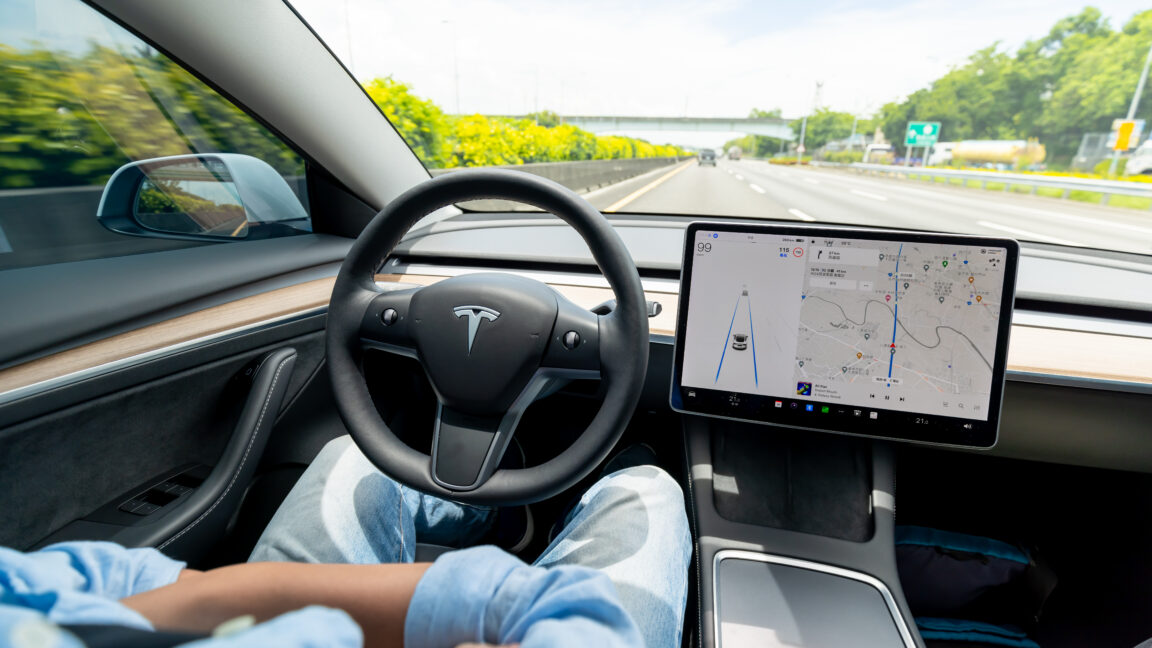
Love it or hate it, Tesla has been responsible for helping to shape the tastes of automotive consumers over the past decade-plus. Over-the-air updates that add more features, an all-touchscreen human-machine interface, large castings, and hands-free driver assists were all introduced or popularized by Tesla’s electric vehicles, prompting other automakers to copy them, mostly in the hopes of seeing the same stratospheric gains in their stock prices. But starting on Valentine’s Day, if you want your Tesla to steer itself, you’ll have to pay a $99 monthly subscription fee.
Tesla currently offers a pair of so-called “level 2” partially automated driver assist systems. Autopilot is the older of these, combining Tesla’s adaptive cruise control (Tesla calls this TACC) and lane-keeping assist (Tesla calls this Autosteer). FSD is the newer system, meant to be more capable and for use on surface streets and divided-lane highways. Although the company and Tesla CEO Elon Musk regularly tout these systems’ capabilities, both still require the human driver to provide situational awareness.
But Autopilot has been under fire from regulators and the courts. Multiple wrongful death lawsuits are in the works, and after a high-profile loss resulting in a $329 million judgment against Tesla, expect many of these suits to be settled. Both the federal government and California have investigated whether Tesla misled customers, and in December, an administrative law judge ruled that Tesla indeed engaged in deceptive marketing by implying that its cars could drive themselves. The judge suspended Tesla’s license to sell cars in California, a decision that the California Department of Motor Vehicles stayed for 60 days.
No Tesla sales in California
Tesla was told that if it couldn’t resolve the deceptive marketing within those 60 days, the sales suspension would take effect. That would be bad for the automaker, as California is far and away its largest market in the US, albeit one that is shrinking each quarter. Having to suspend sales entirely in the state would be disastrous. Some had speculated that Tesla could change Autopilot’s name to something less misleading, but the company chose a more drastic approach.
Now, if you want your new Tesla to steer itself—while you pay attention to the road—you will have to pay for FSD. Until the middle of February, that can be done for a one-time fee of $8,000. But starting on February 14, that option goes away, too, and the sole choice will be a $99/month FSD subscription.
But probably not for very long. Last night, Musk revealed on his social media platform that “the $99/month for supervised FSD will rise as FSD’s capabilities improve. The massive value jump is when you can be on your phone or sleeping for the entire ride (unsupervised FSD).”
The quest for recurring revenue streams is becoming something of a holy grail in the automotive industry as OEMs that previously treated their customers as a single sale now hope to make themselves more attractive to investors by encouraging customers to give them regular payouts.
This may have contributed to General Motors’ decision to drop Apple CarPlay and Android Automotive. BMW has also experimented with subscription services. Tesla’s stock price remains so high that such games are probably unnecessary here, but with falling profit margins, declining sales, and the loss of emissions credits to bolster the bottom line, one can see why regular cash infusions from Tesla drivers would be desirable.

-
 C114 Communication Network
 -
 Communication Home
