
 Search

Credit: Jeep
It’s not really accurate to call the Wagoneer S Jeep’s first electric vehicle. For several years now, Europeans have been able to buy the Jeep Avenger, a subcompact crossover that will surely never see American roads. But it is the first electric Jeep designed for American consumption. It’s aimed at the highly competitive midsize SUV segment, which gets ever more crowded even as electrification faces a less certain future here. Indeed, the brand, along with its Stellantis sibling Chrysler, just shelved all its plug-in hybrids, discontinuing them just a few days ago.
Like the little Avenger, the Wagoneer S makes use of one of parent company Stellantis’ purpose-built EV platforms, one shared with the growly-sounding Dodge Charger. At 192.4 inches (4,886 mm) long, 74.8 inches (1,900 mm) wide, and 64.8 inches (1,645 mm) tall, it’s a little larger than cars like the BMW iX3 or Audi Q6 e-tron but a little smaller than domestically designed rivals like the Cadillac Lyriq and Acura ZDX, which have particularly long wheelbases.
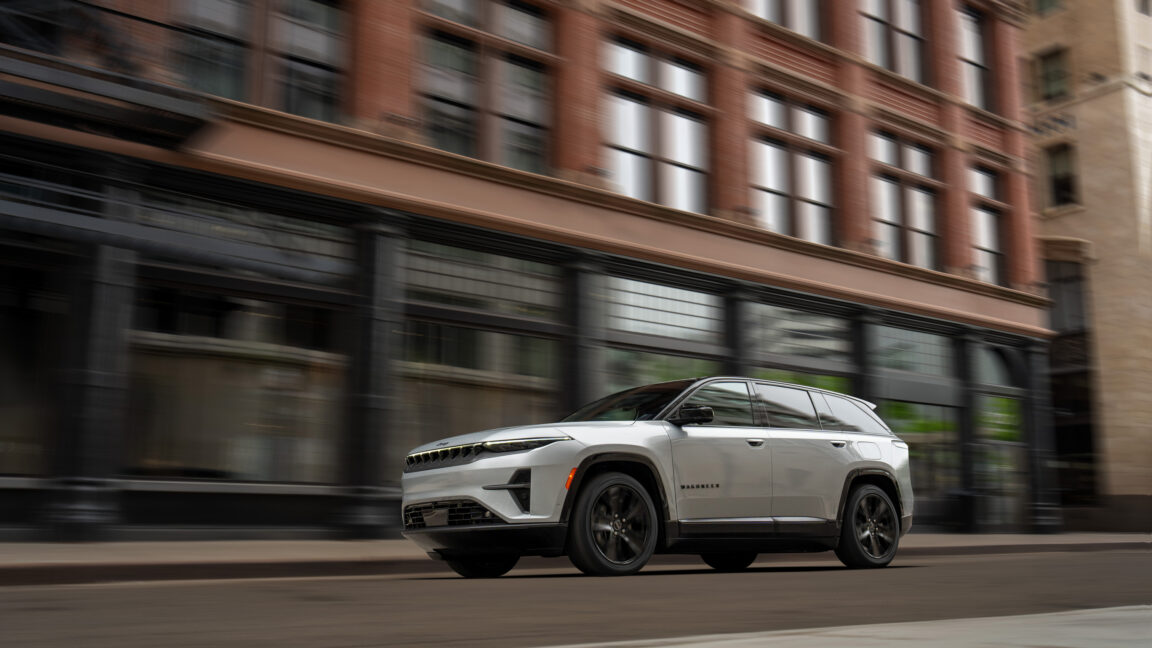
I find it a rather handsome car, one that has to marry Jeep’s Wagoneer styling cues with as many wind-smoothing and air-shaping elements as possible. The way the rear wing juts out above the tailgate window reminds me of a ’90s rally hatchback, but it’s the product of the designers and the engineers working on drag reduction. The overall drag coefficient is 0.29, and since Jeep actually publishes the frontal area, too, I can tell you the more important CdA number—where drag is multiplied by the frontal area—is 8.67 sq ft (0.805 m2).
The rear wing keeps the airflow from forming a turbulent wake as it departs the roof.
Credit: Jeep
Between the wheels lives a 100.5 kWh lithium-ion battery pack, which translates to 294 miles (473 km) of range, according to the EPA test cycle. When Ars first drove the Wagoneer S in early 2025, it was the more powerful (more expensive) Launch Edition. In mid-December, we spent a week with the $65,200 Wagoneer S Limited, which still boasts 500 hp (400 kW) and 524 lb-ft (710 Nm) from its pair of electric motors. (The Launch Edition uses a pair of equally powerful front and rear drive units, and the Limited uses a less-powerful front unit, giving away 100 hp (75 kW) in the process.)
And in mid-December, the weather was not conducive to getting anywhere close to the EPA test cycle. (Nor getting my own photographs, unfortunately.) Although the Wagoneer S claimed to be averaging 3.2 miles/kWh (19.4 kWh/100 km), according to the display on the dash, the estimated range remaining dropped much faster than the miles I actually drove. The fact that EVs, like all vehicles, lose range in cold weather is not a surprise, but was the car’s brain factoring that into the number it chose to show me?
The average didn’t seem to line up with the range estimate after recharging, either. At 81 percent, the dash showed 198 miles (319 km), not the 238 miles (383 km) my math tells me it should have read under ideal conditions. Still, I have to commend the ease of DC fast charging (via CCS1 port), which took 25 minutes from 36 to 87 percent and offered no resistance or irritation. Many of us remain conditioned to expect problems using public chargers, and I’m still surprised when the process is painless.
No NACS port here yet.
Credit: Jeep
This needs work
The range thing I can excuse because of the below-freezing temperatures. I’m less charitable about the way Jeep calibrated the pedal mapping. One-pedal driving, where the motors regeneratively brake in proportion to the amount the driver lifts their foot from the throttle pedal, is far too jerky and abrupt, particularly to initial inputs. The throttle mapping was even worse in reverse, making me a little scared I’d hit something while backing into a parking space. And this was in the most demure of drive modes, Eco. Sport mode exacerbated the problem more than Auto, and we had no need for either Snow or Sand modes.
Because of the vehicle’s 5,667 lbs (2,570 kg) of curb weight, one can understand the impulse to give the base Wagoneer S 500 hp, but in this instance, perhaps less would have been more. The ride is rather firm, and there’s something of a blind spot behind the driver’s A pillar, but with lift-off regen turned down (so the car only regenerates energy when using the brake pedal) I didn’t find anything objectionable about its road manners on surface streets or the highway.
At the first drive, Jeep’s engineers were keen to point out how little road and exterior noise makes it into the Wagoneer S’s cabin. It’s one of the key attributes that makes driving an EV a superior experience to most other cars, although in this case, it allowed me to hear a hissing sound from behind the dash that wasn’t from the air vents. Other than some mild curiosity and then annoyance, it caused me no actual harm, even if I couldn’t drown it out with a podcast.
As a Stellantis brand, the Wagoneer S uses the Uconnect 5 infotainment system, the Android Automotive OS-based platform that here includes wireless Apple CarPlay and Android Auto. The touchscreen was responsive, though the capacitive controls for things like seat heaters, which lie either side of the central infotainment screen, were less so. You may notice that when it’s freezing outside and your bum needs warming.
Sadly for Stellantis, nothing about the Wagoneer S is really compelling enough to make it stand out from the crowd, something it really needs to do in such a packed market segment.

-
 C114 Communication Network
 -
 Communication Home
