
 Search

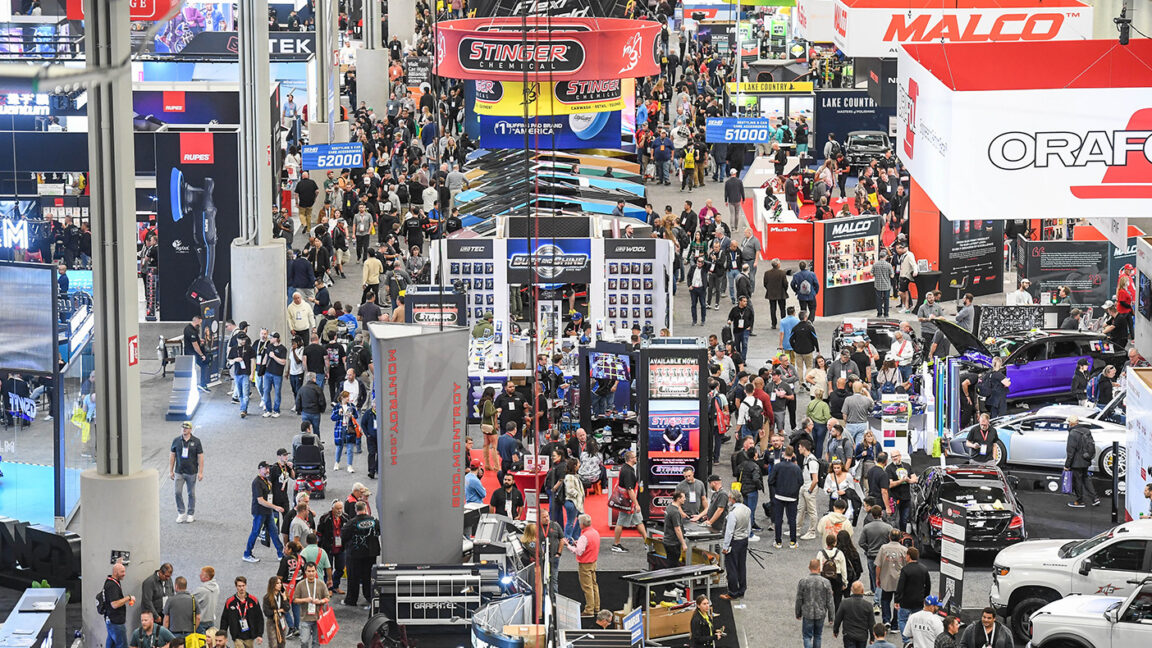
Credit: Peter Nelson
After federal clean vehicle tax credits ended in September, the electric vehicle industry reached a crossroads. Well, technically, it has been there since Trump took office. This is a weird period in automotive history; A chunk of the industry is full-steam ahead with EV development, another is cutting back, and the consumer is left wondering what the electrification landscape will look like next year, let alone in three, during the next administration.
But what about the automotive aftermarket? Typically, this corner benefits from whatever progress is made on the OEM front—have Trump’s policies expanded or contracted its EV technological development? I recently spent some time chatting with personnel of the Specialty Equipment Market Association (SEMA) at its yearly tradeshow in Las Vegas to find out. I also hit the bricks (or, rather, bright carpeting) of the massive show itself, seeking out some new, unique developments in the space that behoove EV tech’s inherent benefits.
Above one of the show’s several sprawling halls, I met with Mike Spagnola, SEMA’s CEO, and Karen Bailey-Chapman, senior vice president, public and government affairs, to learn what the organization’s official stance is. First and foremost: It doesn’t want to be told what to do.
Trump-like talking points
“Thirty-three percent of our industry would’ve been wiped out had EV mandates continued,” Bailey-Chapman said, referring to future federal fuel efficiency regulations that would have required automakers to sell many more EVs to avoid punishing fines. Those efficiency targets were just ripped up by the Trump administration.
“The reality is that we embrace EVs, we embrace all technologies. If it moves on wheels, we’re good… but what we are against is that we have to choose this, and that’s it,” she said.
She claimed that over the past couple of years, SEMA has become more political than ever before, advocating heavily for what it finds to be the best way forward for its members. Part of that includes limiting the power of the California Air Resources Board (CARB), which was given the power to regulate California’s air quality after decades of smog affected the Los Angeles basin.
“We’re not against EVs; we just think that all technology should move forward,” Spagnola added. “We’re environmentally respectful—we do a lot of work with CARB and the EPA—but we think technology should move forward, and you should have a choice of what you drive.” Indeed, SEMA has an emissions lab in Diamond Bar, California, to help its member companies create a wide range of products that meet stringent CARB-level requirements.
On one hand, not giving American consumers the choice is counter to how our economy functions, and it limits technological progress. If there are benefits to be found, they typically are found no matter what, especially in the name of horsepower, chassis development, and so on. But on the other hand, stricter guidelines also breed innovation. Increasing emissions and fuel economy standards have gotten us to a level of internal combustion technology that we could have only dreamed of 30 years ago. Who’s to say the same wouldn’t happen with stricter requirements for electrification?
Talking about torque
After speaking with Spagnola and Bailey-Chapman, I ventured over to SEMA’s FutureTech Studio, where a handful of EV-centric companies were highlighted. Two immediately piqued my interest.
The first was Sierra, a company that specializes in customizable single-seater off-road chassis, including its assemble-it-yourself Echo, which uses an EV powertrain. The benefits of an EV powertrain are immediately noticeable in its packaging. The motor and battery sit far inboard from the rear axle, and due to their compact overall combined dimension, give it small dimensions that would be hard to match with any engine, transmission, and fuel tank.
But the real benefits are found elsewhere. “The biggest thing is torque application,” a company representative told me. “When you’re in off-road racing, going through whoops [and other trail features], I can get all the torque out of that motor instantaneously.” He also highlighted that there are just four moving parts instead of around 400 in an internal combustion-powered rig, so durability is less of a concern. To keep temperatures in check, it sports an active cooling system that flows glycol through the motor and high-velocity fans for the electronics. The application is intended for short-course desert racing that’s less than 200 miles (321 km), in addition to just going for a rip in the dirt.
Classic car top hats?
The next company made me reminisce about my freshman-year science class in the early ’00s, when I first learned that EVs could one day have skateboard chassis. Meaning, there would be a basic chassis that you could swap different bodies between. Elkington Motors of Provo, Utah, follows a similar concept: bolt a classic muscle car (particularly any gen-one Ford Mustang) or truck body onto a ready-to-go chassis.
The specs are appealing: 90 kWh battery, 508 hp (379 kW), 2,212 lb-ft (3,000 Nm), all-wheel drive, and around 220 miles (354 km) of range. All chassis, suspension, and accompanying electronics to make it work are part of the build. Even in the sea of shoulder-to-shoulder attendees, it was apparent how well-thought-out and beneficial this sort of EV conversion could be, especially to the intrepid DIYer.
Has aftermarket EV tech and development stalled in the wake of increased fuel efficiency and other clean vehicle regulations being off the table? It may be that all the advancements over the past decade have matured enough for the sector to take the basic concepts and run. The benefits are apparent (packaging, output potential, chassis engineering, fascinating traction control tuning, etc.), and there’s clearly enough work still being done to create some new and exciting developments.
But I also can’t help but think that progress may be slowed, at least here in the US. Less investment on the OEM side means less for the technologically talented among us to say “I can do that better,” a cornerstone of the aftermarket industry. Remember when turbocharging took F1 by storm in the ’70s and ’80s? It not only helped form the basis of what forced induction is today, but it also made for one of the series’ most fascinating eras. It would be a shame if we miss out on that on the EV front.

-
 C114 Communication Network
 -
 Communication Home
