
 Search

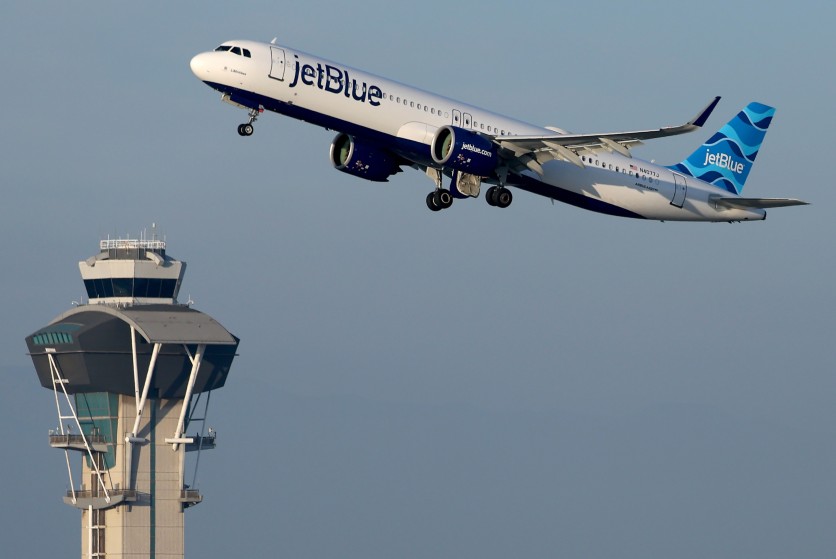
A JetBlue plane takes off from Los Angeles International Airport (LAX) on January 03, 2025 in Los Angeles, California. JetBlue has been fined $2 million by the Department of Transportation for ‘operating multiple chronically delayed flights’ which marks the first time an airline has received such a penalty. Mario Tama/Getty Images
A JetBlue Airways pilot reported Monday morning that a drone struck his Airbus A321 directly above the cockpit while the aircraft descended through 3,000 feet on final approach to John F. Kennedy International Airport — the fourth drone encounter reported near New York and New Jersey airports in four days and one of the few incidents in which a commercial passenger jet crew has reported actual contact with an unmanned aircraft anywhere in the United States.
The pilot, commanding JetBlue Flight 948 from Las Vegas, calmly radioed air traffic control at approximately 7:15 a.m. ET as the aircraft tracked its final approach over the New Jersey coast. "We collided with a drone back there in the turn," he said. When the controller asked him to confirm, the pilot replied: "Yep, it hit us right, right above the cockpit." The aircraft landed safely at 7:21 a.m. and all passengers deplaned normally.
A post-flight inspection of the Airbus A321 found no structural damage and no physical evidence of a collision. JetBlue said the aircraft was then released and flown to its next destination in Los Angeles. The Federal Aviation Administration confirmed it is investigating the pilot's report — and was careful to note only that the pilot reported a strike, not that one was confirmed, given the absence of physical evidence.
Pilot Reports Strike Above Cockpit at 3,000 Feet
Air traffic control audio recorded by ATC.com and circulated online Monday captured the exchange in detail. The aircraft was tracking its approach over the coast near Sea Bright, New Jersey — roughly 10 to 12 miles from JFK, according to flight-tracking data from Flightradar24 — when the pilot made his report.
"We are clear to land, 13 left," the pilot said, confirming his approach clearance before disclosing the collision. "Just quickly, I couldn't talk to approach, but we collided with a drone back there in the turn." After the controller asked for confirmation, the pilot added: "Yep, it hit us right, right above the cockpit." He told the controller the crew did not need assistance and was good to continue.
At 3,000 feet altitude on a commercial approach path, the drone operator would have needed explicit authorization from the FAA — and almost certainly did not have it. JFK sits inside Class B controlled airspace, a permanent restricted zone extending outward from the airport that prohibits drone operations without advance authorization obtained through the FAA's Low Altitude Authorization and Notification Capability system. Unauthorized entry into that airspace at the altitude and position the pilot described is a federal violation regardless of whether the operator knew the rules.
Four Incidents in Four Days Near New York Airports
Monday's reported strike was the fourth drone encounter near New York and New Jersey airports since June 26. On that Friday, the crew of United Airlines Flight 1513 — a Boeing 737 carrying 106 passengers and five crew members inbound from Key West, Florida — reported that a circular drone roughly three feet in diameter passed approximately 100 feet below their aircraft while on approach to Newark Liberty International Airport at about 5:20 p.m. ET. Shortly afterward, a separate crew flying a United Express regional jet operated by GoJet Airlines reported spotting a drone at approximately 2,000 feet on a similar approach into Newark. The FAA opened investigations into both Newark incidents.
An NYPD helicopter launched from Floyd Bennett Field in Brooklyn at approximately 8:00 a.m. Monday to search the Canarsie area for the drone reported by the JetBlue crew. At approximately 8:30 a.m., the helicopter crew reported "no joy" — aviation terminology for failing to visually locate a target.
The cluster of four incidents in four days comes as the region is under elevated security attention: Newark airport is roughly 15 miles from MetLife Stadium in East Rutherford, New Jersey, where FIFA World Cup matches are being played. The Transportation Security Administration has seized more than 300 drones near World Cup venues nationwide since the tournament began on June 11. Despite those seizures, drones appear to be reaching restricted commercial airspace.
The Foundation for Aviation Safety has documented 28 serious safety incidents involving drones reported to police since October 2024. The FAA receives more than 100 drone-sighting reports near airports each month — a figure the agency has cited consistently for years, even as the number of registered drones in the United States has grown to more than 865,000.
Read more: Guide to DJI Drone Registration and Drone Laws 2025: Navigating FAA, CAAS & CAA Rules
Why Remote ID Cannot Stop an Illegal Flight
The FAA has required nearly all registered drones to comply with Remote ID since September 16, 2023. Under 14 CFR Part 89, every qualifying drone in flight must continuously broadcast its identification number, position, altitude, velocity, and the location of its operator — a signal often described as a digital license plate for drones. Violations carry civil penalties of up to $75,000 per incident, and the FAA updated its enforcement policy in 2026 to require mandatory legal action for drone operations that endanger the public or violate airspace restrictions.
But Remote ID is a passive broadcast standard, not a real-time interception system. The drone transmits its information using short-range Bluetooth and Wi-Fi signals readable by smartphones and dedicated receivers. No airport or air traffic control facility in the United States is currently required to monitor Remote ID broadcasts from surrounding airspace, and there is no national detection network that would alert a controller when an illegal drone enters a restricted approach corridor. If no one with a receiver is monitoring the frequency, the broadcast goes unread.
The standard also has structural gaps. Drones weighing under 250 grams are exempt from Remote ID registration requirements. Home-built drones are exempt. And a category of drones sometimes called "dark drones" navigate entirely by GPS waypoints without any radio frequency transmission, making them invisible to traditional RF-based detection systems. Law enforcement organizations responding to a drone incursion near a commercial airport approach path cannot, in most cases, identify the operator in real time or take any interdiction action before the aircraft has already passed — as the NYPD helicopter's "no joy" result Monday morning demonstrated.
Until December 2025, only federal agencies — the Departments of Homeland Security, Justice, and Defense — held legal authority under federal law to take counter-drone action against an airborne drone. The SAFER SKIES Act, signed as part of the Fiscal Year 2026 National Defense Authorization Act, extended counter-drone mitigation authority to certified state, local, tribal, and territorial law enforcement agencies for the first time. But that authority requires individual officer certification, approved technology from a federal list, and significant coordination — none of which was in place in time to interdict the drone reported near JFK on Monday.
Drone technology has "outpaced counter-unmanned aircraft systems," a Federal News Network analysis published in May 2026 concluded, noting that Remote ID has laid important regulatory groundwork but that "federal agencies, airports, critical infrastructure operators and commercial detection systems are still working off separate airspace views." The U.S. Government Accountability Office has recommended that Congress amend statutory authorities related to drone detection and counter-drone operations at airports — a recommendation the Department of Transportation agreed with, but that has not yet produced mandatory airport-level detection infrastructure.
Chris Sununu, the president and CEO of Airlines for America and former governor of New Hampshire, testified before a Senate Commerce subcommittee on aviation that integrating drone safety regulation into all aspects of the national airspace is "absolutely integral. There can't be any loopholes."
What Happens When a Drone Hits a Commercial Jet
Whether the JetBlue aircraft actually collided with a drone remains unconfirmed. Post-flight inspections that find no physical evidence have previously reclassified alleged drone strikes as bird strikes or mechanical anomalies, and the FAA's own statement was carefully worded to reflect what the pilot reported rather than assert a collision occurred. Aviation safety investigators have noted that most bird strikes happen in the same altitude band — below 3,000 feet — where Monday's incident was reported, and that distinguishing bird strikes from drone strikes without recovered material can be difficult.
If a collision did occur, the structural stakes are significant. Research conducted by the University of Dayton Research Institute using a 2.1-pound DJI Phantom 2 quadcopter found that a drone striking the wing of a light civil aircraft at realistic speed punched through the wing and damaged the structural spar. As lead researcher Kevin Poormon noted, "while the quadcopter broke apart, its energy and mass hung together to create significant damage." European Aviation Safety Agency simulations have found that drones exceeding roughly four pounds can penetrate helicopter windscreens in several realistic collision scenarios, and that airliner windscreens can be critically damaged by drone components. Unlike bird carcasses, drone components — motors, circuit boards, and dense lithium-ion batteries — remain rigid and dense through an impact, making a drone strike of equivalent mass substantially more structurally dangerous than a bird strike.
The only confirmed U.S. commercial aviation drone collision to result in documented airframe damage and a federal prosecution involved a firefighting aircraft, not a passenger jet. On January 9, 2025, Peter Akemann, 56, of Culver City, California, flew his DJI Mini 3 drone more than 1.5 miles toward the Palisades Fire and lost control of it. The drone struck a Canadair CL-415 Super Scooper carrying two crew members, tearing a 3-by-6-inch hole in the left wing and grounding the aircraft during a fire that ultimately killed 12 people and destroyed entire Pacific Palisades neighborhoods. In September 2025, Akemann was sentenced to two weeks in federal prison, one month of home detention, and approximately $156,000 in restitution. "Operating a drone anywhere near an active wildfire and rescue operation was irresponsible, regardless of my intention to do no harm," he said at sentencing. Investigators recovered drone debris from the collision site — the physical evidence that the JetBlue investigation has not yet found.
Congress, Airlines Call for No Loopholes in Drone Enforcement
ABC aviation analyst John Nance reviewed Monday's audio and assessed the systemic risk directly: "The fact is that people are still not following the rules and all it takes is one to end up wrecking an engine or impacting a cockpit."
FAA Administrator Bryan Bedford is personally overseeing investigations into both the JetBlue JFK incident and the earlier United Airlines Newark near-miss. The FAA has emphasized that unauthorized drone flights near airports and aircraft carry civil penalties of up to $75,000 per violation and potential criminal charges under federal law, and that its 2026 enforcement policy now mandates legal action — not discretionary compliance conversations — when drone operations endanger the public or violate airspace restrictions.
The Fourth of July travel week beginning June 30 is expected to see the Transportation Security Administration screen nearly 18.7 million passengers at U.S. airport security checkpoints. The New York metropolitan area, which handles roughly 130 million passengers annually across JFK, Newark, and LaGuardia, remains one of the most drone-congested airspace regions in the country.
What Are the Penalties for Flying a Drone Near an Airport
Unauthorized drone operations near airports and in controlled airspace are a federal violation under FAA regulations. Civil penalties can reach $75,000 per incident. Criminal charges are possible in cases involving reckless endangerment, with potential prison time of up to one year for unsafe operation of an unmanned aircraft — the charge Peter Akemann pleaded guilty to in the Palisades Fire Super Scooper case. Operators are also personally liable for any property damage caused. Drone insurance policies universally exclude flights conducted in violation of FAA regulations, meaning an operator responsible for a collision faces any financial judgment with no insurance backstop.
The FAA's B4UFLY app provides pre-flight airspace information allowing operators to check restrictions before takeoff. JFK, Newark, and LaGuardia all sit within permanent Class B no-fly zones that appear automatically in the app.
Frequently Asked Questions
What happens if a drone hits a commercial airplane?
A drone striking a commercial jet can cause significant structural damage depending on the size, speed, and point of impact. Research simulations have found that drone components — including rigid motors and dense lithium-ion batteries — cause more structural damage than a bird of equivalent mass because they do not deform on impact. Studies by the University of Dayton Research Institute and the European Aviation Safety Agency have found that drones can penetrate aircraft windscreens and damage wing spars in realistic collision scenarios. The January 2025 strike on the Los Angeles wildfire Super Scooper is the clearest U.S. example: a sub-2-pound DJI Mini 3 tore a 3-by-6-inch hole in a metal wing and grounded the aircraft for five days during an active wildfire emergency.
Why can the FAA's Remote ID mandate not stop drones from entering airport airspace?
Remote ID requires most registered drones to broadcast their identification and position in real time — but it is a passive broadcast standard, not an interdiction system. No airport or air traffic control facility is currently required to monitor Remote ID signals from surrounding airspace, and there is no national detection network that alerts controllers when an illegal drone enters a restricted approach corridor. Drones under 250 grams and home-built drones are fully exempt from Remote ID. "Dark drones" that navigate by GPS waypoints emit no radio frequency signal at all. Remote ID gives investigators a tool to identify who was flying a compliant drone after the fact; it does not stop an illegal flight while it is happening.
Are drones dangerous to aircraft during landing?
Yes — especially during final approach and landing, which aviation safety experts describe as the most critical flight phase. Aircraft operate at lower altitudes and reduced speed near runways, leaving pilots with minimal room to maneuver if an unexpected object appears. The rigid components of a drone — particularly its lithium-ion battery pack — pose a structurally more severe threat than a bird strike of the same weight. A drone ingested into a turbine engine or striking the cockpit windscreen area at approach speed can disable avionics, cause structural failure, or start a fire in a part of the aircraft where standard suppression systems are not designed to reach.
What is the penalty for flying a drone near an airport without authorization?
Civil penalties can reach $75,000 per violation under FAA regulations. Criminal charges are also possible, carrying potential prison time of up to one year for unsafe operation of an unmanned aircraft — the charge Peter Akemann pleaded guilty to in the 2025 Palisades Fire Super Scooper case. Operators are also personally liable for property damage, and virtually all drone insurance policies exclude coverage for illegal flights, leaving an operator fully exposed to any restitution order. The FAA's 2026 enforcement policy now mandates formal legal action for violations that endanger the public, removing the previous option of resolving incidents through compliance discussions.

-
 C114 Communication Network
 -
 Communication Home
