
 Search

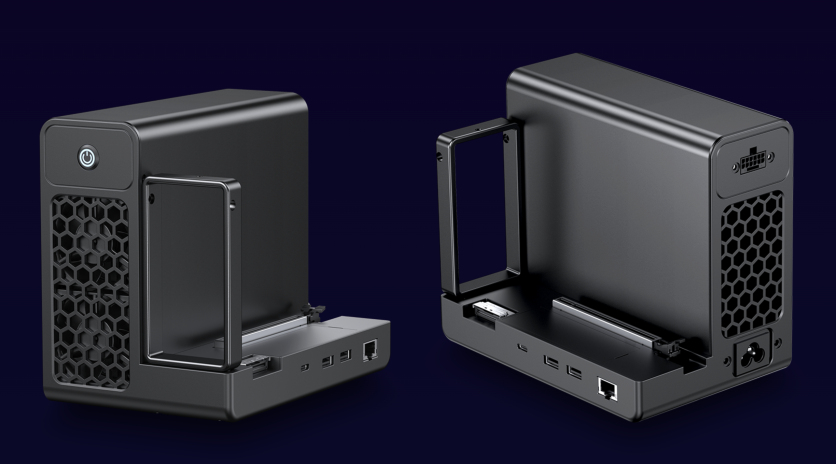
GPD G2 gpd.hk
The external GPU market has long operated under one structural compromise: no matter how powerful the card inside the enclosure, the connection between that card and the host computer bleeds performance. The cable has always been the ceiling. Today, GPD launched the G2 on Indiegogo at an early-backer price of $385 — a 20 percent discount from its planned $459 retail price — built around a connector standard that had, until now, lived exclusively in server racks: MCIO 8i. The company claims the result is a two-percent performance loss when connecting a desktop RTX 4090 externally, a figure no Thunderbolt or OCuLink setup has come close to producing. That claim has not been independently benchmarked, but the architecture behind it represents a genuine step change in how external GPU connections work.
What MCIO 8i Is, and Why PCIe Bandwidth Changes Everything
Every eGPU enclosure on the market today reaches a host computer through one of two paths. Thunderbolt — including Thunderbolt 5 — tunnels PCIe data through an Intel controller chip, translating between protocols in both directions and adding latency overhead at each step. OCuLink, which became the performance ceiling for gaming handhelds and mini PCs, avoids that tunneling by carrying native PCIe signals, but tops out at PCIe 4.0 using four lanes: 64 gigabits per second bidirectional.
MCIO, which stands for Mini Cool Edge IO, was developed by Amphenol and adopted by the PCI-SIG in 2021 as a standard connector for server and high-performance computing environments, where it routes signals between NVMe drive arrays and PCIe expansion cards inside 1U rack chassis. Its defining characteristic in this context is lane density: where OCuLink's SFF-8611 connector physically supports four PCIe lanes, MCIO's 74-pin variant supports eight, doubling the lane count available to an externally connected GPU.
With eight PCIe 4.0 lanes active, the G2's MCIO 8i connection delivers 256 gigabits per second of bidirectional throughput — four times the bandwidth of OCuLink and more than three times what Thunderbolt 5 can supply to a GPU. The G2's dock hardware physically supports PCIe 5.0, which would push that figure to 512 gigabits per second, but GPD has confirmed a real-world constraint: running MCIO 8i and USB4 v2.0 simultaneously on the same board creates signal interference that limits the MCIO link to PCIe 4.0 speeds. PCIe 4.0 x8 at 256 gigabits per second still outpaces every consumer-facing eGPU connection standard available today.
The GPU slot inside the enclosure operates at PCIe 5.0 x16 with eight active lanes, which means the G2 can physically seat any current desktop card, including NVIDIA's RTX 50-series and AMD's RX 9000-series.
The Performance Gap the Architecture Is Built to Close
Traditional eGPU setups using Thunderbolt 3 or 4 delivered anywhere from 70 to 90 percent of the desktop GPU's potential output, depending on workload and resolution. Thunderbolt 5 has narrowed that deficit, but independent reviews measuring eGPU performance against native PCIe setups have consistently found 15 to 20 percent gaps in gaming workloads even at the newer standard's maximum bandwidth. OCuLink, because it avoids the protocol tunneling layer and delivers a direct PCIe connection, performs better than Thunderbolt in most GPU-heavy tasks — but its four-lane ceiling still constrains the latest high-end cards when VRAM transfer loads are heavy.
GPD claims the G2 reduces that gap to roughly two percent when connected via MCIO 8i to a desktop RTX 4090. Independent benchmarks do not yet exist to confirm this figure — the G2 has not shipped — but the architectural reason the claim is plausible is the lane count: an RTX 4090 running at PCIe 4.0 x8 in a desktop slot delivers performance indistinguishable from PCIe 4.0 x16 for most gaming workloads, because the card's actual bandwidth demand at typical frame rates sits comfortably below the x8 ceiling.
Power, Ports, and What the G2 Actually Is
GPD is not positioning the G2 as a single-purpose enclosure. The dock includes an 800W Gold-rated ATX 3.1 server-grade power supply with a 12V-2×6 connector for the graphics card, two USB 3.2 Gen 2 Type-A ports, Gigabit Ethernet, and an M.2 2280 slot wired over PCIe 3.0 x2 for local storage expansion. A USB4 v2.0 port — which runs at 80 gigabits per second symmetric — provides 100W Power Delivery, meaning the dock can charge a connected laptop or gaming handheld over the same cable used for data.
That dual-port design — MCIO 8i alongside USB4 v2.0 — gives the G2 reach beyond GPD's own product line. The USB4 v2.0 port extends compatibility to any laptop or handheld carrying a USB4 or Thunderbolt 5 port, even devices that have no MCIO connector. The MCIO channel, however, requires a host with an MCIO port, which today means the GPD BOX 356H almost exclusively.
The GPD BOX Connection and the Ecosystem Question
GPD launched the G2 alongside the GPD BOX, a mini PC built on Intel's Core Ultra third-generation platform, codenamed Panther Lake. The BOX 356H model includes an MCIO 8i port with eight PCIe 5.0 lanes routed to it for external graphics; the higher-end 358H uses a chip whose PCIe lane allocation is smaller and accordingly omits the MCIO connector. GPD is offering a combined BOX plus G2 bundle through the Indiegogo campaign.
The ecosystem question is the G2's most significant current limitation. MCIO 8i is virtually absent from consumer hardware outside of this specific GPD pairing. One other manufacturer, TOPC, has announced the TA255 mini PC with an MCIO port, suggesting the category is beginning to form — but buyers who purchase a G2 today with the intent of using it at full MCIO bandwidth will need either the GPD BOX 356H or a future MCIO-equipped device. The USB4 v2.0 fallback means the dock is not a stranded asset if the MCIO ecosystem develops slowly, but the near-native performance claim is exclusively tied to the MCIO connection.
What This Means for Gaming Handhelds and Mini PCs
The original promise of external GPU setups was that a portable or compact machine could use a desktop-class graphics card when docked, then revert to its mobile form factor when unplugged. Thunderbolt made that architecturally possible but left a performance penalty large enough that the math rarely justified the hardware cost. OCuLink improved the equation for buyers willing to accept a specialized connector and the loss of hot-swap capability, but its lane ceiling remained a constraint for the most demanding workloads and the latest flagship GPUs.
MCIO 8i, if the ecosystem develops, closes the remaining gap at the connection level — and does so by bringing a server-class interconnect into a consumer enclosure for the first time. The distinction matters because it means the eGPU performance deficit is no longer an architectural inevitability of the external form factor. It is now a function of which connector a host device ships with. That shifts the question from "how much performance must I sacrifice to go portable?" to "does my next mini PC or handheld include MCIO?"
The remaining variables are ecosystem breadth and whether independent benchmarks confirm GPD's internal performance figures when the product ships in August 2026. At $385 for the dock alone — GPU not included — the G2 sits above typical Thunderbolt enclosures but below the cumulative cost of a comparable OCuLink setup with an equivalent power supply.
GPD Is a Chinese Company: What Buyers Should Know
GPD — formally Shenzhen GPD Technology Co., Ltd. — is headquartered in Nanshan, Shenzhen, China. As a Chinese company, GPD is subject to three interlocking national laws that create structural data-sharing obligations regardless of where the company markets or sells its products.
China's National Intelligence Law (2017) requires, under Article 7, that all organizations and citizens support, assist, and cooperate with national intelligence work. China's Cybersecurity Law (2017) mandates that network operators store data within China and provide technical assistance to state security agencies on request. China's Data Security Law (2021) extends those requirements to data handling activities more broadly.
For the G2 specifically, the practical privacy implications are limited: the G2 is passive hardware. It is an enclosure containing a power supply, PCIe slot, and USB ports. It does not run an operating system, does not connect to the internet independently, does not collect telemetry, and does not transmit user data to any server. No backdoor, security vulnerability, or government data-access incident has been documented for any GPD product in any independent security audit, and no such audit has been publicly conducted.
The structural legal obligations above apply to GPD as a corporate entity operating under Chinese law, not to the G2 dock as a device. Buyers purchasing a passive GPU enclosure from a Chinese manufacturer face a different risk profile than buyers of a Chinese-manufactured smartphone, router, or connected device — categories where active data collection is built into the product's function. The legal framework is worth understanding; the device-level risk for the G2 is not comparable to connected hardware.
Should You Back the G2 on Indiegogo?
Crowdfunding carries inherent delivery risk. GPD has run multiple successful Indiegogo campaigns, but the company has experienced supply-chain-driven shipping delays before — the Win Max 2 in 2023 saw delays when a chip supplier failed to deliver on schedule. The August 2026 ship window is a target, not a guarantee. Buyers backing the G2 at the $385 early-backer price are securing a 20 percent discount against the planned $459 retail price, but they are also accepting the standard crowdfunding tradeoff: reduced price in exchange for earlier commitment and the associated risk.
The campaign is live at Indiegogo now. The G2 ships without a graphics card, which buyers must source separately.
Specs at a glance:
| Feature | Detail |
|---|---|
| Host interfaces | MCIO 8i (PCIe 4.0 x8 effective, 256 Gbps bidirectional), USB4 v2.0 (80 Gbps symmetric) |
| GPU slot | PCIe 5.0 x16 (x8 active) |
| Power supply | 800W Gold-rated ATX 3.1 |
| GPU power connector | 12V-2×6 (16-pin) |
| Storage expansion | M.2 2280 (PCIe 3.0 x2) |
| Additional ports | 2× USB 3.2 Gen 2 Type-A, GbE LAN, 100W USB PD |
| Early backer price | $385 (MSRP $459) |
| Estimated ship date | August 2026 |
Frequently Asked Questions
What is MCIO 8i and how is it different from OCuLink for external GPUs?
MCIO (Mini Cool Edge IO) is a connector standard developed originally for servers and high-performance computing environments, standardized by the PCI-SIG under the SFF-TA-1016 specification. Where OCuLink carries PCIe signals over four lanes — delivering 64 gigabits per second at PCIe 4.0 speeds — MCIO 8i carries eight lanes, doubling the available bandwidth to 256 gigabits per second. Both deliver a native PCIe connection without the protocol tunneling overhead that reduces Thunderbolt's effective throughput, but MCIO 8i's additional lanes are what GPD claims eliminate nearly all remaining performance loss versus a desktop PCIe slot.
Is an external GPU as good as a desktop GPU when connected via MCIO 8i?
GPD claims a two-percent performance loss when connecting a desktop RTX 4090 via MCIO 8i, compared to typical losses of 15 to 25 percent over Thunderbolt or OCuLink setups in demanding workloads. That claim has not been independently verified — no external reviewer benchmarks exist because the G2 has not yet shipped. The architectural case for the claim is sound: an RTX 4090 running at PCIe 4.0 x8 in a desktop produces performance indistinguishable from PCIe 4.0 x16 for most gaming workloads, and MCIO 8i delivers a native PCIe 4.0 x8 connection without tunneling overhead.
Does the MCIO 8i port on the GPD G2 work with any laptop or gaming handheld?
No. The MCIO 8i connection requires a host device with an MCIO port, which as of June 2026 means the GPD BOX 356H mini PC and the TOPC TA255, with very few other options commercially available. The G2 also includes a USB4 v2.0 port, which connects to any Thunderbolt 5 or USB4-equipped laptop or handheld at 80 gigabits per second — an improvement over earlier USB4 speeds, but below MCIO 8i's ceiling and without the native-PCIe-connection advantage.
What are the risks of buying a GPU dock from a Chinese manufacturer?
The G2 is passive hardware — it does not run an operating system, collect data, or connect to the internet — so the direct device-level privacy risk is low compared with connected Chinese-manufactured products. However, GPD as a company is legally subject to China's National Intelligence Law (2017), Cybersecurity Law (2017), and Data Security Law (2021), which require cooperation with Chinese government intelligence requests. These obligations apply to the company, not to this specific passive device. As with any crowdfunded hardware from an overseas manufacturer, buyers should also factor in delivery timeline risk: GPD has experienced supply-chain-driven delays on prior campaigns.

-
 C114 Communication Network
 -
 Communication Home
