
 Search

Credit: Telly
Telly, a company that accepts advertising data instead of cash for its TVs, has reportedly had a hard time getting its “free” TVs into people’s homes.
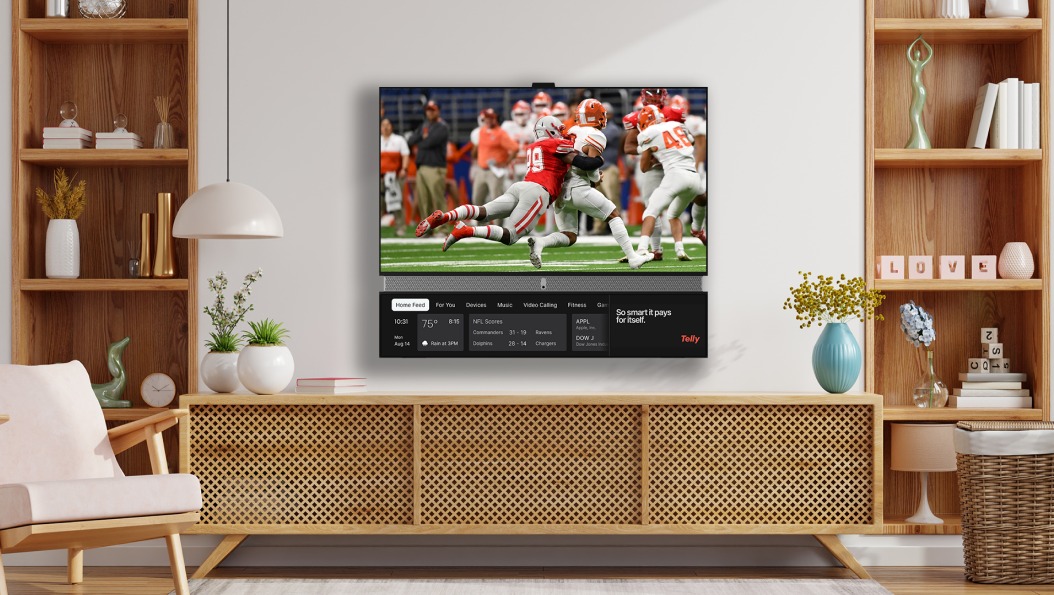
Telly debuted in May 2023. Its dual-screen design can show ads, even when people aren’t watching. Although the smaller, secondary screen can be used for more helpful applications, like showing the weather or sports scores, its primary purpose is to serve as a billboard south of the 55-inch primary display. Owners cannot disable tracking or cover up the secondary screen (or they have to pay for the TV, which Telly claims is worth $1,000), and they must fill out a lengthy, detailed survey to get one.
When it debuted its TV, Telly said it expected to ship 500,000 devices that summer. In June 2023, the startup said 250,000 people signed up to get a Telly. In a 2024 press release, Telly said that it planned to ship “millions more in 2024.”
But a report from Lowpass this week, citing a “Q3 update sent to investors in November 2025,” said the startup had 35,000 TVs in people’s homes at that time. In Q2 2025, there were 28,000 Telly TVs in use, the note said, according to Lowpass.
The publication reported that the investor note suggests Telly will order 100,000 TVs from supplier Foxconn and increase deliveries soon.
Telly declined to comment to Lowpass and didn’t respond to Ars Technica’s requests for comment.
Shipping problems
So what gives? Based on early registration numbers, it seems Telly has generated enough interest to ship more than 35,000 TVs.
One issue seems to be poor shipping. Per the investor note that Lowpass reviewed, Telly claimed that FedEx delivered 10 percent of its shipments of Telly TVs broken. Since moving to a different company—seemingly Samsung partner RXO, based on Reddit posts—fewer Tellys are arriving broken, the company reportedly said.
As Lowpass noted, dozens of online complaints claim that the free TVs, which ship directly from Telly, were broken upon arrival. The Verge also reported receiving a broken unit in September.
A Reddit user posted this image a year ago, suggesting that their Telly TV arrived defective.
Credit: DimensionSimple7426/Reddit
Today, the subreddit dedicated to Telly TVs seems to show numerous other technical difficulties Telly users are experiencing. Technical complaints are common on subreddits for tech gadgets, but the forum highlights the problems Telly owners might encounter.
Telly’s reported failure to meet its high shipment goals or even fulfill reported demand demonstrates the scaling complexities startups can face. While some companies struggle to get people interested in their product, Telly’s “free” pitch has been successful enough to lure thousands. But in its early stages, Telly has reportedly struggled with its direct-to-consumer model and smaller team compared to other TV makers.
Ad-based TV
Still, Telly’s ad-centric business model may be starting to show its value. The investor update reportedly said Telly made $22 million in annualized revenue in Q3 2025. This could equate to about $52 in advertising revenue per Telly in use per month ($22 million divided by 35,000 TVs divided by 12 months in a year is $52.38).
That’s notably more than what other TV companies report, as Lowpass pointed out. As a comparison to other budget TV brands that rely heavily on ads and user tracking, Roku reported an average revenue per user (ARPU) of $41.49 for 2024. Vizio, meanwhile, reported an ARPU of $37.17 in 2024.
The investor note reportedly said that Telly recently raised $350 million in debt funding over two rounds. The note didn’t specify when the funding occurred or how much equity Telly has raised overall.
As smart TVs at every price point increasingly rely on software-integrated advertisements and user tracking to offset declining hardware margins and rising competition, Telly argues that its premise is forward-thinking, not far-fetched. Some longtime Telly users point to the sets’ decent image and audio quality but question their reliance on an (included) streaming stick to access popular apps, their default AI-avatar home screen, and repetitive ads.
The Verge writer Emma Roth said her Telly showed her “three of the same ads in Spanish (which I don’t speak) in a row.” There’s also concern about potentially invasive uses of the TV’s integrated camera and mic.
As the leaked investor report highlights, there are plenty of other challenges standing in the way of free, ad-supported TVs. Still, Telly’s early ARPU figures are notable enough to keep the idea alive.

-
 C114 Communication Network
 -
 Communication Home
