
 Search

(Image credit: Future / Chris Hall)
A new category of mobile game is taking advantage of folding phone hardware and integrating the hinge into the game's design. It's an interesting approach to the new tech, but could lead to increased wear and tear on devices.
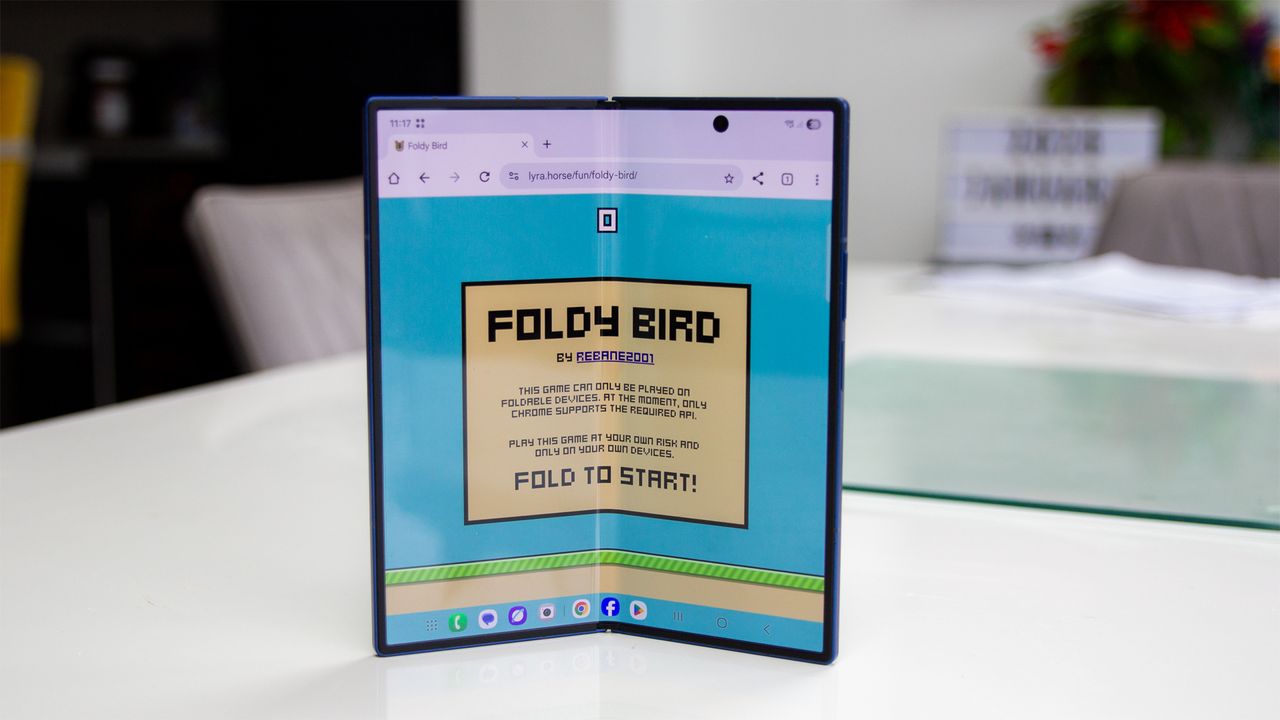
Uncovered by 9to5Google, new games like Foldy Bird and Kami let the player use the hinge on their phone to control the game. Kami is an origami game, letting you fold paper by folding your phone – a simple idea.
Foldy Bird on the other hand is another iteration of Flappy Bird, this time using the folding action of the phone to jump. It's hardly the best version of the game, but it's definitely creative.
The downside is that you might end up folding your phone a lot more than normal. The hinges on folding phones are tested to a particular number of folds, which lets the manufacturer guarantee them for a certain number of years.
If you're then throwing in hundreds of additional folds a day because you're addicted to an origami game, you're going to age your device a lot faster. This is a browser based game, so it's accessible on devices like the Samsung Galaxy Z Fold 7.
You can find Foldy Bird here and Kami here.
Neither of these titles are the gaming future that we want from folding phones, which so far haven't demonstrated their ability to game in the best of lights.
Part of the problem is that the display on a folding phone is still more fragile than a traditional candy bar device. I personally have experienced creasing in the OLED layer when putting repeated pressure into a particular spot on a phone, which is common when playing games with on-screen controllers like Call of Duty Mobile.
What we're yet to really see is games that take advantage of the larger display. Most games are designed for traditional phones and then scaled up for the larger displays of tablets or folding phones. In some cases the UI doesn't fit properly, but in most cases, things are often just bigger.
For games to really get the best out of larger displays, they need to use the space more effectively, designed to be played across a larger canvas. As folding phones move into the mainstream, perhaps we'll see a new wave of real-time strategy games that can take advantage of the space for a better mobile gaming experience.
Let's hope so.

-
 C114 Communication Network
 -
 Communication Home
