
 Search

Phonemax
In a CES landscape often dominated by delicate glass slabs and folding screens that feel more like jewelry than tools, Phonemax stands as a reminder of the "Quietly Outstanding" side of mobile tech. For over 13 years, the Shenzhen-based manufacturer has carved out a niche as a specialized OEM/ODM partner for the toughest environments on Earth, and their 2026 showcase highlights an aggressive expansion into integrated industrial hardware.
The Rise of the "All-in-One" Workhorse
Phonemax is not trying to compete with Apple or Samsung for the average consumer's pocket. Instead, they are doubling down on what they call "rocket smart devices"—highly durable, ruggedized phones and tablets designed for military, construction, and logistics applications.
The defining theme for 2026 is the integration of high-end specialized sensors directly into their durable chassis.
"For 2026, we'll still do the same direction. But we will try to add some different features," a Phonemax representative shared during a booth interview. "Like adding the thermal imaging to the device, adding the barcode scanner. So like an all-in-one device... For this year, I think thermal imaging is the big interest."
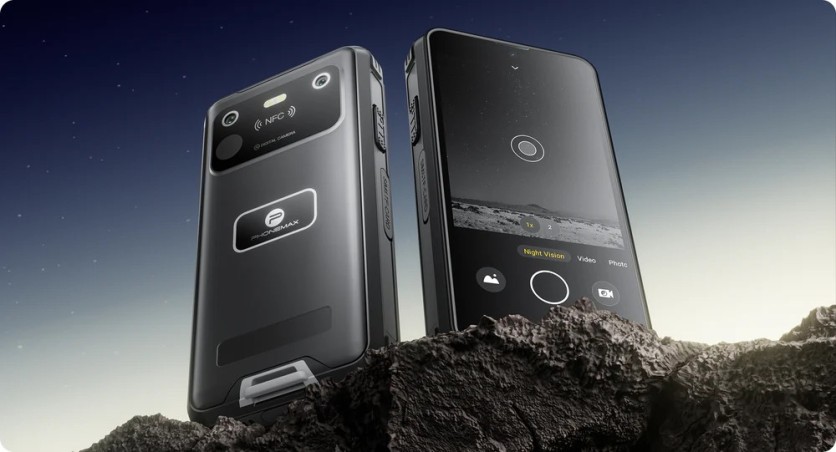
One of the standout models at their booth is the R4GT, which the company bills as the "World's Smallest Thermal Imaging Night Vision Rugged Phone." Despite its compact 4.3-inch display, it packs a serious industrial punch: a 64MP main camera paired with a 20MP night vision sensor and a high-resolution thermal imaging camera.
Phonemax
Engineering for Extremes
A "positively critical" assessment of Phonemax's strategy reveals a company that understands its limitations and plays to its strengths. They openly admit they aren't the biggest name in the market, but they use that agility to offer services the giants cannot.
"I think Phonemax, we are not as famous as our competitor and maybe as not as big as them," the staff member noted. "But we provide very flexible support and service... [our phones] are more durable than normal regular phones."
This flexibility is evident in their pricing and wholesale model. With wholesale prices ranging from $80 to $300 per unit, Phonemax is democratizing access to industrial tools that were once prohibitively expensive for small logistics firms or independent contractors. Their Rocky series devices come with IP68/IP69K waterproof and dustproof ratings, reinforced rubberized frames, and massive batteries—some reaching up to 12,000mAh—ensuring multiple days of standby time in the field.
The 2027 Vision: Portability without Compromise
Looking ahead to CES 2027, Phonemax is planning to challenge the current definition of the "rugged tablet." The staff hinted at a new form factor that merges the durability of their current line with the utility of a laptop.
"We are trying to bring some unique products that nobody else has," the representative teased. "Maybe like, for example, we may do maybe 20 inch, like very portable, very slim design tablets and can use as a notebook, you know something it's very portable."
Critical Takeaway: Niche Dominance
While some might argue that the lack of 5G in their most popular compact models like the R4GT is a drawback, Phonemax prioritizes "meaningful utility" over the latest network speeds. For a search-and-rescue team or a warehouse manager, the ability to see heat signatures or scan 1D/2D barcodes with a Honeywell scanner head is far more valuable than 5G connectivity.
Phonemax is a company that has successfully moved away from being a generic manufacturer to becoming a "quietly outstanding" specialist. In a world of fragile electronics, their 2026 lineup proves that there is still a massive, hungry market for devices that can take a beating and keep on working.

-
 C114 Communication Network
 -
 Communication Home
