
 Search


OneXPlayer
LAS VEGAS — As the neon lights of the Las Vegas Strip flicker with the energy of CES 2026, the halls of the convention center are buzzing with a different kind of power. Amidst a sea of tech giants, OneXPlayer has carved out a commanding presence, not just as a manufacturer of handheld PCs but as a vanguard of a new era in portable computing.
For years, the dream of "AAA gaming in the palm of your hand" was a compromise between performance and portability. But at this year's show, OneXPlayer is proving that those days are over. By leveraging the latest breakthroughs in AI-driven silicon, SDR-enhanced displays, and unconventional form factors, the company is redefining what it means to be a "gamer on the go."
The Star of the Show: The Super V and the Panther Lake Revolution
The headline of OneXPlayer's 2026 showcase is undoubtedly the Super V. In a strategic coup, the company announced this new flagship tablet just moments after Intel pulled the curtain back on its highly anticipated Panther Lake lineup.
The Super V is a testament to the "3-in-1" philosophy that has become a hallmark of the brand—part high-performance gaming handheld, part sleek productivity tablet, and part ultra-portable laptop.
- Intel Power: Under the hood, the Super V is powered by the Intel Core Ultra X7 358H, a beast of a processor featuring 16 cores.
- The Arc B390 Leap: The real magic lies in the integrated Arc B390 GPU. In a move that has sent shockwaves through the handheld community, this GPU is touted to be up to 82% faster than the Radeon 890M from AMD's Strix Point lineup when running at 53W.
- A Visual Feast: The device boasts a stunning 2.8K OLED display. By moving toward OLED, OneXPlayer is addressing one of the last remaining hurdles for handhelds: perfect blacks and infinite contrast, ensuring that games look as vibrant in a dimly lit plane cabin as they do on a high-end desktop monitor.
- Precision Input: For the creators and professionals in the crowd, the Super V supports a 4096-level pressure-sensitive stylus, turning a gaming powerhouse into a legitimate digital canvas.
The AI Edge: More Than Just a Buzzword
While "AI" is the ubiquitous term of CES 2026, OneXPlayer is demonstrating its practical application in the palm of the hand. The company isn't just using AI for marketing; they are weaving it into the very fabric of the user experience.
One of the most impressive demonstrations at the booth involves intelligent upscaling. By utilizing the NPU (Neural Processing Unit) found in the latest chips, OneXPlayer devices are now capable of sophisticated AI-driven frame generation and resolution enhancement. This allows demanding titles like Cyberpunk 2077 to run at high frame rates on a battery-powered device without the typical "blur" associated with traditional scaling methods.
Furthermore, the company is experimenting with AI-driven energy management. The system can now analyze a game's current workload in real-time—recognizing, for instance, when a player is in a quiet dialogue scene versus a high-octane firefight—and dynamically adjust power consumption to squeeze every possible minute out of the battery.
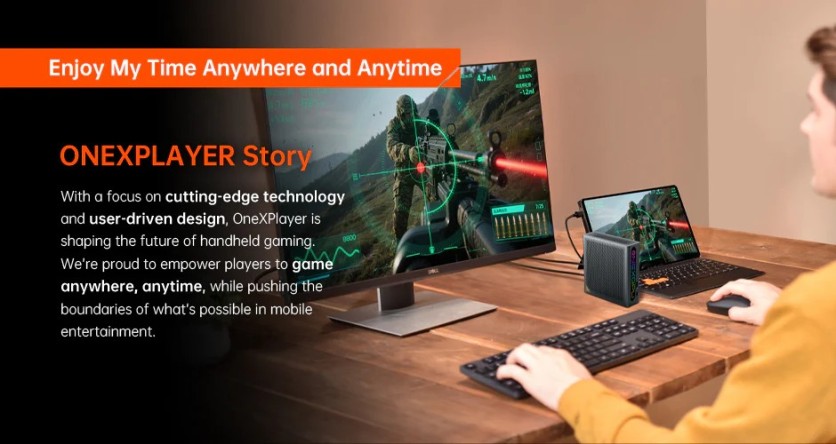
OneXPlayer
SDR and the Quest for Visual Perfection
A recurring theme in OneXPlayer's 2026 presentation is the refinement of the display experience. Beyond just resolution and refresh rates, the company is focusing on SDR (Standard Dynamic Range) intelligence.
The goal is to provide a "more energy-efficient" visual experience that doesn't sacrifice clarity. By utilizing "intelligent" software to enhance SDR content, OneXPlayer is able to provide an HDR-like experience—with bright highlights and deep shadows—on screens that are optimized for the lower power envelopes of handheld devices. This is critical for mobile gamers who want the "pop" of modern graphics without the massive battery drain typical of high-brightness HDR panels.
From Apex to Mini: A Device for Every Hand
While the Super V targets the ultra-enthusiast, OneXPlayer is showcasing a diverse fleet of hardware that ensures no gamer is left behind.
- The OneXFly Apex: This device is a marvel of miniaturization. As one of the first liquid-cooled gaming handhelds, the Apex uses the AMD Strix Halo chip to deliver performance that was unthinkable in this form factor just two years ago. It's a bold statement that "small" no longer has to mean "slow."
- The X1 Air: For those who prioritize weight, the X1 Air remains a favorite. Crafted from aviation-grade aluminum and weighing only 789g, it offers a massive 72.77Wh battery—enough for up to 17 hours of use in productivity mode.
- OneXGPU 2 & 3: Recognizing that even the best handhelds have limits, OneXPlayer continues to lead the eGPU (External GPU) market. These compact boxes allow users to plug their handheld into a desktop-class graphics card when they get home, instantly transforming a portable device into a 4K gaming rig.
Positively Critical: The Software Frontier
Despite the hardware brilliance, the "handheld PC" category still faces a fundamental challenge: Windows. While OneXPlayer's hardware is world-class, the Windows 11 operating system wasn't originally designed for small touchscreens and joysticks.
OneXPlayer is meeting this challenge head-on with OneXConsole. This custom software layer acts as a "bridge" between the user and the PC, allowing for one-click performance adjustments, fan control, and game library management. However, as competitors move toward SteamOS for a more "console-like" experience, the pressure is on OneXPlayer to continue refining its software suite to ensure that the user experience is as seamless as the hardware is powerful.
Looking Toward 2027: The Era of Intelligent Mobility
As the interview with OneXPlayer representatives at the booth concluded, the focus shifted to the horizon. "Next year, I do not want to walk into hand," a representative teased, hinting at a future where the interaction with our devices becomes even more natural.
The roadmap for CES 2027 is centered on "intelligent" energy and deeper AI integration. We can expect to see devices that are not just "handheld PCs," but proactive companions that understand the player's needs. This could mean everything from controllers that adapt their haptic feedback based on the player's stress levels to batteries that utilize revolutionary new chemistries for even longer play sessions.
"We're trying to watch AI also," the representative shared, underscoring that the company is no longer just in a race for higher clock speeds. They are in a race for a smarter, more intuitive, and ultimately more human way to play.
The OneXPlayer Legacy
Born just five years ago as an ambitious spin-off of the One-Netbook team, OneXPlayer has grown with staggering speed. From the world's first 7-inch gaming pocket PC equipped with Intel Tiger Lake to the liquid-cooled monsters of today, the company's trajectory is a testament to the power of focused engineering.
In the crowded halls of CES 2026, OneXPlayer has proven that it is no longer a "startup" to be watched—it is the standard to be met. By refusing to compromise on the dream of high-end portable gaming, they are ensuring that the future of play is not tethered to a desk, but is as mobile, intelligent, and vibrant as the gamers themselves.

-
 C114 Communication Network
 -
 Communication Home
