
 Search


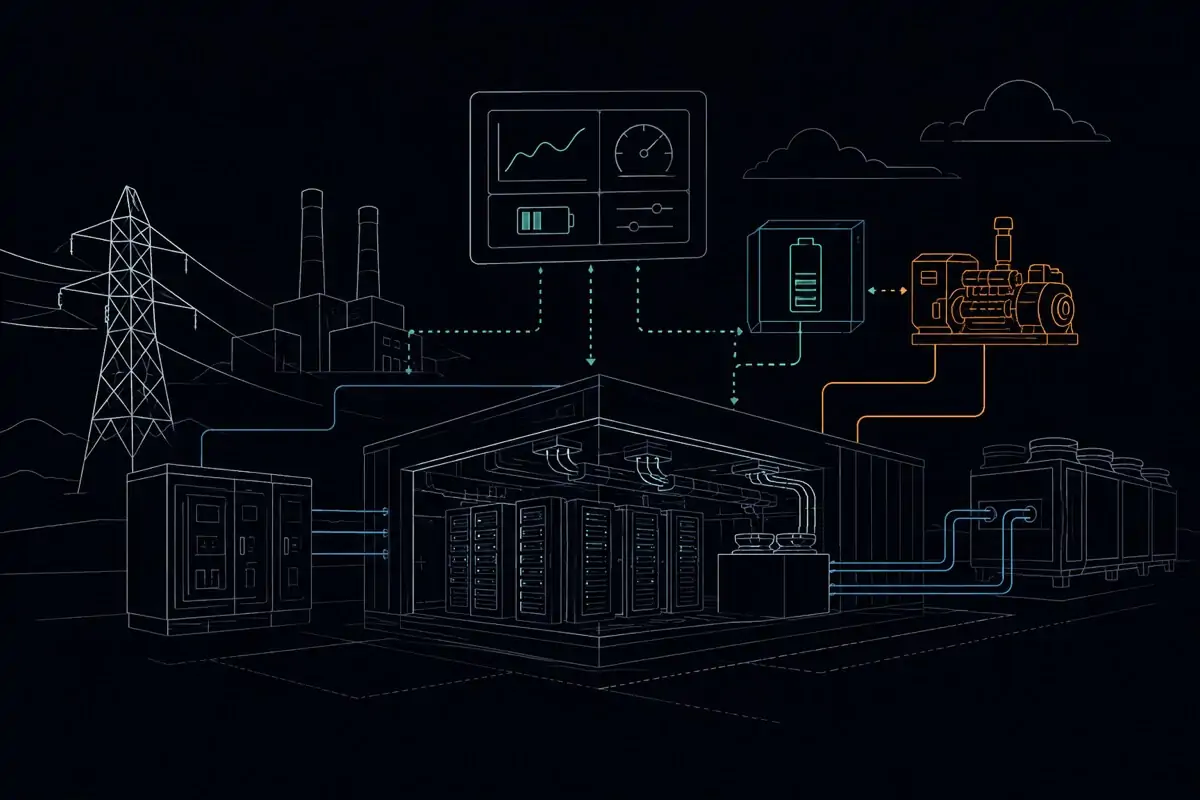
Vertiv is expanding its electrical infrastructure portfolio for AI and high-performance computing data centers with two products addressing different sections of the power chain: PowerNexus MV UPS, an outdoor medium-voltage uninterruptible power system for utility-side protection and dynamic load management, and PowerStation 3100, a high-density remote power panel for distribution inside compute facilities. The announcements address both grid-facing power disturbances and the increasing current requirements of AI data halls.
The PowerNexus MV UPS is rated at 3.0 MVA and 34.5 kV with up to 98.5% peak efficiency. Its line-interactive design combines UPS protection, fault ride-through and AI power smoothing in an outdoor skid architecture that can integrate battery energy storage for up to four hours of backup. Vertiv expects shipments to begin in mid-2027. Demonstrations with QTS, SoftBank and Rosendin at Vertiv’s Bologna research facility tested dynamic loads from zero to full capacity, a complete voltage sag for 150 milliseconds and a 25% overvoltage lasting five seconds. A dedicated medium-voltage laboratory in Bologna is planned to become operational in 2027.
The PowerStation 3100 supports 600A, 800A, 1,000A and 1,200A configurations in a 90-by-38-by-16-inch enclosure. The remote power panel supports up to 22 three-pole molded-case circuit breakers with branch outputs of up to 150A per circuit, a 100%-rated main breaker with 65 kA interrupting capacity, circuit-level metering and front-only servicing. PowerStation 3100 is intended for AI, HPC, neocloud and colocation facilities; its role in low-voltage data-hall distribution is distinct from the campus-level PowerNexus MV UPS.
Kyle Keeper, senior vice president of Vertiv’s power management business unit, said: “The Vertiv PowerNexus MV UPS is designed as a system-level response to those challenges.”
| Vertiv | AI Power Infrastructure — Key Specifications | |
| PowerNexus MV UPS | • Outdoor medium-voltage UPS at utility connection • 3.0 MVA rated power; 34.5 kV operating voltage • Up to 98.5% peak efficiency • 1–4 hours backup with integrated battery storage • Fault ride-through, AI load smoothing and Class 1 voltage quality • Shipments expected mid-2027 |
| PowerNexus validation | • QTS, SoftBank and Rosendin proof-of-concept demonstrations in Bologna • 100% voltage sag for 150 ms; 25% overvoltage for 5 seconds • Dedicated Bologna medium-voltage laboratory planned for 2027 |
| PowerStation 3100 | • 600A–1,200A configurations • Up to 22 three-pole molded-case breakers; up to 150A per circuit • 100%-rated main breaker; 65 kA interrupting rating • 90 × 38 × 16-inch cabinet; front-service access • Up to 0.5% metering accuracy with Liebert DPM |
Analysis
The architectural significance of PowerNexus is the relocation of UPS functionality toward the medium-voltage utility connection rather than relying exclusively on low-voltage UPS rooms inside individual data center buildings. Moving equipment outdoors can preserve interior space for compute, but the reduction in utility interconnection time depends on utility studies, protection coordination, permitting and site-specific electrical design. Vertiv has not established a universal reduction in connection timelines.
GPU-intensive computing can generate rapid changes in electrical demand. The PowerNexus architecture is designed to absorb these load fluctuations before they reach the utility connection while providing power-quality functions and battery-backed fault ride-through. Its Bologna demonstrations provide tested proof-of-concept conditions rather than evidence of full commercial production deployment or purchase commitments.
PowerStation 3100 addresses a different design requirement: distributing high current to dense rack rows while retaining circuit-level protection and monitoring. Its 65 kA figure describes short-circuit interrupting capability, not the continuous load delivered to any rack. Similarly, 1,200A is panel input capacity, not an individual rack power rating. Rack-level kilowatts depend on voltage, phase design, power factor and branch circuit sizing.
Together, the products illustrate Vertiv’s expansion across the physical electrical chain serving AI data centers, from campus power protection and utility interconnection to downstream data-hall distribution. The company’s acquisition activity in microgrids and thermal infrastructure provides broader architectural context, while its Bologna laboratory is expected to validate medium-voltage and medium-voltage-to-800 VDC systems starting in 2027.
| Company Profile | Vertiv Holdings Co. (NYSE: VRT) | |
| Headquarters | Westerville, Ohio, United States |
| Leadership | Giordano (Gio) Albertazzi, CEO |
| Business | Critical power systems, thermal management, modular data center infrastructure and global services |
| AI Infrastructure | Medium-voltage UPS, high-current power distribution, battery systems, liquid cooling, heat rejection, microgrid controls and future 800 VDC architectures |
| Primary Markets | Hyperscale, neocloud, colocation, enterprise and telecommunications |
| Website | vertiv.com |
We’re tracking AI data center power infrastructure, utility interconnection, medium-voltage distribution, 800 VDC architectures and liquid cooling. Follow our Data Centers coverage.

-
 C114 Communication Network
-
 Communication Home
