
 Search


(Source: Andrey Suslov/Alamy Stock Vector)
Direct-to-device (D2D) services are becoming table stakes for mobile operators that are seeking to fill in coverage gaps in their terrestrial networks, but those same operators are concerned that tapping certain spectrum for D2D could hamstring their core 5G businesses.
CTIA and execs with AT&T, T-Mobile and Verizon met with senior FCC staff on October 20 to argue that two heavily used 5G bands – 2.5GHz and 3.45GHz – should be stripped out of rules being drafted for Supplemental Coverage from Space (SCS) and D2D connectivity. Naturally, any and all spectrum used for D2D would benefit others, such as Starlink, that are pushing forward with next-gen D2D platforms.
The US mobile industry is highlighting those concerns as the FCC prepares to vote this Thursday (October 29) on a proposed item to make an additional 482MHz of spectrum (across more than a dozen bands) available for SCS alongside other measures aimed at harmonizing the SCS and Mobile Satellite Service (MSS) rules. They also enter the picture as AT&T, T-Mobile and Verizon move ahead on a D2D-focused joint venture.
The MNOs' concerns center on the incompatibility between the use of Time-Division Duplex (TDD) technology in those 5G bands and the use of paired Frequency-Division Duplex (FDD) for D2D. While TDD enables uplink and downlink traffic to share the same frequency using carefully timed sequences, FDD separates uplink and downlink traffic into separate, independent channels.
They noted that some 300 million users depend on these 5G bands and warn that introducing satellite operations there raises significant interference risks.
"Supplemental Coverage from Space is not technically feasible in TDD bands, and the Commission should remove the 2.5 GHz and 3.45 GHz bands from its proposal for inclusion in the SCS framework," they explained in this ex parte about the meeting.
They also want some specific changes to the language in the rules, including that D2D implementations in bands using TDD "would" – rather than "could" – create coexistence challenges to in-band and adjacent band systems.
T-Mobile: D2D in the 2.5GHz band would paralyze our 5G uplink
T-Mobile amplified its concerns in a separate filing arguing that D2D services can't share the 2.5GHz band, and that any such attempt would massively degrade the performance of T-Mobile's 5G network. That band serves as the "core foundation of its Ultra Capacity 5G network," T-Mobile explained.
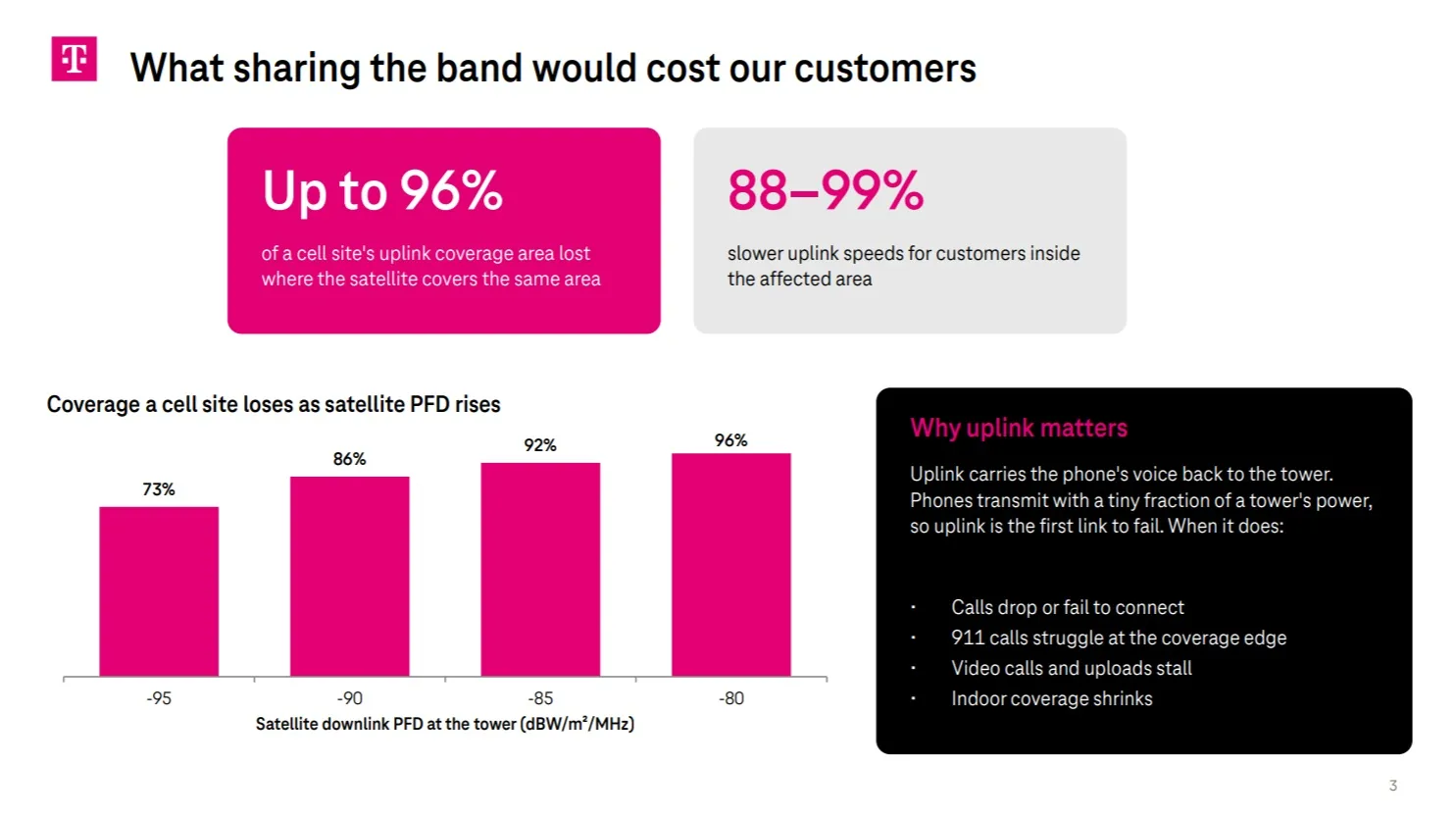
A satellite signal in the 2.5GHz band, T-Mobile noted, "can land on top of a tower and collide with terrestrial signals, leading to dropped and complete calls … delayed uplink transmission and reduced indoor coverage." The issue would still be present if terrestrial and satellite transmissions were perfectly aligned, T-Mobile stressed.
T-Mobile estimates that up to 96% of a cell site's uplink coverage area could be lost where satellite coverage bleeds over, with customers seeing uplink speeds slow down by 88% to 99%.
(Source: Slide from T-Mobile presentation made to FCC officials on October 21, 2026)
"Even as far as 15 miles from the market boundary, satellite transmissions could reduce T-Mobile's uplink coverage by approximately 35 percent," T-Mobile said, noting that 2.5GHz spectrum for D2D was already considered and rejected in 2024.
One satellite phone "near the line can drown out a cell site" one to three miles away, T-Mobile said.
The FCC, T-Mobile concluded, should focus SCS on terrestrial spectrum operating in FDD schemes, therefore enabling 5G services in the 2.5GHz band to stay interference-free.
The 'Starlink Doctrine'
The entire issue is coming to a head as companies like Starlink believe they have a natural right to use any and all spectrum, Roger Entner, analyst and founder at Recon Analytics, explained on the October 26 edition of his weekly podcast. The "Starlink Doctrine," he explained, is: "What's mine is mine, and what's yours is mine, too."
But he said that approach flies in the face of the mobile model. "There's a reason why we have licensed spectrum and there's a reason why we have unlicensed spectrum. And the people who pay for the license should have the exclusive benefits for that," Entner said.
"The FCC will ultimately decide exactly how spectrum should be used for phone-to-satellite D2D services, whether that's in a Starlink D2D network or a D2D network from AST SpaceMobile, Amazon Leo or another company. Now, it looks like the cellular industry (through the CTIA) wants to have a voice in how that all goes down," Mike Dano, lead industry analyst at Ookla and former Light Reading editor, explained in this LinkedIn post.
This is also playing out as Starlink threatens to develop and build out a terrestrial network to work in tandem with its satellite network.
The specter of Starlink is clearly spooking investors in the Big Three. AT&T and T-Mobile shares closed down more than 7% on Friday, with Verizon dropping 1.19%, but all three rebounded a bit in Monday morning trading.

-
 C114 Communication Network
-
 Communication Home
