
 Search

Credit: Bloomberg
Big Tech is set to agree to build its own power plants for data centers and shield consumers from rising electricity costs, but companies face daunting logistical obstacles to delivering on the pledge championed by President Donald Trump.
At a White House event on Wednesday, executives from Amazon, Google, Meta, Microsoft, xAI, Oracle, and OpenAI are due to sign the pledge to supply their own power instead of relying on a grid connection.
Trump hailed the plan in his State of the Union speech last week, promising US consumers that “no one’s prices will go up” as a result of “energy demand from AI data centers.”
But industry executives have suggested the commitment will not be binding, while experts warn it is likely impossible to fully insulate consumers from the extra power demand coming from the vast expansion of data centers to run AI.
“Regardless of how these data centers connect, behind the meter or as part of the network, you’re going to increase demand,” said Ari Peskoe, director at Harvard Law School’s Electricity Law Initiative.
Independent power supplies for data centers most often come from gas turbines, which are in short supply and not always designed to provide continuous power. “We still need more of these turbines,” Peskoe added.
Trump’s pressure on big data center operators comes in response to consumer backlash and political pressure over rising power bills.
On the campaign trail in 2024, Trump pledged to cut energy bills in half within a year of taking office.
In reality, residential electricity costs rose by 6 percent nationwide in February, compared with a year before, according to the US Energy Information Administration.
States such as New Jersey and Pennsylvania, which have clusters of data centers, reported bigger increases at 16 percent and 19 percent respectively.
Natural gas prices, extreme weather, and the need to upgrade aging grid infrastructure have all contributed to higher costs—after decades of low investment in power plants and transmission lines. The hit to energy supplies from Trump’s war against Iran could add to the problem.
Critics of data centers say they are increasing energy bills by adding to demand. US data center power demand will more than triple by 2035, rising from almost 35 gigawatts in 2024 to 106 GW, according to data from BloombergNEF.
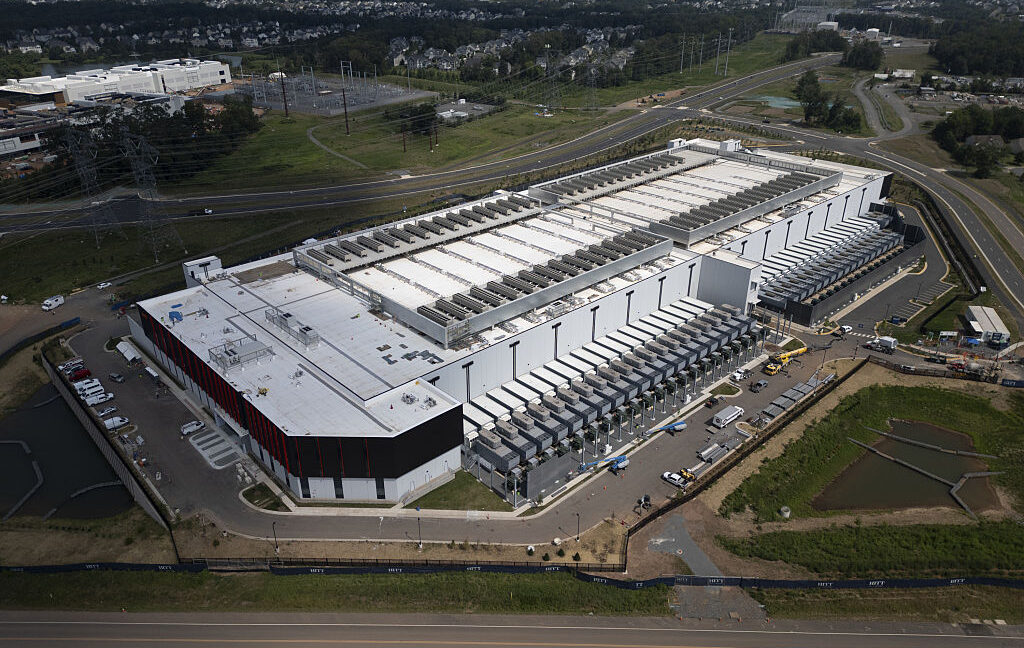
To avoid political backlash and waits of up to four years for grid connections, tech companies are already building their own power supplies for many new data centers.
Nearly three-quarters of planned generation equipment for data centers is natural gas fired, according to energy research firm Cleanview, which is tracking 56 GW of projects across the US.
Wednesday’s pledge would see tech companies expand these efforts to prevent higher power costs being pushed on to customer bills.
Josh Price, director of energy and utilities at strategy firm Capstone, said Big Tech was “trying to push back against the narrative that they’re the bad guy.”
But the boom in data center building is already pushing the limits of the supply chain for power generation, making it difficult for companies to meet their commitment to Trump.
Competition for gas turbines is fierce, with waits as long as seven years for new orders.
Turbine-maker GE Vernova said it would expand production by 25 percent, and Mitsubishi Power announced plans to double its output over the next two years. But manufacturers have been cautious about expanding capacity, and it may not be enough to meet booming demand.
Two-thirds of gas projects in development in the US have not announced a turbine manufacturer, according to Global Energy Monitor.
The price of gas turbines has risen sharply, and greater competition from tech companies will mean higher costs for utilities and industrial customers who also need generating capacity—costs that could still be passed on to ratepayers.
To overcome shortages, data centers are increasingly relying on alternatives. Companies, including Google and Microsoft, have also struck deals to reopen nuclear power plants, but these plans will take years to deliver.
In the near term, companies are using options such as reciprocal engines and diesel generators. Experts point out that these power sources, as well as ordinary gas turbines, are not designed to provide the kind of continuous power needed by data centers.
“They say, ‘we have documented evidence that these can run 90 percent of the time’… But that’s not the average use case,” said Jigar Shah, an energy investor and former Department of Energy official.
Keeping these data centers, and their power supplies, operational for decades would also present challenges around securing spare parts and qualified technicians, he added.
Shah said: “The level of ineptitude by which the data center companies are sleepwalking into major problems just seems shocking for trillion-dollar companies.”
© 2026 The Financial Times Ltd. All rights reserved. Not to be redistributed, copied, or modified in any way.

-
 C114 Communication Network
 -
 Communication Home
