
 Search

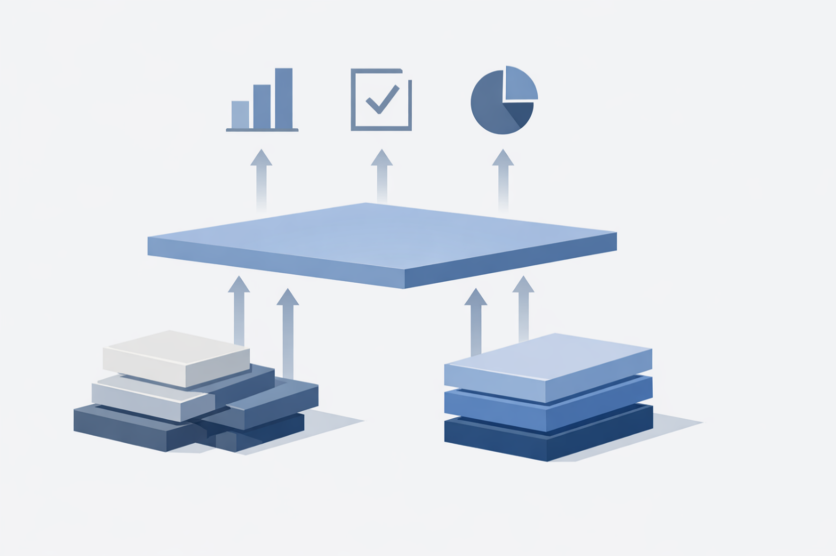
Image generated using OpenAI's image generation model
Enterprise leaders rarely underestimate the technical complexity of replacing core systems of record. What is still consistently underestimated is the operational risk those replacements introduce to analytics during prolonged coexistence. When definitions drift mid-transformation, the cost is not cosmetic. It shows up in delayed decisions, rework, and leadership teams debating metrics instead of acting on them.
ERP modernizations, cloud migrations, and platform consolidations almost never happen as clean cutovers. They unfold incrementally by region, function, or capability. Legacy and next-generation systems run in parallel for years. Schemas change. Organizational structures shift. New data sources are introduced.
Throughout all of this, executive expectations remain unchanged: stable analytics, historical comparability, and decision-grade insight.
That combination is where many analytics architectures quietly fail.
The Failure Mode Most Transformations Don't Plan For
When analytics degrades during transformation, the symptoms are familiar:
- Analytics and KPIs diverge between old and new systems
- Historical comparability erodes
- Reconciliation effort explodes
- Teams rebuild metrics manually in spreadsheets and side systems to reconcile outputs across platforms
- Trust in reported numbers weakens
These outcomes are often treated as unavoidable side effects of progress. Analytics disruption is framed as temporary. Manual workarounds are justified as transitional.
That framing is flawed.
The issue is not that systems are changing. Enterprises change continuously. The issue is that analytics is rarely designed to remain stable while systems change.
In many organizations, analytics is implicitly treated as downstream of systems of record. Definitions, calculations, and reporting logic are tightly coupled to transactional schemas. When systems evolve slowly, this coupling appears manageable. During multi-year coexistence, it becomes a structural liability. Every system change becomes an analytics change. Every analytics change reopens questions of meaning.
At scale, this does not just create operational friction. It slows down decisions.
Why Layered Architectures Alone Don't Solve the Problem
Most data leaders are familiar with layered architectures: foundational, integrated and aggregated data products. The presence of layers is not the issue. The issue is how those layers are allowed to change over time.
The missing design variable is rate of change.
During transformation, transactional systems evolve quickly. Source schemas shift. Pipelines are reworked. If semantic definitions and decision logic are allowed to evolve at the same pace, instability propagates upward. Analytics consumers experience constant reinterpretation rather than continuity.
Architectures that survive transformation treat semantic stability as a first-class objective. They explicitly separate what must change frequently from what must remain stable.
This is less about eliminating duplication and more about deliberate insulation.
Designing Analytics for Continuity, Not Completion
Analytics architectures are often evaluated based on their elegance in a future target state. During transformation, that focus is misplaced.
In a multi-year ERP transformation I led within a global energy organization, analytics continuity became a binding constraint. Early executive reviews began surfacing conflicting interpretations of identical KPIs depending on whether they were sourced from legacy or newly migrated environments. As legacy and next-generation systems operated in parallel, it was clear that without insulating semantic definitions from system-specific structures, executive decision forums would face diverging interpretations of the same performance metrics. That experience forced a shift in architectural thinking: analytics could not be designed as a downstream byproduct of system replacement.
Transitional periods are not brief anomalies. They are long-lived architectural states that must be designed for explicitly.
In practice, this means anchoring analytics around decision semantics, not system structure.
- Foundational data products remain close to systems of record. They change as systems change. Their role is fidelity, not interpretation.
- Integrated data products operate at a slower pace. They reconcile semantic differences across domains and platforms explicitly, absorbing volatility rather than allowing it to leak into reports.
- Aggregated data products change the slowest. They are anchored to governance cadence and decision forums, not schemas. Their role is to support judgment under uncertainty, not to mirror transactional detail.
The value of this separation is not theoretical. It determines whether analytics remains usable while the ground beneath it is shifting.
How Semantic Stability Is Enforced in Practice
Treating semantic continuity as an objective requires more than architectural intent. It requires explicit enforcement mechanisms.
Organizations that preserve analytics continuity during prolonged system coexistence tend to apply three controls consistently.
First, semantic definitions are versioned independently of systems.
Core KPIs and business definitions are treated as governed assets with explicit lifecycle management. Changes are deliberate, documented, and introduced on decision cadence rather than system release cadence. This prevents routine platform updates from silently redefining meaning.
Second, data contracts separate source change from semantic change.
Foundational data products are allowed to evolve as systems change, but integrated and aggregated layers consume them through contracts that protect semantic intent. Schema drift is absorbed at the integration boundary rather than propagated upward, keeping decision-facing metrics stable even as underlying structures evolve.
Third, governance cadence overrides system cadence.
Semantic changes are synchronized to decision forums, not deployment pipelines. If a definition change cannot be explained, justified, and accepted in a governance setting, it does not ship. This discipline slows semantic drift by design, without slowing system modernization.
These mechanisms do not eliminate change. They control where change is allowed to surface.
Why This Matters Even More in the Era of AI
This design discipline becomes more critical as organizations deploy AI models, advanced analytics, and autonomous agents.
AI does not resolve semantic ambiguity. It amplifies it.
Models trained on drifting definitions learn inconsistent relationships. Agents operating on unstable KPIs take confident actions based on shifting meaning. Automation layered on top of unstable semantics accelerates confusion rather than insight. In practice, this appears when forecasting models, anomaly detection systems, or automated controls generate conflicting recommendations because the same KPI is computed differently across platforms.
Many AI initiatives stall at scale in global organizations, not because models are weak, but because the semantic foundations feeding them are unstable. Without a durable semantic layer, organizations risk scaling ambiguity at machine speed.
Designing analytics for continuity is therefore not a legacy concern. It is a prerequisite for trustworthy AI in environments where systems, data, and organizational structures are in constant motion.
Continuity Is the Real Advantage During Transformation
Organizations that navigate transformation most effectively are not those with the most advanced tools. They are those that preserve clarity while change is underway.
Analytics architectures that assume a single, stable system of record struggle during prolonged coexistence. Architectures that explicitly separate semantic stability from transactional volatility do not.
This is not a technology decision. It is a design decision.
Enterprises that treat analytics continuity as a first-class architectural objective, rather than a downstream byproduct of system implementation, are better positioned to make consistent, confident decisions even while transformation is still underway.
In a world where change is constant, that may be the most durable advantage analytics can provide.
Author Bio

Werner van Rossum is a senior finance and business transformation leader specializing in enterprise-scale FP&A, performance management, and analytics architecture. He has led large, multi-year finance and system transformations across globally distributed organizations, focusing on aligning processes, data, and operating models to improve decision quality at scale.
His work centers on designing decision-oriented finance and analytics frameworks that reduce complexity, strengthen governance, and preserve clarity during periods of significant system change. He regularly contributes perspectives on finance transformation, decision effectiveness, and enterprise operating-model design.
Werner holds an MSc in International Business and has completed executive education in global leadership and transformation. He is based in the United States.

-
 C114 Communication Network
 -
 Communication Home
