
 Search

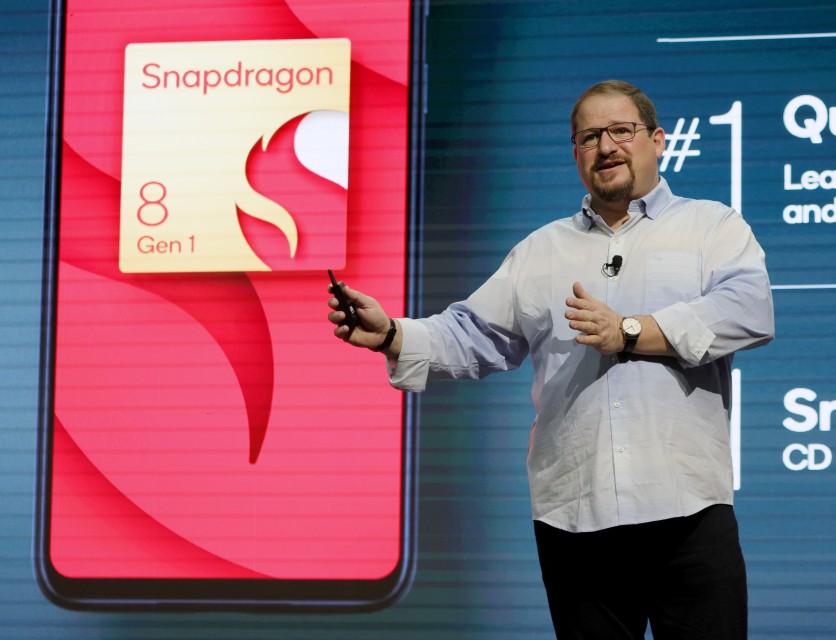
Qualcomm Inc. President and CEO Cristiano Amon speaks during the company's press event for CES 2022 at the Mandalay Bay Convention Center on January 4, 2022 in Las Vegas, Nevada. Ethan Miller/Getty Images
Qualcomm broke two records simultaneously on September 22, 2026, when it unveiled both chips at its annual Snapdragon Summit in Lahaina, Maui, Hawaii — the industry's first mass-market mobile chips built on TSMC's 2nm process node and the first to push a smartphone CPU clock past 5 GHz. The chips, which will power the premium Android phones that Samsung, Xiaomi, Motorola, and other manufacturers ship through 2027, are not simply faster versions of last year's platform: Qualcomm designed both of them around a new cache architecture called FlexCache, whose specific purpose is to cut the latency of the orchestration loops that autonomous AI agents rely on. For any reader planning a flagship Android upgrade in the next six months, these two chips define what premium means — and understanding what they actually do differently from every chip that came before is the most useful thing you can take away from this week's summit.
What the 2nm Node Actually Changes — and What It Doesn't
Qualcomm produced both chips on TSMC's N2 process node, which entered high-volume manufacturing in the fourth quarter of 2025. The "2nm" label is a marketing designation — no physical feature of these transistors is two nanometers — but the underlying change is concrete: TSMC has transitioned from FinFET to Gate-All-Around FET (GAAFET) nanosheet transistors, in which the current-control gate wraps around all four sides of the transistor channel rather than three. At equivalent clock speeds, GAAFET enables up to 15% higher performance or 30% lower power consumption compared to TSMC's prior 3nm N3E process, according to TSMC's own characterization, along with a 15% increase in transistor density.
Qualcomm used that density headroom not primarily to push clock speeds — though the 5 GHz mark on two Prime cores is genuinely new for mobile — but to build out three subsystems that the prior chip's transistor budget could not accommodate: a shared L2 cache pool that all eight CPU cores draw from dynamically, a 50% larger shared memory block in the Hexagon NPU, and 18 MB of High-Performance on-chip memory in the Extreme model's GPU. Each of those choices points at the same architectural target: reducing the memory traffic penalty of AI agent workloads.
How FlexCache Changes the Economics of Agentic AI
Every major SoC before the Snapdragon 8 Elite Gen 6 divided its CPU's L2 cache into fixed partitions, one per core. That architecture is efficient for sustained single-threaded workloads, where a core's working set stays consistent and its fixed partition stays warm. Agentic AI breaks that assumption. An AI agent executing a multi-step task — perceiving context, calling a tool, updating a plan, generating an action — shifts its working set at every step. Each shift in a fixed-partition design means the active core must evict its current cache contents and reload from slower L3 memory or DRAM, adding latency to every link in the agent's chain.
FlexCache replaces those fixed partitions with a single shared pool that all eight Oryon cores can draw from dynamically, with demand determining allocation rather than a static pre-assignment. A Prime core orchestrating an agent's planning step can access "nearly the entire pool," per Qualcomm's description at the summit; as the agent hands off work to a Performance core for execution, the pool re-allocates accordingly. The practical consequence is that context-switching between reasoning steps, tool invocations, and memory retrieval — the defining rhythm of an agentic AI workflow — produces far fewer cache misses than it would on any prior mobile CPU. That is why the 5 GHz barrier matters specifically for agents: the clock speed ensures each individual operation is fast, while FlexCache ensures the transitions between operations are cheap.
This is not what prior mobile CPU generations were designed for. The Oryon v3 in the Snapdragon 8 Elite Gen 5 was also a 5 GHz-class CPU in Prime core clock aspirations, but its L2 was partitioned. The jump from Gen 5 to Gen 6 is not purely a speed story; it is a cache architecture story whose significance only becomes visible when the workload is agentic.
Two Chips, One Node: The Dual-Flagship Strategy Explained
Qualcomm's decision to launch two distinct silicon designs simultaneously is, according to Alexander Maxham's reporting at AndroidHeadlines, a direct response to the ongoing DRAM supply constraints that are driving RAM prices higher. By offering a mainstream Snapdragon 8 Elite Gen 6 (SM8950) and a premium Snapdragon 8 Elite Extreme Gen 6 (SM8975), Qualcomm gives original equipment manufacturers a cheaper path to a 2nm flagship chip for mid-tier Ultra devices without forcing every high-end phone to absorb the cost premium of the Extreme model's full feature set.
Both chips share the same 2nm process, the same eight-core Oryon CPU configuration (two Prime cores at 5.00 GHz and six Performance cores at 4.00 GHz), the same FlexCache architecture, the same Snapdragon X105 5G modem (the industry's first certified against 3GPP Release 19, with peak downlink at 14.8 Gbps), and the same FastConnect 8800 wireless subsystem with Wi-Fi 8 readiness and Bluetooth 6.0.
Where they diverge is significant for buyers at the Ultra tier. The Extreme Gen 6 adds 18 MB of Adreno High-Performance on-chip GPU memory (versus none on the standard chip), embedded Adreno Matrix Cores inside the graphics pipeline, LPDDR6 memory support (versus LPDDR5X on the standard), an upgraded Hexagon NPU with 35% more performance and 50% larger shared memory, 8K video capture at 60 frames per second, and hardware decode for the H.266 (VVC) codec — which, per Qualcomm, extends battery life during video playback by up to 55% versus software decoding. The standard Gen 6 delivers an NPU improvement of 14% over the prior generation and handles 8K at 30 frames per second and 4K at 120 frames per second.
The GPU on the Extreme adds a second dedicated feature that the standard chip does not have: Adreno Neural Fusion, which combines AI super-resolution upscaling and AI frame generation into a single coherent pipeline already integrated into both Unity and Unreal Engine workflows.
How the Extreme Runs a 30-Billion-Parameter AI Model on a Phone
The Snapdragon 8 Elite Extreme Gen 6's claim to run 30-billion-parameter Mixture-of-Experts (MoE) AI models becomes meaningful once you understand what MoE architecture actually does. A standard 30-billion-parameter language model would require roughly 15 to 30 gigabytes of high-bandwidth memory to operate — far beyond what any smartphone carries. MoE sidesteps this problem through selective activation: the model is divided into dozens of specialized sub-networks called "experts," and a routing mechanism selects only the subset most relevant to each input token. In Qualcomm's implementation, approximately 3 billion parameters activate per token, even though the full model has 30 billion.
The Extreme Gen 6's hardware makes this tractable through the combination of LPDDR6 memory, UFS 5.0 flash storage, and the Hexagon's enlarged shared memory block. At UFS 5.0 peak read speeds exceeding 4.2 GB/s, dormant expert weights can be loaded from flash with latency measured in milliseconds per inference step — fast enough that the seam between flash and DRAM does not become a visible bottleneck at conversational speeds.
The Hexagon NPU's new Element Accelerator is the architectural mechanism that makes those 3 billion active parameters run efficiently. Earlier mobile NPUs were built primarily around matrix multiplication, which is the dominant operation in convolutional neural networks. Transformer-based language models additionally require attention mechanisms — irregular memory access patterns that matrix-only architectures handle less gracefully. The Element Accelerator adds dedicated compute paths for transformer attention operations, directly targeting the workload that governs most of today's large AI models.
What AI Agents Actually Do on Your Phone — and What They Cannot Yet Do
Qualcomm CEO Cristiano Amon used both the Computex 2026 keynote and Snapdragon Summit 2026 to articulate a consistent vision: the smartphone's role as the center of a user's digital life is ending, replaced by an AI agent that follows the user across devices — smartphone, smart glasses, earbuds, laptop, vehicle. The Snapdragon 8 Elite Gen 6's new Sensing Hub is the always-on subsystem that makes this ambient awareness possible without draining the battery: a dual micro-NPU that delivers 85% more performance than its predecessor at 20% lower power, processing voice activity and contextual signals continuously without waking the main application processor.
The Sensing Hub also enables Personal Scribe — a feature that, at the user's direction, indexes conversations, identifies speakers, and organizes information into a secure on-device personal knowledge graph that agents can query over time.
That "at the user's direction" qualifier is where the privacy conversation begins. The Register's Tobias Mann, covering Amon's Computex remarks, asked plainly about the privacy stakes of an AI agent that monitors a user's entire context across devices. Qualcomm's hardware answer to privacy concerns is processing data locally rather than in the cloud — on-device inference means the raw context never leaves the device. But as Mann noted, that protection holds only insofar as the software vendor running on top of the hardware respects it: Google's business model, for example, is built on telemetry.
Analyst Richard Windsor of Radio Free Mobile, writing during the summit, was measured about the agent thesis itself: while he acknowledged Qualcomm's compelling silicon story, he cautioned that widespread AI agent adoption is "just a theory" and that the investment case for Qualcomm rests more solidly on its diversification away from pure smartphone silicon than on any specific agent-driven upgrade cycle.
Both of those notes belong alongside Qualcomm's vision — not as refutations, but as the honest acknowledgment that the agentic AI era Qualcomm is building silicon for is not yet a proven consumer reality. The hardware is ready; the software ecosystem and the consumer habits are still arriving.
Mastercard, Google, and the Agentic Commerce Infrastructure
The summit's partner sessions highlighted what happens when AI agents acquire the ability to execute purchases on a user's behalf — a capability that the Extreme Gen 6's combination of on-device inference and secure payment authentication infrastructure makes technically possible for the first time. Mastercard announced it is building a dedicated "trust layer" for agentic commerce, combining its payment authentication infrastructure with Qualcomm's device-level security.
Google's Senior Vice President Rick Osterloh joined CEO Amon on stage for a broader reframing: Android is no longer an "operating system" — it is, in Google's current terminology, a "Gemini Intelligence" platform. Osterloh said Gemini has reached one billion monthly users, the fastest product in Google's history to that milestone, with token usage rising sevenfold year over year, according to the company.
First Devices: Xiaomi Today, Samsung in January
Xiaomi announced at Snapdragon Summit that its 18 Pro series is scheduled to be the world's first commercially available product on both chips simultaneously, with the 18 Pro carrying the standard Gen 6 and the 18 Pro Max carrying the Extreme Gen 6. A launch event for both is scheduled in Beijing on September 23. Honor's Magic 9 series, which launched on September 20, arrived first on the calendar but without both-tier chip coverage.
Motorola's Signature 27, built on the Extreme Gen 6, brings a seven-year OS upgrade commitment, audio tuned by Bang and Olufsen, a six-antenna radio design, and AI-native video creation tools powered by Google's Gemini models.
The broader 2027 flagship wave — including the Samsung Galaxy S27, which has historically been Samsung's first phone to ship with the latest Snapdragon platform — is expected in the first quarter of 2027. No Samsung announcement confirming the Galaxy S27 configuration has been made as of the time of this article. Qualcomm confirmed as OEM partners: Honor, iQOO, Motorola, Nubia, OnePlus, Oppo, Redmi, RedMagic, Vivo, Xiaomi, and ZTE.
Where Qualcomm's Platform Is Headed Next
The Snapdragon 8 Elite Gen 6 is not the top of Qualcomm's announced roadmap. Amon previewed an upcoming "High Bandwidth Compute" co-processor technology — originally developed for Qualcomm's data-center business and now being miniaturized for smartphones, laptops, smart glasses, and vehicles — with a formal announcement scheduled for Mobile World Congress. If that co-processor delivers additional compute bandwidth at the package level, it would address one of the remaining constraints on on-device AI at scale: not peak inference throughput, but sustained throughput under thermal pressure, which is the real bottleneck when an agent runs continuously for hours rather than seconds.
Qualcomm also announced the acquisition of Modular, the company behind the Mojo programming language and MAX inference engine, both of which will be open-sourced. The strategic intent is clear: building a hardware-agnostic software path — analogous to what CUDA is for Nvidia GPUs — that lowers the cost of deploying AI models across the fragmented landscape of mobile, PC, and embedded silicon. If successful, it would make the Snapdragon 8 Elite Gen 6's architectural innovations accessible to a broader developer base than currently writes silicon-specific optimization code for mobile.
Benchmark Caution
Pre-launch reference device results shared at the summit showed an 82% single-core improvement over Gen 5 in Geekbench 6 and a 65% gain in AnTuTu — with reference device Geekbench 7 scores competitive with the Apple A20 Pro. Qualcomm itself cautioned that reference-device results may not reflect final commercial product performance, as retail device configurations, thermal management, and software stacks all influence real-world benchmark outcomes. Independent testing of retail devices, when they ship, will determine how much of the reference performance survives into a consumer's pocket.
❓
Frequently Asked Questions
What is the difference between the Snapdragon 8 Elite Gen 6 and the Snapdragon 8 Elite Extreme Gen 6?
Both chips use the same TSMC 2nm process and the same eight-core Oryon CPU running at identical clock speeds. The Extreme Gen 6 adds features specifically for the top tier of the flagship market: 18 MB of Adreno High-Performance on-chip GPU memory, dedicated Adreno Matrix Cores and Adreno Neural Fusion for AI-powered gaming, LPDDR6 memory support, a stronger Hexagon NPU (35% more performance vs. 14% for the standard), 8K video at 60 frames per second (vs. 30 fps on the standard), and hardware decode for the H.266 codec. Budget-conscious Ultra phones are likely to use the standard Gen 6; phones positioned at the very top of the Android price range will use the Extreme.
When will phones with the Snapdragon 8 Elite Gen 6 be available to buy?
Xiaomi is scheduled to hold a launch event for its 18 Pro (standard Gen 6) and 18 Pro Max (Extreme Gen 6) in Beijing on September 23, 2026 — making those the first commercially announced devices. Motorola's Signature 27 (Extreme Gen 6) is targeting global availability later in 2026. The bulk of the 2027 flagship class — Samsung Galaxy S27, OnePlus 16, and others — is expected to arrive in the first quarter of 2027, consistent with the cadence that has followed every prior Snapdragon Summit announcement.
What exactly is an "agentic AI" and why does it need a chip with a new cache architecture?
An agentic AI is a software system that acts autonomously on a user's behalf rather than merely responding to prompts. Instead of waiting for you to ask a question, an agent perceives context, makes decisions, calls tools (a calendar, an e-commerce API, a web search), and executes actions — repeatedly, without continuous human direction. Each step in that cycle shifts the AI's working memory to a different task, which in a conventional chip with fixed per-core cache partitions causes repeated cache flushes and reloads from slower memory. Qualcomm's FlexCache lets all eight CPU cores share a single dynamic cache pool, so the agent can move between reasoning, tool-calling, and action execution without that memory-reload penalty accumulating at every step. The 5 GHz clock makes each step fast; FlexCache makes the transitions between steps cheap.
What does the 30-billion-parameter on-device AI model capability mean in practice — and what are its limits?
Running a 30-billion-parameter Mixture-of-Experts model on the Extreme Gen 6 is possible because MoE activates only a fraction of those parameters — roughly 3 billion — per inference step, with the rest stored on UFS 5.0 flash and loaded on demand. The practical upshot is that the Extreme Gen 6 can run AI reasoning at a quality level previously possible only on a server, offline, with all data staying on your device. The limits are real: sustained agentic operation over hours generates heat that thermal throttling must manage, expert weight loading from flash adds latency compared to a fully in-memory model, and the quality of a 30-billion-parameter MoE model is still below what frontier cloud models achieve with hundreds of billions of parameters. On-device AI at this scale is meaningfully better than what any prior smartphone offered — but it is not a replacement for cloud AI for the most demanding tasks.

-
 C114 Communication Network
 -
 Communication Home
