
 Search

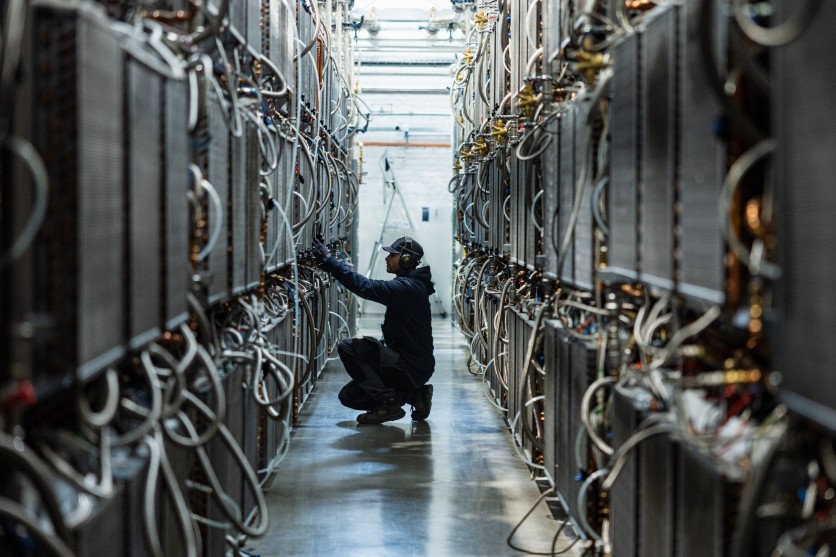
An operator works at the data centre of French company OVHcloud in Roubaix, northern France on April 3, 2025. SAMEER AL-DOUMY/AFP via Getty Images
At France Quantum 2026 in Paris on Wednesday, OVHcloud announced two developments that together sketch the near-term architecture of a European quantum data center: Quobly's Alloy Pioneer — the first silicon-spin quantum processing unit to be made available via a sovereign cloud — will join the OVHcloud Quantum Platform in late 2026, and the French cloud giant has begun a research collaboration with quantum networking startup Welinq to tackle the field's unsolved infrastructure problem: how to connect different quantum processors into a coherent distributed system.
Both announcements were made by OVHcloud founder and CEO Octave Klaba at the fifth edition of France Quantum, an annual summit that drew more than 1,500 attendees and 60 speakers to Station F in Paris. They follow France's €1 billion in additional quantum investment announced by President Emmanuel Macron in May, bringing the country's total public quantum commitment to approximately €3.3 billion.
The deeper story behind both announcements is an economic hypothesis that has guided Quobly since it spun out of French research institutions CEA-Leti and CNRS in 2022: that quantum computing can follow the same cost trajectory as classical computing if its processors are manufactured on the same industrial chip-fabrication lines. If the bet proves out, it would change quantum hardware from a bespoke laboratory instrument to a commodity produced on existing semiconductor infrastructure — the same transition that reshaped classical computing between the 1970s and 1990s.
Why Chip-Factory Fabrication Is Quantum Computing's Missing Economic Link
Most quantum computers today require exotic materials, bespoke fabrication processes, and supply chains built from scratch. Quobly's approach is fundamentally different. Its silicon-spin qubits are manufactured on 300-millimeter FD-SOI wafers at STMicroelectronics' commercial production facility in Crolles, France — the same industrial-grade equipment that manufactures classical chips for automotive, IoT, and RF applications.
FD-SOI, which stands for Fully Depleted Silicon-on-Insulator, is a planar semiconductor technology that places an ultra-thin silicon channel on top of a buried oxide layer. It has been in commercial production since around 2012 and is one of STMicroelectronics' flagship process technologies. Using it for quantum processors means Quobly can leverage decades of process maturity — yield optimization, cleanroom standards, precision lithography — that qubit platforms built on bespoke materials simply cannot inherit.
The physical device at the heart of Quobly's system is a silicon quantum dot: a nanoscale well approximately 50 nanometers across in which a single electron is electrostatically confined. A gate electrode above the well controls the potential barrier that traps the electron, and the qubit itself is the electron's spin state — either spin-up or spin-down, or a quantum superposition of both. Logic operations are performed by applying voltage pulses to the gate electrodes to manipulate the spin state, and two-qubit operations use exchange interactions between adjacent quantum dots.
The 50-nanometer quantum dot footprint gives silicon-spin qubits a structural density advantage over superconducting qubits. A superconducting transmon resonator, the dominant qubit type used by IBM and Google, occupies roughly 100 to 200 micrometers across — approximately 4,000 times larger in linear dimension. That size difference is why silicon-spin qubits are theoretically capable of packing millions of qubits onto a single chip using standard semiconductor processes.
The engineering tradeoff is real: silicon-spin qubits require precise analog voltage tuning for each quantum dot, whereas digital CMOS transistors need only switch reliably between on and off states. Each dot may behave slightly differently due to process variation, a challenge that does not exist in the same form for digital logic. Quobly has not yet publicly disclosed qubit counts or performance benchmarks for the Alloy Pioneer, and the system targets early adopters in high-performance computing and research rather than production-scale quantum advantage. The coming months will determine how well its manufacturing approach handles qubit-to-qubit uniformity at the scale its FD-SOI fab strategy envisions.
Alloy Pioneer will be accessible through Alloy Forge, Quobly's quantum application development environment, which lets users compile and validate quantum chemistry and optimization applications against real hardware constraints before broader deployment. The company raised a €115 million Series A on June 3, led by Bpifrance, STMicroelectronics, and SEALSQ.
Read more: France Quantum 2026 Opens at Station F: Five Hardware Bets and a Nasdaq Listing Lead the Race
How OVHcloud's Quantum Platform Works
Launched in November 2025, OVHcloud's Quantum Platform offers quantum processing units in an as-a-service consumption model — pay-as-you-go access with no long-term infrastructure commitment — designed to let enterprises and research institutions experiment with quantum computing without building dedicated quantum infrastructure.
Before Wednesday's announcement, the platform already hosted two QPUs: Pasqal's neutral-atom system and Quandela's Belenos, a 12-qubit photonic quantum computer added in April 2026. The addition of Quobly's Alloy Pioneer will make three fundamentally different qubit architectures available through a single cloud access point: neutral-atom, photonic, and silicon-spin.
OVHcloud operates more than 500,000 servers across 46 data centers on four continents and serves 1.6 million customers in more than 140 countries. Its Quantum Platform is the first European Quantum-as-a-Service offering and the only one built on sovereign cloud infrastructure, meaning all data processed on it remains within European jurisdiction under European law — without exposure to the jurisdictional reach of the US CLOUD Act, which applies to data managed by US-headquartered providers regardless of where their servers physically sit.
Welinq and OVHcloud: Wiring Quantum Computers Together
The second announcement is architecturally the more ambitious of the two. OVHcloud's research collaboration with Welinq addresses a structural bottleneck that currently limits every quantum cloud platform: each quantum processor operates in isolation, with no mechanism to share quantum states, distribute workloads, or link heterogeneous systems into a combined computational resource.
Welinq, founded in 2022 as a spinout from Sorbonne University, CNRS, and PSL University, has developed what it describes as a quantum Ethernet port: a high-rate entanglement generation platform based on waveguide quantum electrodynamics. The system generates entangled photon pairs, with one photon in the telecom C-band for fiber transmission and a second at a visible wavelength optimized for coupling with atomic systems, enabling compatibility with multiple qubit modalities across existing fiber infrastructure. In February 2026, Welinq commercially launched a rack-mounted version of this system and delivered its first unit to a European institution.
The OVHcloud collaboration specifically targets heterogeneous quantum networking — connecting QPUs built on different qubit technologies — which requires an additional capability: quantum transduction, or the conversion of quantum states between different physical carriers. Welinq's quantum memory system, commercially designated QDrive, acts as a buffer that stores quantum states during transduction, managing the timing mismatch between processors operating at different frequencies and speeds.
Tom Darras, CEO and co-founder of Welinq, described the collaboration in terms of infrastructure rather than near-term products: "The future of quantum computing is not only a matter of raw power but also depends on their ability to be networked and orchestrated within computing infrastructures."
For OVHcloud, the practical appeal is the ability to route workloads across a heterogeneous set of QPUs — sending each problem to whichever processor architecture is best suited for the computation — rather than maintaining a collection of isolated quantum systems that a customer must choose between at the outset. The collaboration is framed as research rather than a near-term product, and quantum networking remains a research-stage technology. Connecting QPUs with different qubit modalities introduces significant additional complexity that no commercial provider has yet demonstrated at scale.
What Can Researchers Actually Do With These Systems Today
The honest answer is constrained but not trivial. Current silicon-spin systems like the Alloy Pioneer and photonic systems like Belenos operate in what the industry calls the NISQ era — Noisy Intermediate-Scale Quantum — where qubit counts and error rates limit the depth of circuits that can be executed reliably. No system available today on any cloud platform can outperform a classical computer on a real-world problem of practical importance.
What researchers can do is develop and validate quantum algorithms under real hardware constraints, explore the noise characteristics of a qubit architecture that has never previously been accessible outside a laboratory, and begin building the software and workflow infrastructure that will matter when error-corrected quantum computing arrives. For silicon-spin specifically, the cloud deployment represents a first: a qubit modality long theorized as the most manufacturable path to large-scale quantum computing will, for the first time, be available for independent researchers to probe its actual behavior in a production-adjacent environment.
Quobly's Alloy Forge development environment is designed to make this accessible to researchers and industrial early adopters in high-performance computing without requiring prior expertise in quantum hardware.
European Quantum Strategy: Sovereignty as a Feature
Both announcements carry a deliberately European orientation. Quobly's Alloy Pioneer is designed and developed in France and fabricated on a French semiconductor line. Welinq is a Parisian startup. OVHcloud, headquartered in Roubaix, co-founded the France Quantum organization. The quantum platform runs on sovereign European infrastructure.
France has made a deliberate policy decision to fund five competing qubit architectures simultaneously through its €500 million PROQCIMA initiative, administered by the Direction Générale de l'Armement. Silicon-spin — Quobly's approach — is one of the five. The structure is a competition: France is betting on the architecture that can reach fault-tolerant quantum computing first, and Quobly's OVHcloud deployment advances its commercial positioning in that race.
For enterprise customers in regulated industries — finance, healthcare, defense — the sovereign cloud angle is not incidental. European law, including the General Data Protection Regulation and the EU Data Act in force since September 2025, creates affirmative obligations around data jurisdiction that US cloud providers cannot satisfy when subject to the CLOUD Act. Access to cutting-edge quantum hardware without quantum-computed outputs leaving European borders is a meaningful differentiator from IBM Quantum, Amazon Braket, and Microsoft Azure Quantum, all of which operate under US legal jurisdiction.
Miroslaw Klaba, Research and Development Director at OVHcloud, said the collaboration with Welinq is oriented toward building the infrastructure of the future rather than the products of today: "We are delighted to work with Welinq to leap ahead by designing the data centres of tomorrow to the benefit of the European quantum computing ecosystem."
Frequently Asked Questions
What is a silicon-spin quantum computer, and how is it different from IBM's or Google's quantum computers?
A silicon-spin quantum computer encodes information in the quantum spin states of individual electrons trapped in nanoscale silicon structures called quantum dots. The key difference from IBM's and Google's superconducting quantum computers is fabrication: silicon-spin qubits are built using the same CMOS semiconductor manufacturing processes used to make classical chips, while superconducting systems require specialized materials and custom fabrication. A silicon quantum dot is approximately 50 nanometers across; a superconducting transmon qubit is roughly 100 to 200 micrometers — about 4,000 times larger. The theoretical implication is that silicon-spin qubits could eventually be packed onto a chip in vastly larger numbers using existing semiconductor fabs, following the same industrial logic that made classical microprocessors cheap and abundant.
Is the OVHcloud Quantum Platform the right place to run quantum workloads now?
For most production workloads, no — not yet, and the same is true for every quantum cloud platform currently available. Today's systems operate in the NISQ era, where qubit counts and error rates limit the circuits that can be reliably executed. The platform's value right now is research access: developers and researchers can explore algorithm behavior on real hardware, validate quantum-classical hybrid approaches, and begin building the software infrastructure needed for when error-corrected systems arrive. For European organizations in regulated industries, the sovereign cloud guarantee — all data stays under European jurisdiction — adds a compliance dimension that US-based quantum clouds cannot match.
What is quantum networking, and why does the Welinq collaboration matter?
Quantum networking connects separate quantum processors using quantum channels, enabling them to share quantum states and operate as a distributed system. Unlike classical networking, quantum information cannot be copied or amplified without destroying it — a consequence of the no-cloning theorem — so quantum networks require entanglement-based links and specialized quantum memories rather than classical repeaters. The Welinq collaboration matters because it targets heterogeneous quantum networking, connecting quantum computers built on different qubit technologies, which is the harder problem. If it succeeds, a quantum data center could route workloads to whichever processor architecture is best suited for each task rather than forcing users to choose between isolated systems. That capability is years away, but OVHcloud and Welinq are beginning the infrastructure research now.
Does sovereign cloud status mean quantum computations on OVHcloud are more secure?
Sovereign cloud addresses a specific and important risk: legal jurisdiction over data. OVHcloud is a French-headquartered company operating under European law, meaning its quantum platform is not subject to US CLOUD Act orders that can compel American cloud providers to disclose data regardless of where servers are physically located. This matters for organizations in finance, healthcare, defense, and government that process sensitive data and need assurance that quantum-computed outputs cannot be accessed by foreign authorities without European legal process. It is not the same as end-to-end encryption or absolute physical security — it is a jurisdictional guarantee, which is the form of assurance that regulated industries typically require.

-
 C114 Communication Network
 -
 Communication Home
