
 Search

(Image credit: Nvidia)
-
Facebook -
X -
-
-
Pinterest -
Flipboard -
Email
This week, Nvidia released its Q1 2027 results, posting a record-breaking $81.65 billion in revenue thanks to sales of its AI and data center products. Colette Cress, chief financial officer of Nvidia, said that he expects sales of the company's Grace and Vera CPUs for data centers to hit $20 billion this fiscal year, thus outselling both AMD and Intel and becoming the world's largest supplier of processors by revenue. This is a realistic expectation, principal analyst and president of Mercury Research, Dean McCarron, tells Tom's Hardware Premium.
Outselling AMD and Intel
"Vera CPU opens a brand-new $200 billion TAM for Nvidia, a market we have never addressed before," Cress said during the company's conference call with financial analysts and investors. "Every major hyperscale and system maker is partnering with us to get it deployed. We have visibility to nearly $20 billion in total CPU revenue this year, setting us up to become the world-leading CPU supplier."
Nvidia later clarified that the $20 billion figure includes sales of Grace and Vera processors within Superchip combinations, NVL72 systems, and standalone CPUs sold either as racks aimed at agentic AI workloads or other applications.
(Image credit: Tom's Hardware)
Intel's data center and AI (DCAI) division's revenue totaled $16.8 billion last year, whereas AMD's data center unit earned $16.635 billion in 2025. While CPUs account for the lion's share of earnings of these business units, their sales are by far not 100% of their revenue, so actual sales of Xeon and EPYC products are well below $16 billion. The entire x86 server CPU market is worth around $30 billion. Therefore, the $20 billion figure would indeed approach two-thirds of the traditional server CPU market, making Nvidia the world's No. 1 server CPU supplier.
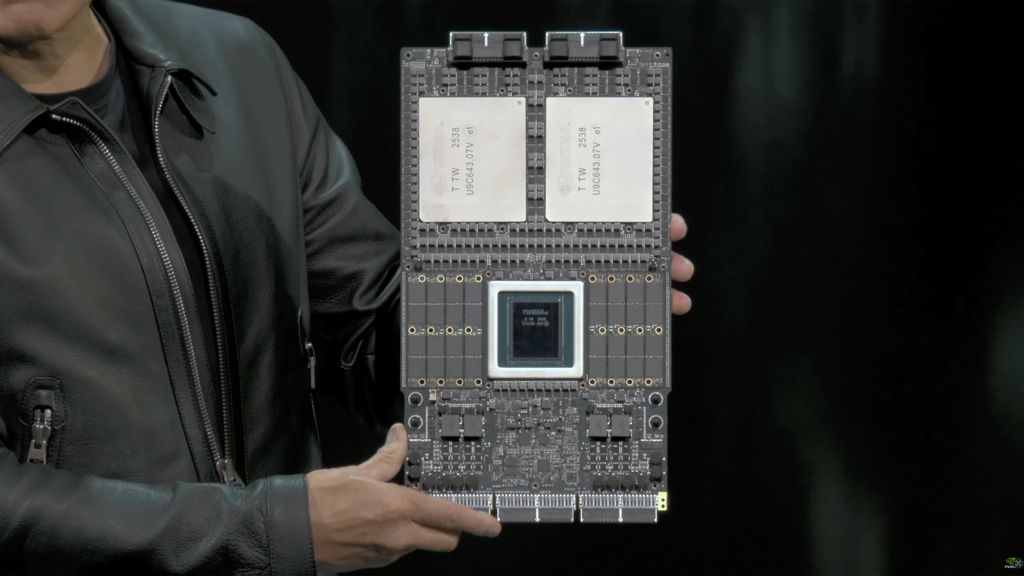
What makes Nvidia's statement especially remarkable is that while Grace CPUs are widely available and have shipped in huge quantities, its 88-core Vera CPU hasn't yet shipped in high volume. Furthermore, Nvidia has never meaningfully participated in mainstream server CPUs before. Given that Nvidia is poised to sell millions of Rubin data center GPUs, and every two of them will be attached to a Vera CPU, the company is almost guaranteed to sell plenty of CPUs.
"We will sell millions of Rubin GPUs and every two of them is connected to a Vera [CPU]," Jensen Huang, chief executive of Nvidia, told analysts and investors. "Vera is used in [four] ways. The first is Vera Rubin [platform containing two Rubin GPUs and one Vera CPU]. The second use case is Vera as a standalone CPU. The third is Vera with CX9 and its software stack for storage. The fourth is Vera with CX9 alongside a software stack for security, compute isolation, and confidential computing."
Conquering the CPU kingdom
Given the dominance of x86 servers, alongside AMD's EPYC and Intel's Xeon CPUs in particular, it is hard to imagine that another company can outsell these highly popular products. Yet, it is more than possible, given the fact that Nvidia can price its CPUs well above the average selling prices (ASPs) of other x86 offerings, and still manage to outsell competitors. This is because Nvidia sells vertically integrated platforms rather than standalone CPUs or GPUs. While Nvidia is not 'known' for its CPUs, it is definitely not a new entrant.
"Nvidia is in a unique situation, and I do not think we can really call them a 'new entrant," McCarron told Tom's Hardware Premium.
(Image credit: Nvidia/YouTube)
Based on leaked estimates from Morgan Stanley Research, Nvidia will charge its hyperscale clients around $5,000 per Vera CPU when they purchase VR200 NVL72 machines later this year. Assuming that the estimate is correct, then selling CPUs worth $20 billion will require Nvidia to sell 4 million Vera units. Four million units is perfectly achievable for Nvidia, McCarron believes.
"As far as delivering 4 million CPUs per year, Nvidia is already on track to deliver a number very near that for its GB300 and Rubin systems in FY2027 (so roughly Q2 2026 - Q1 2027 calendar year)," McCarron said. "So, their comment indicates some moderate upside to CPU shipments."
In fact, Nvidia could probably sell considerably more than four million CPUs this fiscal year if it wanted to, and if it secured or reallocated additional capacity for production of its 88-core Arm-based processor, according to McCarron.
"This really just comes down to customer demand and pricing/revenue allocation to get to the $20 billion," the analyst told us. "I would expect that the number is going to be heavily weighted towards the end of their fiscal year."
Speaking of capacity, Nvidia has commitments for capacity and inventory of around $145 billion, so capacity allocation may not be a problem for the company.
"We remain front-footed in securing sufficient supply to support our customers' growth," Cress said. "In Q1, we increased total supply, inclusive of inventory, purchase commitments, and prepaids, to $145 billion."
AMD and Intel shipped nearly 20 million EPYC and Xeon SP processors for data center systems in 2025, Dean McCarron told us. Meanwhile, AMD's EPYC average selling price was about $1,325, whereas the ASP of Intel's Xeon SP was about $1,125, according to Mercury Research. That said, if Nvidia sells 4 million processors worth $20 billion, then it will not only outsell both AMD and Intel, but will become a formidable rival for both companies from a pure unit sales point of view, too.

-
 C114 Communication Network
 -
 Communication Home
