
 Search

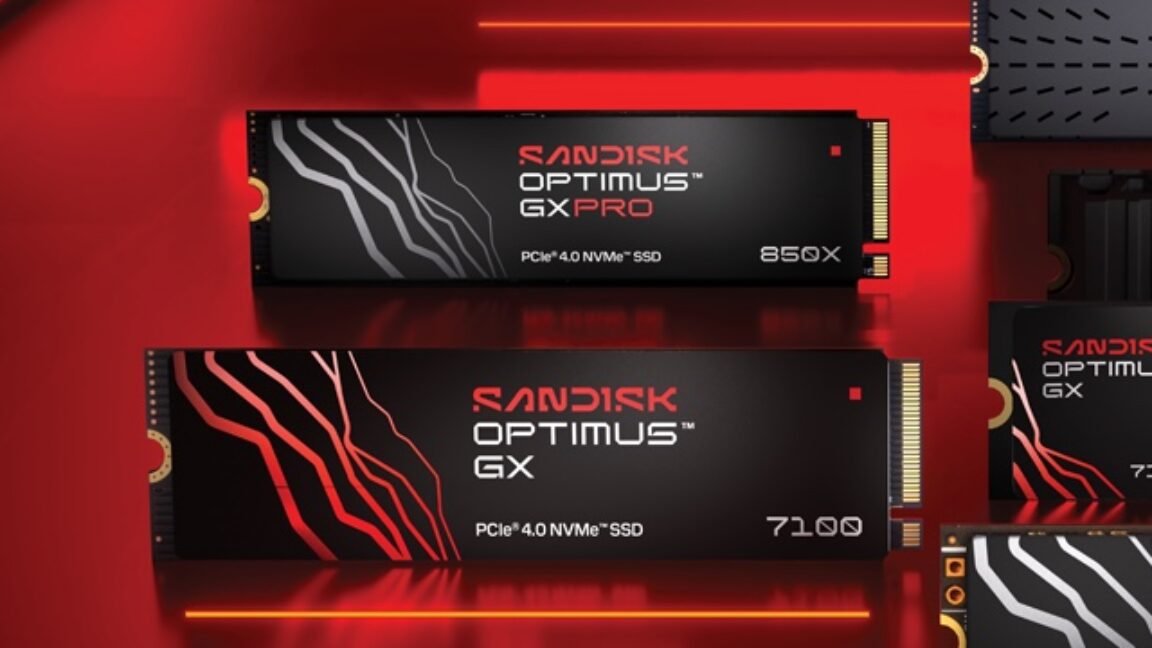
Credit: Sandisk
In late 2023, storage company Western Digital announced plans to split itself into two companies. One, which would still be called Western Digital, would focus on spinning hard drives, which are no longer used much in consumer systems but remain important to NAS devices and data centers. The other, called SanDisk, would handle solid-state storage, including the drives that Western Digital sold to consumers under its Blue, Black, Green, and Red brands.
That split effectively undid what Western Digital did a decade ago when it bought SanDisk for $19 billion. And we’re just now starting to see the way the split will affect the company’s existing consumer drives.
Today, SanDisk announced that mainstream WD Blue and WD Black SSDs would be discontinued and replaced by SanDisk Optimus-branded disks with the same model numbers.
WD Blue drives will now be “SanDisk Optimus” drives, starting with the Optimus 5100, a rebadged version of the WD Blue SN5100. Mid-tier WD Black drives will be branded as “SanDisk Optimus GX,” and the Optimus GX 7100 will replace the WD Black SN7100. And high-end WD Black drives will become “SanDisk Optimus GX Pro” SSDs, with the Optimus GX Pro 850X and 8100 replacing the WD Black SN850X and 8100 drives.
Given that these are all fast NVMe SSDs, I suspect the average user would have trouble detecting much of a difference between the low-end WD Blue/Optimus drives and the high-end WD Black/Optimus GX Pro SSDs. But the functional differences between the drives remain the same as before: the Blue/Optimus 5100 uses somewhat slower and less durable quad-level cell (QLC) flash memory, while the Black/Optimus GX 7100 uses triple-level cell (TLC) memory. The Black/Optimus GX Pro 8100 maximizes performance by stepping up to a PCIe 5.0 interface instead of PCIe 4.0 and including a dedicated DRAM cache (the 5100 and 7100 each claim a small chunk of your system RAM for this, called the Host Memory Buffer, or HMB). The 850X is a slightly older drive that keeps the dedicated DRAM but is also limited to PCIe 4.0 speeds.
Other drives are still in flux
Rebrandings are always fraught—you can end up just confusing people more in your attempts at clarity and simplification. But SanDisk’s new names at least make some logical sense: The more words the name has, the better the drive is meant to be. The model number continuity will help prevent confusion during this period of overlap between WD- and Optimus-branded SSDs, and the demarcation between the GX and GX Pro drives emphasizes the differences between those SSDs in a way that the catch-all “WD Black” branding didn’t.
Users of both WD-branded and SanDisk-branded SSDs should be able to use the SanDisk Dashboard software to check for firmware updates and perform other kinds of drive maintenance; the equivalent WD Dashboard software package was formally discontinued a year ago.
SanDisk’s press release doesn’t mention the WD Green or WD Red-branded SSDs, which are targeted toward entry-level and NAS usage, respectively. When contacted for comment, SanDisk representative Robyn Pagulayan told Ars that the company had nothing to announce about the fate of those drives.
SanDisk’s rebrand comes at a strange time for the memory business. Though not as badly affected as RAM prices, SSD prices have been spiking recently due, in part, to demand from AI data centers (and now, at least partly, by companies and consumers rushing out to buy things just in case prices get even worse). Shortages of both RAM and NAND flash chips will likely keep prices elevated in the short- to medium-term, at least. Due in part to this volatility, Micron announced last month that it would be discontinuing its Crucial-branded consumer SSDs and RAM sticks.

-
 C114 Communication Network
 -
 Communication Home
