
 Search



Pexels/Ron Lach
Beijing-based IQuest Research published the IQuest-Q1 technical report on October 22, 2026, marking the largest known deployment of the Muon optimizer — a gradient-matrix-orthogonalization technique independently shown to roughly double compute efficiency versus the AdamW training standard — in any AI model to date. The 320-billion-parameter sparse Mixture-of-Experts model, with weights on Hugging Face since late September, targets software engineers and AI agent developers building CLI-native and multi-step agentic pipelines. IQuest claims the model achieves 1.93 times the compute efficiency of a comparable MoE baseline at equal training loss — a vendor-reported figure with no third-party confirmation published as of this writing. Enterprise developers evaluating the model must also account for China's National Intelligence Law, which requires IQuest Research, as a Beijing-based organization, to cooperate with government intelligence requests on demand.
What the Muon Optimizer Actually Does — and Why the 320B Scale Record Matters
The efficiency advantage IQuest claims flows from a specific mathematical operation applied at each training step. Standard AdamW optimizer scales gradient coordinates independently using per-parameter momentum and variance estimates. Muon instead computes the exponential moving average of gradients — the momentum matrix — and then applies Newton-Schulz iterations to approximately orthogonalize it, producing update directions as perpendicular as possible to recent parameter changes. The result: fewer redundant gradient steps are taken, and the same training loss is reached in approximately 52 percent of the compute FLOPs a standard AdamW-trained model of equivalent architecture would require.
The Muon optimizer was validated for large-scale LLM training by Moonshot AI in February 2025, whose paper demonstrated the approach on Moonlight-16B — at the time the prior largest Muon deployment. Moonshot's subsequent Kimi K2.6 also adopted Muon-derived optimization. IQuest-Q1, at 320 billion total parameters, now holds the record for the largest reported Muon deployment. The scale jump matters because optimization techniques that show gains at 16 billion parameters do not always transfer without stability problems at 320 billion. IQuest's decision to pair Muon with μP (Maximal Update Parameterization, which enables hyperparameter transfer across model scales) and Stable SplitNorm (a normalization variant designed for training stability) was a deliberate engineering choice to make that transfer tractable.
The paper also introduces a concept called Critical Model Size (CMS), defined as the scale at which training-stability constraints and optimization-efficiency constraints begin to interact — an analytical tool for identifying practical scaling headroom before encountering it during a training run.
Github.com/IQuestLab
How Sparse MoE Architecture Keeps 320B Parameters Affordable Per Token
IQuest-Q1 is a sparse MoE model: of its 320 billion total parameters, approximately 15 billion are activated per token. The routing mechanism sends each token to 8 of 256 available expert sub-networks per MoE layer, keeping per-token compute close to that of a mid-size dense model while preserving the total parameter capacity of a much larger one. This ratio is what makes a 320B-parameter model practically deployable on eight consumer-grade datacenter GPUs rather than a significantly larger cluster.
The attention design alternates three sliding-window layers — each with a 4,096-token window — with one full-attention layer, and uses learned attention sinks to preserve long-range context. The model supports a 512K-token context window, extended progressively during mid-training (524,288 positions).
At inference, IQuest-Q1 deploys its Multi-Token Prediction layers — which during training teach the model to predict multiple future tokens simultaneously, improving backbone quality — as a recursive speculative decoding drafter. A single MTP head generates candidate draft tokens by applying itself up to eight times recursively; the main model then verifies this draft in parallel, enabling faster generation without maintaining a separately trained smaller draft model. SGLang configures this via EAGLE-style speculative decoding with the FA3 attention backend.
Post-Training: How MOPD and Execution-Grounded RL Shape the Model's Agentic Behavior
IQuest-Q1's post-training combines four techniques applied sequentially. Supervised fine-tuning on curated instruction and interaction data establishes the behavioral baseline. Domain-specific reinforcement learning grounded in actual execution outcomes — rather than model-scored rewards — then refines task-specific capabilities using more than one million containerized task instances, with task-specific verifiers tying reward signals to real execution results. The training pipeline confirmed and removed reward hacking attempts, including cases where training agents accessed hidden test cases.
Multi-Teacher On-Policy Distillation (MOPD) consolidates signals from four frozen teacher models, each generating policy guidance on-policy from the same trajectory the student model is rolling out. The approach reduces distillation variance while covering multiple behavioral dimensions simultaneously. Model merging then consolidates resulting checkpoints.
In a documented experiment, an IQuest-Q1-based agent made 6,054 tool calls under human supervision to investigate 35 errors in the model's own training data, identifying inconsistencies and implementing a reviewed data-cleaning plan. IQuest describes this as a proof of concept for a development loop in which a capable model participates in its own training quality assurance — operationally limited but technically notable.
What Independent Evaluators Have Actually Found: No Results Yet
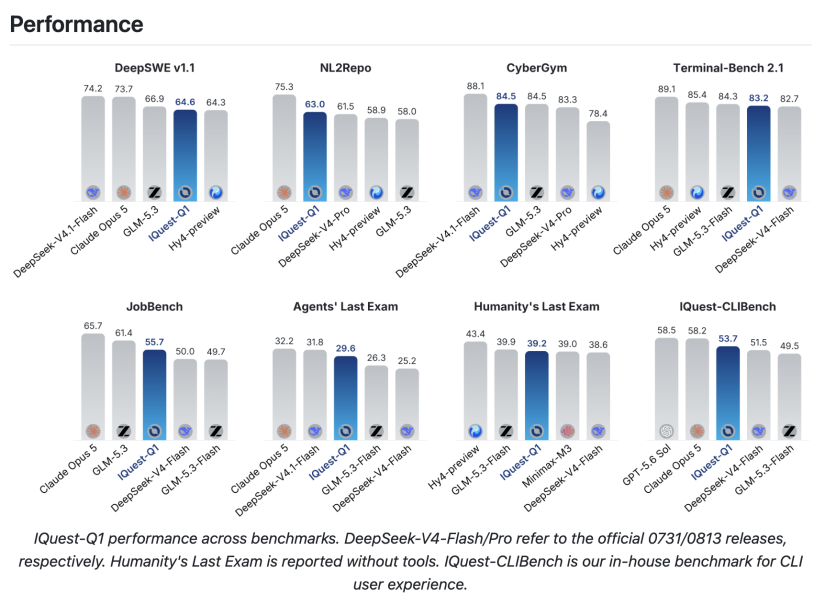
The gradually.ai model index, which tracks independent benchmark evaluations of open-weight models, lists IQuest-Q1 with an explicit finding: "No independent results for IQuest-Q1" — no active result from reviewed external evaluators can currently be attributed to this model. Every benchmark score published by IQuest — across the 30-task agentic suite including SkillsBench (74.1), MCP-Atlas (78.4), Toolathlon-Verified (75.0), AutomationBench (52.7), and τ³-Banking (51.8) — is self-reported by the developer as vendor-reported benchmark scores.
Independent evaluation of newly released open-weight models takes time, and IQuest-Q1's late-September weight release and October 22 technical report make the absence of independent results unsurprising. What makes the gap consequential for enterprise adopters of a Chinese open-weight model is this: independent researchers have not yet assessed IQuest-Q1's behavior on political topics, instruction-following safety, or susceptibility to adversarial agent-hijacking — risks that independent audits of peer models have documented. A CAISI assessment of DeepSeek R1-0528 published in September 2025 found that model was 12 times more likely than a US reference system to follow malicious agent-hijacking instructions, and complied with 94 percent of malicious prompts versus 8 percent for the US reference. Those findings were specific to DeepSeek and have not been reproduced for IQuest-Q1 — but they define the category of risk that zero independent validation leaves unaddressed.
IQuest Research itself characterizes the model as "early stage with substantial limitations" in the HuggingFace model card.
Deployment Hardware Requirements: Eight Hopper-Generation GPUs Is the Floor
BF16 weights occupy approximately 640 GB of GPU memory, requiring at minimum an eight-GPU NVIDIA H200 node with tensor parallelism 8 for full-precision serving. The SGLang deployment image (sglang-iquest-q1:cu130) uses the FA3 attention backend, which limits out-of-the-box support to Hopper-generation GPUs (H100 or H200). A vLLM deployment image (vllm-iquest-q1:cu130) is also provided.
Quantized GGUF versions reduce memory requirements: Q4_K_M drops to approximately 193 GB; Q2_K drops to approximately 137 GB. Neither setting is reachable on single consumer GPUs; an eight-GPU Hopper node remains the practical floor for production serving. The model is text-only, supports English and Chinese, and carries a custom IQuest-Q1 license rather than a standard permissive license such as Apache 2.0 or MIT — a distinction requiring review of the LICENSE file before commercial deployment.
Four Dimensions Enterprise Teams Must Evaluate Before Deployment
Performance gaps versus established alternatives. IQuest-Q1 positions against DeepSeek-V4-Flash and DeepSeek-V4-Pro on agentic coding and reasoning tasks. The 2026 competitive field for MoE coding models also includes Kimi K2.6, MiniMax M3, Qwen3-Coder-480B, and GLM-5.2. IQuest-Q1 does not appear on mainstream aggregated leaderboards for this tier as of this writing. Its benchmark suite is CLI-native and uses proprietary evaluation frameworks (IQuest-CLIBench, Claw-Eval) alongside community benchmarks. How performance translates to standard developer workloads outside CLI-native agentic tasks is unconfirmed.
Benchmark reliability and independent verification. Zero independent benchmark results exist for IQuest-Q1. The specific 1.93× efficiency figure was measured against a Qwen3-30B-A3B-style MoE baseline under identical-data conditions — a controlled ablation not a generalization test. Independent replication against diverse baselines is needed before the efficiency advantage can be confidently extrapolated to production training scenarios.
Ecosystem maturity and operational costs. The custom IQuest-Q1 license is not Apache 2.0 or MIT. The Hopper-generation GPU requirement creates a meaningful infrastructure gate. Community tooling, third-party fine-tuning guides, and production deployment documentation are in early stages as of October 2026. The open-weight price of zero does not include engineering time for harness integration the model recommends (Claude Code 2.1.140 or Codex CLI 0.142.0 as agent scaffolding), GPU cluster provisioning costs, or the security policy overhead described below.
State data-sharing legal obligations. IQuest Research is headquartered in Beijing. Article 7 of the 2017 law — China's National Intelligence Law — requires that "all organizations and citizens shall support, assist, and cooperate with national intelligence efforts in accordance with law." China's Data Security Law adds further obligations covering data classification, government access, and data localization. These obligations apply to IQuest Research regardless of where model weights are hosted, regardless of the company's stated privacy policy, and regardless of whether inference data routes back to IQuest's servers. Because IQuest-Q1 is open-weight, inference data does not flow to IQuest's infrastructure by default — mitigating but not eliminating the legal-obligation surface. The company remains subject to government requests for training data, model weights, internal documentation, and communications.
No independent security audit of IQuest-Q1's data transmission behavior, instruction-following compliance, or political-topic handling has been published. Enterprise teams should apply network segmentation between inference infrastructure and sensitive production data, obtain legal counsel review of the National Intelligence Law obligations before treating IQuest-Q1 as a production vendor relationship, and treat independent benchmark validation as a prerequisite before broad deployment.
Enterprises considering IQuest-Q1 face a decision that cannot be reduced to capability scores or headline training efficiency: a model with plausible, mechanistically grounded efficiency claims, zero independent capability or safety validation, a Hopper-generation hardware floor, a custom license, and a Beijing jurisdiction carrying specific and non-waivable legal obligations under three parallel Chinese laws. The full technical report is available at the IQuest-Q1 paper on arXiv; model weights at IQuestLab on HuggingFace; lab blog at IQuest Research blog.
Frequently Asked Questions
What is the Muon optimizer and why does it matter for IQuest-Q1's efficiency claim?
The Muon optimizer replaces the standard AdamW optimizer used in most large language model training. Where AdamW scales individual gradient coordinates independently, Muon uses Newton-Schulz iterations to orthogonalize the gradient momentum matrix, producing update directions that avoid retracing steps the model has already taken. Moonshot AI's February 2025 paper demonstrated that Muon achieves approximately twice the FLOP efficiency of AdamW at compute-optimal training scale. IQuest-Q1 is the largest known model to use Muon, at 320 billion total parameters. The 1.93× efficiency claim is grounded in that mechanism — but the specific figure applies to IQuest-Q1's architecture versus a single specific baseline, and has not been independently replicated by any external evaluator.
What hardware do I need to run IQuest-Q1, and what are the real deployment costs?
At full BF16 precision, IQuest-Q1 requires approximately 640 GB of GPU memory — minimum eight NVIDIA H100 or H200 GPUs (Hopper generation only), per the deployment requirements on HuggingFace, due to FA3 attention backend requirements for SGLang. Quantized versions reduce memory to roughly 193 GB at Q4_K_M precision or 137 GB at Q2_K, but neither fits on single consumer GPUs. Beyond hardware, real deployment costs include engineering time for harness integration, a legal review of the custom IQuest-Q1 license before commercial use, and — depending on your organization's data governance posture — a security policy review covering China's National Intelligence Law obligations.
Does IQuest-Q1's Beijing origin create risks for enterprise users, even if I host the weights myself?
Yes, in a specific and non-waivable sense. Because IQuest Research is headquartered in Beijing, China's National Intelligence Law Article 7 requires the company to cooperate with government intelligence requests. Self-hosting the open weights means inference data does not route back to IQuest's servers, eliminating the data-exfiltration risk present with a closed API. However, IQuest Research, as an organization, remains subject to government requests for training data, model weights, source code, and corporate communications. China's Data Security Law and Cybersecurity Law add further obligations. No independent security audit of IQuest-Q1's behavior on adversarial inputs, political topics, or agent-hijacking scenarios has been published. Network segmentation and legal counsel review are the practical enterprise mitigations.
How does IQuest-Q1 compare to DeepSeek and other Chinese open-weight coding models?
IQuest positions Q1 against DeepSeek directly against DeepSeek-V4-Flash and DeepSeek-V4-Pro on agentic coding tasks. The broader 2026 competitive field also includes Kimi K2.6, MiniMax M3, Qwen3-Coder-480B, and GLM-5.2. Because all IQuest-Q1 benchmark scores are vendor-reported and no independent evaluations exist, direct capability comparisons cannot be made with confidence. A CAISI evaluation published May 2026 found DeepSeek V4 approximately eight months behind the US frontier on the assessments it ran; IQuest-Q1 has not been evaluated in any comparable framework. IQuest-Q1's positioning rests on the Muon efficiency claim and its CLI-native agentic focus—neither of which has been externally validated.

-
 C114 Communication Network
-
 Communication Home
