
 Search

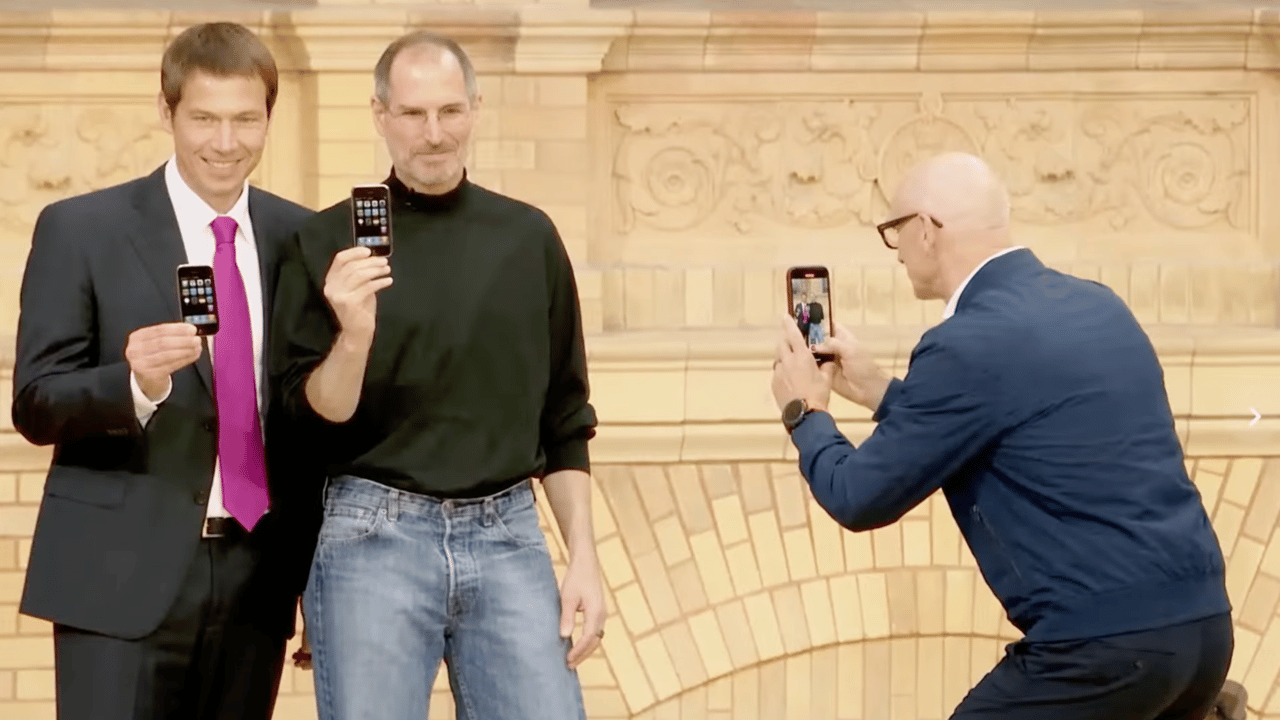
Deutsche Telekom CEO Timotheus Höttges in what looked like the German operator's remake of Forrest Gump.(Source: Deutsche Telekom)
In what looked like a Deutsche Telekom remake of Forrest Gump, CEO Timotheus Höttges talked to the camera from various iconic moments – German reunification, the telco's initial stock market listing in 1996, the launch of the first iPhone, where he was semi-crouched to photograph Steve Jobs. Seconds later, he was abseiling from a telecom mast wearing a magenta-colored hardhat and gilet.
None of it, of course, was real, and no executives were harmed in the making of this film. Production did not even require Höttges to find a gap in the hectic day of a company boss, it seems. "You see what is possible with AI," he told an audience at Deutsche Telekom's AI investor day in Bonn this week. "The language, the pictures, the movements – everything was copying me already," he said. "To a certain extent, it's scary as well."
It is probably a lot scarier for his employees. Deutsche Telekom has leapt into AI with the telecom sector's typical enthusiasm for the next big technological thing and a corporation's standard zeal for any potential profit-raising force. Höttges himself looks symbolic of the widening AI rift between opportunistic company leaders and worried employees. "I'm an AI optimist," he said on stage. Most Germans appear more nervous about it. Only a third are prepared to trust AI-generated information, according to a KPMG survey last year.
If Deutsche Telekom's employees weren't already among the nervous cohort, they might be after watching the company-sanctioned deepfake of Höttges. Excited by what AI can do, Deutsche Telekom's executives now believe they can slash indirect costs by around €2.5 billion (US$2.8 billion) in 2030, compared with 2023, through investment in AI and automation. They are also targeting AI-related revenues outside the US of about €800 million ($899 million) that same year.
Bored of AI
But the market reaction to the update was "meh." Deutsche Telekom's share price squeaked up 1% in Frankfurt on AI investor day, having dropped 7.4% in the last year. Revenues of €800 million would not even equal 2% of what Deutsche Telekom earned outside the US in 2025. Savings of €2.5 billion would represent less than 3% of its full operational costs in 2023, including interest, tax, depreciation and amortization. Do these piddly amounts justify the hype and investment, including the €1 billion ($1.1 billion) that Deutsche Telekom and Nvidia are pouring into a single AI factory in Munich? Shareholders seem to think not.
The costs of AI might have been overlooked, too. Höttges was a chief complainant when Europe's big telcos were drawing a link between network traffic and costs while demanding "fair share" payments from a few voracious Internet companies blamed for the congestion. He has abandoned the case, which always looked spurious. But he would probably defend the view that new AI services could put networks under even more strain in future.
What's far more obvious, today, is that AI costs far exceed AI revenues and there is no clear path to profitability. Bain, a management consultancy, reckons the world's annual capital expenditure on AI could hit $1.5 trillion by 2031. To justify it, the planet would need to be generating annual AI-related revenues of about $6 trillion. "Consider the scale of investment and the gap between that and the revenue model necessary to fund it," said the company in a recent report.
All that is reflected in the surging cost of AI tokens. A token is a measure roughly equivalent to a syllable in a written word. The generation of a 1,000-word essay would therefore consume about 1,500 tokens. What users pay currently falls short of what AI processing costs in energy consumption, data-center expenses and so on.
But Deutsche Telekom's savings target of €2.5 billion is a gross figure that excludes any token costs, said the company in its presentation. According to a separate slide, it seems to think it can "manage" token costs through avoidance of "model lock-in" and by having what it calls "tiered token budgets." The goal is to ensure that token costs will not exceed a "low double-digit percentage of gross savings." Even if it can exert restraint, this alone would already wipe at least €250 million ($281 million) off the net savings amount.
Employees foot the bill
When companies talk about cutting costs with AI, the natural assumption is that employees will pay the price. Using AI, Deutsche Telekom might be able to streamline IT systems, shrink the real-estate footprint and even cut energy consumption by network infrastructure. But the emphasis it puts on "automation" implies savings would largely come from reducing manual effort.
Despite that, the financial part of Deutsche Telekom's AI presentation makes not a single overt reference to headcount targets. The operator finished June with fewer than 192,000 full-time employees across the entire group, having cut about 34,500 jobs since 2020. Last year, which it finished with roughly 198,000 employees, it spent around €19.8 billion ($22.3 billion) in total on personnel costs. The gross savings target equates to about 12.6% of that figure. If all the savings were realized through headcount reduction, and job cuts were evenly distributed across salary bands, a crude calculation indicates up to 25,000 roles could be endangered.
Years ago, companies would swat aside talk of the AI threat to jobs, arguing the technology would instead liberate workers from drudgery to carry out more rewarding tasks. But no company ever saved money by redeploying full-time staff and paying them the same amount as before.
It provides another reason to doubt that Deutsche Telekom can realize its savings target. Amid a public backlash against AI and rising technology costs, the software continues to make mistakes and do the unintended. As a regurgitator of what it finds online, it will probably always get things wrong. The most advanced technologies that underpin it are controlled by a few US companies. Substituting it for thousands of jobs and losing that human expertise would be an extremely risky step.
At a very high level, the virtual Höttges doing the Forrest Gump routine illustrates the conundrum. Not having to feature in that video undoubtedly freed up time for the real Höttges. It might not even have been filmable without AI if he had been traveling for work. But Deutsche Telekom is presumably not about to automate its CEO, and maintaining both AI and real versions of Höttges seems unlikely to have saved it any money. Staff much lower down the food chain will naturally feel more vulnerable. But they could prove stubbornly hard to replace.

-
 C114 Communication Network
 -
 Communication Home
