
 Search

Physics AI physicsx.ai
On the same day IEEE Spectrum reported that General Motors had compressed two weeks of aerodynamics analysis into a matter of minutes using AI trained on simulation data, the broader field that made it possible had already attracted more than $15 billion in venture capital within a single week. Physics AI — the discipline of training machine-learning models on the outputs of physics simulations rather than on text or images — announced itself this month as a named category in its own right, not just a research curiosity.
PhysicsX, the London-based startup at the center of that category, closed a $300 million Series C on June 8 at a valuation of approximately $2.4 billion — more than double its valuation from just twelve months earlier. The round was oversubscribed and led by Singapore's Temasek, with participation from new investors M&G Investments and Intrepid Growth Partners alongside existing backers including NVIDIA, Siemens, Applied Materials, Atomico, and General Catalyst. The company's recognized revenue has doubled year over year, its booked revenue has tripled, its customer count has more than doubled, and its headcount has grown from roughly 150 to more than 300 people in the past twelve months.
Those numbers come on the heels of a broader category moment. Within days of PhysicsX's raise, Prometheus — backed by Jeff Bezos — announced a $12 billion Series B at a $41 billion valuation to build what it called an "artificial general engineer." Days after that, Mistral AI was reported to be seeking $3.5 billion in new funding specifically to advance a physics AI initiative for industrial engineers. Three companies independently reached for the same new phrase in the same week and collectively raised $15.8 billion. That is a category crystallizing, not a coincidence.
What Engineering Simulation Is and Why It Has Been So Slow
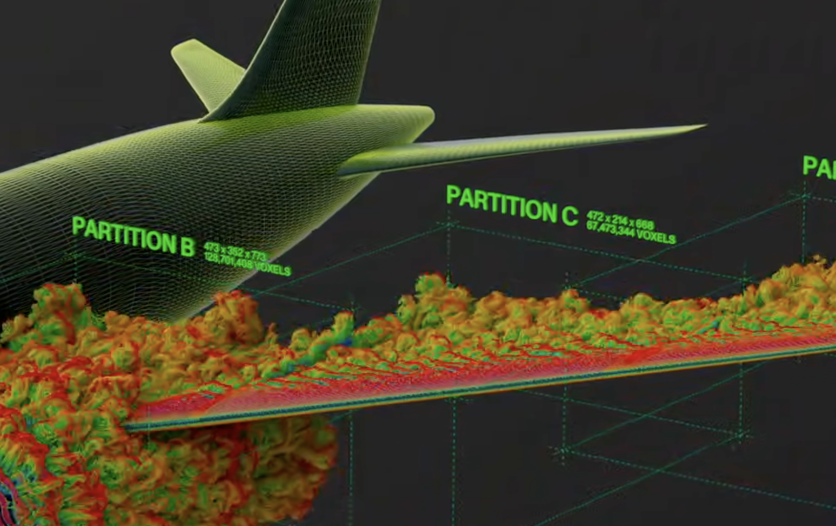
To understand what physics AI is doing, it helps to understand what it is replacing. Computational fluid dynamics — CFD — and finite element analysis (FEA) are the two main tools engineers use to test how a design will behave in the real world before building a physical prototype. CFD predicts how air, water, or heat will flow through or around a structure. FEA predicts how the structure will deform or fail under load. Both work by dividing the design space into an enormous mesh of tiny elements, then solving the governing equations — primarily the Navier-Stokes equations for fluid problems — at every element simultaneously.
The computational cost is what constrains everything. A high-fidelity CFD simulation of a car's aerodynamic drag might require solving a system with hundreds of millions of coupled equations, on hardware that has to iterate thousands of times before converging on a stable answer. That process takes hours or days per run. An engineering team testing fifty design variants before committing to production must wait fifty simulation cycles. In practice, teams test far fewer. The design space goes incompletely explored not because engineers lack imagination but because the physics solver is the bottleneck.
How Large Physics Models Work: The Architecture Behind the Speed
Physics AI takes a different approach. Instead of solving the equations from scratch each time, a large physics model learns the solution operator from data — specifically, from the outputs of thousands of prior simulation runs. Feed in a new design geometry, and the model returns a prediction of the resulting pressure field, temperature distribution, or stress pattern in milliseconds rather than hours. The speedup, according to PhysicsX CEO Jacomo Corbo, ranges from ten thousand to close to a million times faster depending on the type of physics being simulated.
The dominant architecture underlying this approach is the Fourier Neural Operator — a machine-learning framework now used as a backbone for industrial physics AI. A Fourier Neural Operator does not take a fixed-size input vector and produce a fixed-size output vector the way a conventional neural network does. It learns a mapping between function spaces: given any spatially varying input field (such as a 3D geometry with varying material properties), it produces the corresponding output field (such as the pressure map over that geometry) at any resolution, without retraining.
The architecture has three stages. First, a lifting network expands the sparse input representation into a richer internal feature space. Second, a series of operator layers — the computational core — runs a dual-path update at each stage: a spectral path using the fast Fourier transform to capture global structure across the entire domain at a cost that scales as O(N log N) rather than O(N²), combined with a local pointwise bypass that captures fine-scale boundary behavior. Third, a projection network collapses the internal representation back to the physical output the engineer needs.
The reason this is so much faster than a traditional solver is in the spectral path. A direct solver computes interactions between every pair of elements in the mesh — a cost that scales quadratically with the number of elements. The Fourier Neural Operator replaces that with a Fast Fourier Transform that retains only the dominant low-frequency modes of the solution. For smooth, laminar physics problems — the coefficient of drag on a car body, the heat distribution in a circuit board, the stress in a turbine blade operating below the shock regime — most of the physical information lives in those low-frequency modes. The truncation cuts computational cost dramatically without sacrificing accuracy for the problems the model was designed to solve.
Where Physics AI Still Fails: Limitations the Funding Rounds Do Not Advertise
That mode-truncation design choice, which makes large physics models so fast, also defines the situations where they perform poorly. According to PhysicsX's own published technical analysis, physics AI models based on Fourier Neural Operators struggle in at least four categories.
Shock-dominated and discontinuous flows are the first limitation. When a design involves a supersonic aircraft, a detonation wave, or any other flow in which sharp discontinuities carry significant energy, that energy spreads across the full frequency spectrum rather than concentrating in the low modes. Fourier truncation loses the physics that matters most. Hybrid approaches — running traditional solvers for the shock region and AI surrogates elsewhere — are the current workaround.
Irregular and unstructured geometries are the second. The standard Fourier Neural Operator assumes a uniform Cartesian grid, because the Fast Fourier Transform requires it. Real engineering components — turbine blades with complex internal cooling channels, aircraft fuselages with curved surfaces and discontinuous boundaries — live on meshes that are anything but Cartesian. Geometry-aware extensions of the neural operator framework exist but trade some of the FFT's computational efficiency for mesh flexibility.
High-dimensional problems are the third. The number of learned parameters in a standard Fourier Neural Operator scales exponentially with the dimensionality of the problem. A three-dimensional fluid simulation that requires tracking dozens of interacting variables can make training computationally impractical on anything short of large-scale GPU infrastructure. PhysicsX's research team has published approaches to reduce this parameter growth, but the challenge constrains the domains where large physics models work reliably out of the box.
Data scarcity is the fourth. Unlike large language models, which train on billions of publicly available text documents, large physics models must train on proprietary, domain-specific simulation outputs. If a customer has run only a few hundred prior simulations in a particular configuration, the model may not generalize reliably to new design variants that differ substantially from its training distribution.
What this means in practice: physics AI is a powerful accelerator for the large portion of engineering simulation that involves smooth, periodic, or laminar physics on regular grid geometries — aerodynamics of production vehicles at cruising speed, thermal management of electronics assemblies, structural analysis of components below their yield point. It is not yet a general-purpose replacement for the classical solver under all conditions.
GM, Jaguar Land Rover, and What Production Deployment Actually Looks Like
The deployment evidence is real, even with those constraints acknowledged. General Motors has integrated large physics models into its car design process over the past six months. Previously, a creative design engineer would develop a 3D model of a new vehicle concept, send it to aerodynamics specialists, and wait roughly two weeks for a simulation-derived coefficient of drag. With a large physics model trained on GM's accumulated simulation library, that process now returns a result in minutes. The creative design team and aerodynamics specialists can now iterate in the same room at the same time.
At this stage in the design cycle, the AI model's precision does not need to match the accuracy of a full simulation. "When it really starts to matter is when we're getting close to launching a vehicle, and the coefficient of drag is going to be used for our energy calculation, which eventually goes to the certification of our miles per gallon on the sticker," GM's director of virtual integration engineering Rene Strauss told IEEE Spectrum. At that stage, a physical model of the car still goes into a wind tunnel. The AI model handles the early exploration — the thousands of design candidates that would never survive a two-week wait.
Jaguar Land Rover presented separately at NVIDIA GTC in March on how its engineering teams have deployed similar technology for aerodynamics analysis. PhysicsX, which announced a collaboration with NVIDIA at the same event to advance open standards for physics AI models, is actively expanding the range of industrial problems its platform can handle.
How PhysicsX Compares to the Incumbents It Works With
The established engineering simulation vendors — led by ANSYS, now owned by Synopsys following a 2025 acquisition — have not been standing still. Synopsys launched Ansys 2026 R1 in March with generative AI and agentic AI simulation capabilities, targeting the same speed problem from within the existing solver framework.
The architectural difference is meaningful. The incumbent tools have added AI as a layer on top of existing physics solvers — using machine learning to initialize solvers with better starting points, to reduce the number of iterations needed to converge, or to generate design suggestions for engineers to evaluate. PhysicsX's approach is to replace the solver itself for the classes of problem where the AI model's accuracy is sufficient, and to integrate workflow automation, active learning, and uncertainty quantification as core capabilities rather than add-ons.
The investor lineup reinforces that framing. NVIDIA's continued participation is a hardware endorsement: its GPUs are the infrastructure on which physics AI runs at scale, and NVIDIA simultaneously publishes its own PhysicsNeMo open-source framework for building physics AI models. Siemens is both a manufacturing partner — providing the high-fidelity simulation data used to train PhysicsX's aerodynamics models — and a strategic investor in a company whose technology competes with Siemens' own simulation tools in some use cases.
That tension is deliberate. A traditional simulation vendor that does not invest in the technology that may eventually replace its core product is the vendor that does not survive the transition. Applied Materials, which produces semiconductor manufacturing equipment, has the same stake: the faster chip designers can test thermal and electromagnetic behavior in simulation, the faster the equipment company's customers can bring new processes to market.
A Category, Not Just a Company
The $2.4 billion valuation places PhysicsX among the most valuable AI startups in the United Kingdom. But the more significant figure is the $15.8 billion deployed across three physics AI companies in a single week — a number that signals to the engineering software market that the competitive dynamics of the next decade will be shaped by whether traditional simulation incumbents can match the speed and flexibility of purpose-built AI surrogates.
Thomas von Tschammer, managing director of Neural Concept, a competing physics-based AI company, told IEEE Spectrum today that AI would not fully replace traditional simulation. "We will never fully replace simulations," he said. "But the idea is to make a much smarter usage of simulation at the most major phase of developments, and you use AI to speed up the early design stages."
PhysicsX's CEO takes the opposite position. "The whole idea is to take numerical simulation out of the workflow," Corbo told the same publication, "and to move that to inference."
Both may be right, for different problem classes. That argument — over exactly which engineering problems are amenable to AI surrogates and which still require classical solvers — is the intellectual center of the field PhysicsX now leads by valuation, though not yet by market share. The companies that figure out the boundary accurately will define which portion of the engineering simulation market belongs to AI and which belongs to the solvers that have governed it for the past forty years.
Frequently Asked Questions
What is a large physics model, and how does it differ from traditional simulation?
A large physics model is a machine-learning system trained on the outputs of thousands of prior physics simulations — computational fluid dynamics runs, finite element analyses, and similar high-fidelity calculations. Instead of solving the governing equations from scratch for each new design, the model predicts the outcome directly from the geometry and boundary conditions. The speedup is dramatic: where a traditional CFD simulation might take hours or days, a trained physics model returns results in milliseconds. The tradeoff is that the model's accuracy is bounded by its training distribution; it cannot reliably predict behavior for geometries or flow conditions that differ substantially from those it was trained on.
Will AI fully replace engineering simulation software like ANSYS or Siemens tools?
Expert opinion is divided. Neural Concept's Thomas von Tschammer argues that AI will never fully replace traditional simulation — instead, AI handles rapid early-stage design exploration while classical solvers validate final designs before manufacturing. PhysicsX CEO Jacomo Corbo takes a more aggressive position, arguing the goal is to remove numerical simulation entirely from the workflow and replace it with AI inference. The current evidence suggests a middle path: for smooth, laminar-flow problems on regular geometries, AI surrogates are already accurate enough to displace traditional solvers in the design-exploration phase. For shock-dominated flows, irregular meshes, and problems requiring strict boundary-condition enforcement, classical methods remain necessary.
What are the known limitations of Fourier Neural Operator–based physics AI?
Physics AI models based on Fourier Neural Operators — the leading architecture — perform poorly on four categories of problems: shock-dominated or discontinuous flows (where energy spreads across all frequency modes rather than concentrating in the low-frequency range the model captures); irregular or unstructured geometries (because the fast Fourier transform assumes a regular Cartesian grid); high-dimensional problems (where the parameter count scales exponentially with dimensionality); and cases where training data is very scarce. For smooth physics on regular grids, evaluated many times in a design sweep, these models can be ten thousand to a million times faster than classical solvers.
Why did PhysicsX raise $300 million and what will the funding support?
The oversubscribed Series C, led by Temasek at a $2.4 billion valuation, is intended to fund three priorities: global expansion of engineering teams and customer deployments, particularly in Asia; broader platform capabilities for operators and designers who are not CFD specialists; and frontier research into larger, more powerful pre-trained large physics models. The company's growth metrics signal a delivery pipeline that has outrun its current capacity to fulfill contracts — its booked revenue has tripled while recognized revenue has doubled, suggesting the capital will be used to close that gap and serve the customers already committed.

-
 C114 Communication Network
 -
 Communication Home
