
 Search

Coupler.io
It's no secret that artificial intelligence (AI) is rapidly transforming how businesses interact with data. For years, organizations relied heavily on dashboards, spreadsheets, and traditional business intelligence platforms to monitor performance and guide decision-making. And while effective, those systems often required technical expertise, manual reporting processes, and significant time investment before teams could extract actionable insights.
Conversational AI is now changing that model entirely.
Platforms like Claude allow users to ask complex business questions in natural language and receive immediate answers, summaries, trend analysis, and strategic insights in seconds. Instead of navigating dozens of dashboards, teams can interact with data conversationally.
But while AI has dramatically improved accessibility, many businesses are discovering that accessibility alone is not enough. The quality of AI-generated insights still depends heavily on the quality of the data behind them.
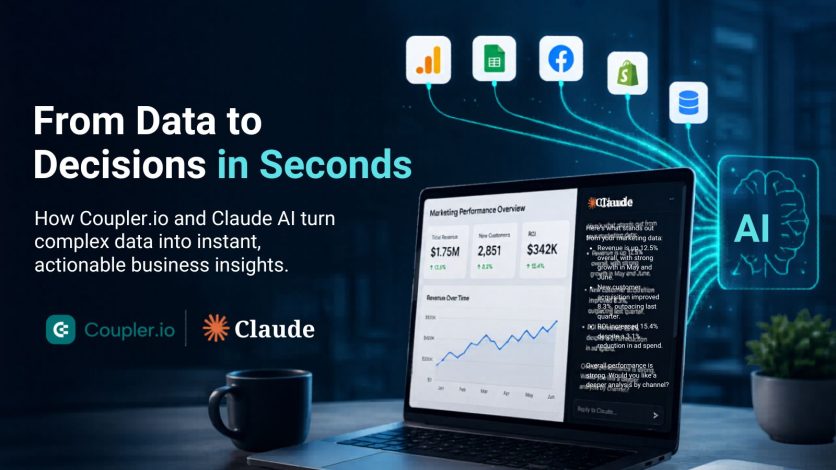
That is where the combination of Coupler.io and Claude is beginning to stand out. Together, the two platforms are helping businesses move beyond isolated AI experiments and toward something far more operational: continuously connected AI analytics powered by live business data.
AI Analytics Has a Data Problem
Over the past two years, many companies rushed to experiment with AI analytics tools: marketing teams uploaded campaign reports into chatbots, sales organizations analyzed CRM exports using AI prompts, and finance departments tested forecasting models using conversational AI interfaces. And the results were often impressive.
AI could summarize reports instantly, identify anomalies, generate recommendations, and simplify complex analysis tasks that traditionally required hours of manual work. But those early workflows also exposed a major problem. Most business data environments were never designed for AI consumption.
Critical information is often fragmented across multiple systems: CRM platforms, advertising dashboards, financial software, spreadsheets, and more. As a result, AI systems frequently receive incomplete, outdated, or inconsistent information.
One team may define revenue differently from another. Marketing attribution models may not align with finance reporting. Sales data may refresh at different intervals than operational metrics. And when AI operates on fragmented data, trust quickly becomes an issue.
"Businesses do not have an AI problem anymore. They have a data coordination problem," said Olexander Paladiy, Product Director at Coupler.io. "Most organizations already have access to powerful AI models. The real challenge is making sure those models are securely connected to accurate, continuously updated business information."
That challenge is becoming increasingly important as organizations attempt to operationalize AI across entire departments rather than use it for isolated experimentation.
Why Coupler.io Strengthens Claude's Capabilities
Claude is highly effective at interpreting information, identifying trends, summarizing datasets, and answering complex business questions conversationally. But large language models are only as effective as the information they receive. This is where Coupler.io plays a critical role.
Coupler.io acts as the infrastructure layer connecting business systems directly into AI-powered analytics workflows. The platform integrates data from hundreds of sources (including CRMs, advertising platforms, accounting systems, spreadsheets, databases, and analytics tools) and structures that information before it reaches Claude. Rather than manually exporting CSV files or uploading reports into AI interfaces, businesses can work from continuously refreshed datasets connected directly into conversational analysis environments.
That dramatically changes how organizations use AI.
Instead of functioning as a standalone chatbot, Claude becomes an intelligent analytics layer operating on live operational data. The result is a far more scalable and reliable analytics workflow. Teams can now:
- Analyze marketing performance in real time
- Compare revenue trends across business units
- Evaluate sales pipeline activity
- Generate executive summaries
- Forecast operational performance
- Identify customer behavior trends
- Explore cross-platform reporting insights
- And many more
And they can do it all through natural language conversations connected to synchronized business data.
"AI becomes significantly more valuable when it understands the operational context behind the numbers," Paladiy explained. "That context comes from connected systems, not isolated prompts."
Moving Beyond Static Reporting
One of the biggest limitations of traditional analytics environments is the amount of manual work involved. Teams often spend enormous amounts of time exporting reports, cleaning datasets, validating calculations, and reconciling numbers across multiple systems before analysis even begins.
Conversational AI simplifies the analysis layer, but without an automated data infrastructure, many organizations still rely heavily on manual preparation processes. That creates operational bottlenecks.
Reports become outdated quickly. Data inconsistencies increase. Teams duplicate work across departments. And decision-making slows down.
The Coupler.io and Claude integration addresses this by helping businesses automate how data flows into AI systems. Instead of rebuilding reports manually each week, organizations can create continuously synchronized pipelines feeding updated information directly into conversational analytics workflows. This allows teams to spend less time preparing data and more time acting on insights.
"We are seeing companies move away from one-time AI experiments toward operational workflows that run continuously in the background," said Paladiy. "That is where data integration infrastructure becomes incredibly important."
That shift may ultimately become one of the defining trends in enterprise AI adoption.
Why Reliability Is Becoming the Competitive Advantage
Early AI adoption was driven largely by novelty and experimentation. Businesses wanted to explore what AI could do. Now the conversation is evolving.
Today, organizations increasingly want to know:
- Can the outputs be trusted?
- Is the data current?
- Are insights repeatable?
- Can AI support operational decision-making?
- Will reporting remain consistent across departments?
Those questions are forcing companies to rethink the relationship between AI and data infrastructure. The businesses generating the greatest value from AI are increasingly the ones building reliable systems underneath it. That includes automated integrations, structured data environments, standardized metrics, governed access controls, continuous synchronization, and centralized reporting logic.
Without those foundational systems, conversational AI often struggles to move beyond experimentation. This is one reason the Coupler.io and Claude combination is resonating with business teams. Claude provides the conversational intelligence layer. Coupler.io provides the live operational data infrastructure needed to make conversational analytics reliable at scale.
Together, the platforms help transform AI from a productivity experiment into a practical business intelligence environment.
"Companies are starting to realize that AI accuracy is directly tied to data readiness," Paladiy said. "If the information flowing into AI is fragmented or inconsistent, the outputs will reflect that."
The Rise of Conversational Business Intelligence
The broader analytics industry may now be entering a major transition period. For decades, traditional BI platforms required users to navigate dashboards, build visualizations, configure reports, and understand technical query structures before extracting insights. Conversational AI changes that experience entirely.
Instead of asking users to learn analytics systems, AI allows analytics systems to adapt to how humans naturally communicate. That shift has enormous implications for business accessibility. Executives, marketers, finance leaders, operations managers, and sales teams can now interact with complex datasets without relying as heavily on technical intermediaries.
But conversational interfaces only become truly valuable when connected to reliable operational data. That is why integrations like Coupler.io and Claude are becoming increasingly important.
The combination creates a model where AI is not operating in isolation. It is operating within a connected business infrastructure designed to continuously deliver relevant, updated context.
"The future of analytics is becoming conversational," Paladiy said. "But conversational AI only works at scale when the underlying data ecosystem is structured to support it."
The Future of AI Analytics Will Be Connected
As AI adoption continues accelerating, businesses are beginning to realize that the next competitive advantage may not come from AI access alone. It may come from how effectively organizations connect AI to live operational systems.
Claude brings powerful reasoning, summarization, and conversational analytics capabilities. Coupler.io brings the connected, transformed, continuously refreshed business data needed to make those capabilities operational in real-world environments.
Together, the platforms create something significantly more valuable than standalone AI: a connected analytics ecosystem where organizations can interact with real business performance through natural conversation.
That combination may ultimately represent the next phase of enterprise analytics, one where AI is no longer simply a tool sitting beside the business, but an integrated layer operating within it.

-
 C114 Communication Network
 -
 Communication Home
