
 Search

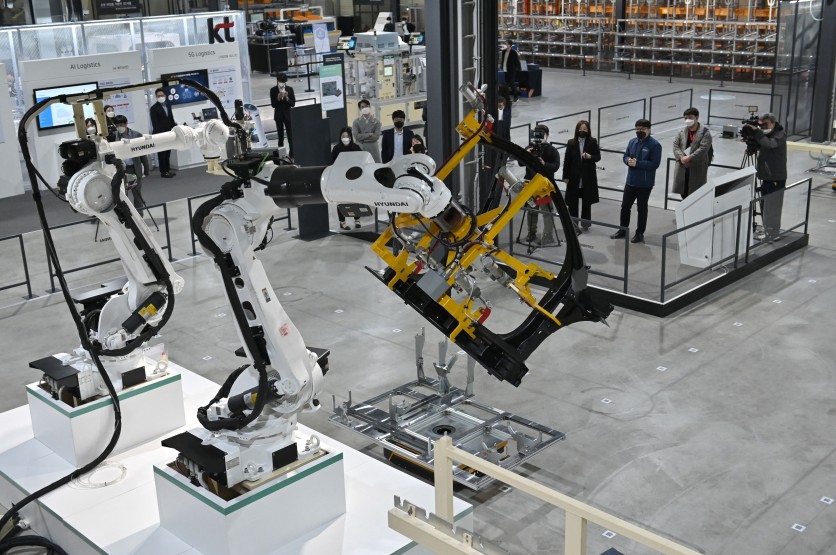
Visitors look at industrial robots during a smart logistics demonstration event organised by South Korea's Land, Infrastructure and Transport Ministry at Hyundai robot logistics demo centre in Gwangju on March 30, 2021. JUNG YEON-JE/AFP via Getty Images
South Korean manufacturers have the strongest conviction of any surveyed country that artificial intelligence is essential to staying competitive — and among the weakest records of actually spending money on it. That gap between declaration and investment, now quantified in a major global survey released this week, poses a direct threat to the export industries that power one of the world's most advanced manufacturing economies.
Rockwell Automation, the Milwaukee-based industrial automation company, published its 11th Annual State of Smart Manufacturing Report on May 19, 2026, drawing on responses from 1,560 manufacturing leaders across 17 countries. The Korea-specific findings, which arrived Tuesday, reveal a country whose manufacturers talk urgently about digital transformation but have not yet translated that urgency into committed budgets.
95% Urgency, 28% Investment
Globally, 90% of manufacturers told Rockwell that digital transformation is now essential to staying competitive — a figure that itself represents a new high-water mark for the decade-long survey series. South Korean respondents came in even higher, at 95%. More than half (53%) of Korean manufacturers identified AI and machine learning as the single most important smart manufacturing technology driving business results.
The investment data tells a different story. Only 28% of Korean manufacturers have actually committed capital to AI or machine learning — compared with 50% globally. Korean factories also dedicate a smaller share of their operating budgets to industrial technology: 22.8% on average, versus 27.6% worldwide. On actual AI deployment, one-third of manufacturing operations globally are now AI-augmented, with companies expecting more than half of operations to run on AI support by 2030.
Why Korean Manufacturers Are Holding Back
When Korean respondents explained what stopped them from investing, cost led the answers at 37%. Return-on-investment uncertainty followed at 17% — a friction point familiar to finance teams globally as they struggle to put hard numbers on AI payoff. Internal company policy and data security each registered at 13%.
The pattern is consistent with what economists describe as an aspirational-adoption gap: organizations that have absorbed the message about technological necessity but have not yet cleared the internal approval processes, vendor-selection cycles, or board-level risk tolerances required to open capital budgets.
Rockwell Automation Korea head Lee Yong-ha pointed directly to the competitiveness stakes. "Korean manufacturers are more aware than ever of the importance of digital transformation and AI adoption," he said in a statement accompanying the report. "But the share of operating budgets going to technology investment still lags the global average. Accelerating investment in AI and smart manufacturing is becoming urgent if Korea wants to stay globally competitive."
Blake Moret, Rockwell Automation's chairman and CEO, framed the broader global shift. "The organizations that are seeing results are those that connect technology, people and processes to turn insight into better decisions, stronger performance and greater resilience," Moret said.
Data Collected, Rarely Used
South Korea's investment gap extends beyond AI purchasing into data utilization — the unglamorous work of turning sensor readings and production logs into decisions. Globally, 43% of manufacturers say they use the data they collect effectively. In South Korea, that figure falls to 34%. As factory floors generate more data through connected sensors and smart devices, the gap between collection and application represents a compounding disadvantage: Korean manufacturers are accumulating raw material without the analytical processes to extract value from it.
Worldwide, six in ten manufacturers (59%) are now actively using smart manufacturing technologies in daily operations, with only 18% still in pilot mode — a marked decline in the experimentation-heavy phase that characterized the sector for much of the previous decade.
Cyberattacks Strike 41% of Korean Factories
South Korea's digital exposure extends to a cybersecurity problem that cost-conscious factories may be making worse by deferring connected-technology investments without hardening existing systems. Forty-one percent of Korean manufacturers reported at least one cyberattack in the past year. The weakest points: IT systems and corporate networks (39% identified as most vulnerable), employee awareness and training (36%), and remote access and connected devices (29%).
Globally, nearly half of all manufacturers (46%) experienced at least one cyber incident over the same period — a figure that reflects the sector's rising exposure as operational technology converges with internet-connected systems. The report identifies secure, integrated IT/OT architectures as now foundational to scaling AI and advanced automation.
Stakes for Samsung, Hyundai, and Korea's Export Engine
For an economy whose global reach runs through Samsung's semiconductors, Hyundai's automobiles, and a network of precision component makers, the survey data carries a specific competitive weight. South Korean manufacturers compete directly with peers in Germany, Japan, and the United States — countries where the survey shows higher AI investment rates and higher budget allocations for industrial technology.
The 22-percentage-point gap between Korea's stated AI commitment and its actual AI investment is not a new phenomenon; versions of this tension have appeared in prior Rockwell surveys. What is new in the 2026 data is the sharpness of the global contrast: as other leading manufacturing nations move from pilots to production-scale AI deployment, the cost of Korea's hesitation is becoming more precisely measurable — and the window to close it is narrowing.

-
 C114 Communication Network
 -
 Communication Home
