
 Search


Cris Lenta
The life simulation genre has attracted hundreds of millions of players over the past two decades, but the characters inside those games have always followed scripts. Recent advances in large language models are changing that equation, making it possible to build non-player characters that remember past conversations, form their own opinions, and act without being told what to do. The race to bring that technology out of research labs and into actual products is now underway.
Cris Lenta, a German-educated founder of LifeSim, Inc., recognized early that AI could serve as the foundation for a new kind of interactive world. His platform lets players create characters powered by autonomous AI, and its early traction, with over 2 billion tokens processed, suggests the concept has legs.
LifeSim
The Research Behind the Product
Cris' path to game development ran through an academic lab. At Ludwig Maximilian University of Munich, Germany's second-ranked university, where he studied AI, computer science, and statistics, he worked alongside lead researchers Thomas Gabor and Steffen Illium on studies exploring how simple computational units can organize themselves into complex, adaptive structures. The first paper, "Self-Replication in Neural Networks," was published in MIT Press's Artificial Life journal. A second, "Constructing Organism Networks from Collaborative Self-Replicators," appeared in IEEE Xplore.
Both papers dealt with emergent behavior in artificial systems. Mainly, they tackled the phenomenon of individual components producing collective outcomes that no single unit was programmed to achieve, a topic that greatly intrigued Cris and influenced his future projects. "The first time I trained an artificial neural network and saw it improve from a random distribution of weights to successfully accomplishing a specific task, I knew this was the ultimate technological leap," he recalls.
The academic work gave him a technical vocabulary for the problem, but it also gave him a framework for what the product should feel like. He spent those years thinking about the ways in which meaning is built through narrative, relationship, and conflict, and how those aspects could be translated into technical systems.
A First Exit and a Transatlantic Bet
Cris tested the entrepreneurial waters before LifeSim. He built and exited his first company, ooval UG, in Munich, establishing a track record as a founder who could ship a product and close a deal. But the theoretical foundations of simulating life had been in his mind for years, well before the AI wave made the technology commercially plausible.
But when large language models reached sufficient capability, Cris recognized they could serve as the missing infrastructure for the kind of autonomous characters he'd been imagining. "When ChatGPT launched, I didn't see a chatbot; I saw the missing piece for building worlds where everything's alive and every behavior emergent to the player," he recalls. He began the process of relocating to the United States to access the capital and talent networks required to build at scale.
His fundraising strategy was deliberate. Instead of pursuing generalist venture capital, Cris targeted backers with deep operating experience in gaming. He raised $350,000 in a combination of compute credits from Google and cash from two firms: Founders Inc, a San Francisco fund whose leadership includes founders with gaming exits to Twitch, and SMOK VC, led by Paul Braghiel, an early investor in Unity, Roblox, and Niantic.
Building LifeSim: A One-Man Team Behind Thousands of Thinking AI Characters
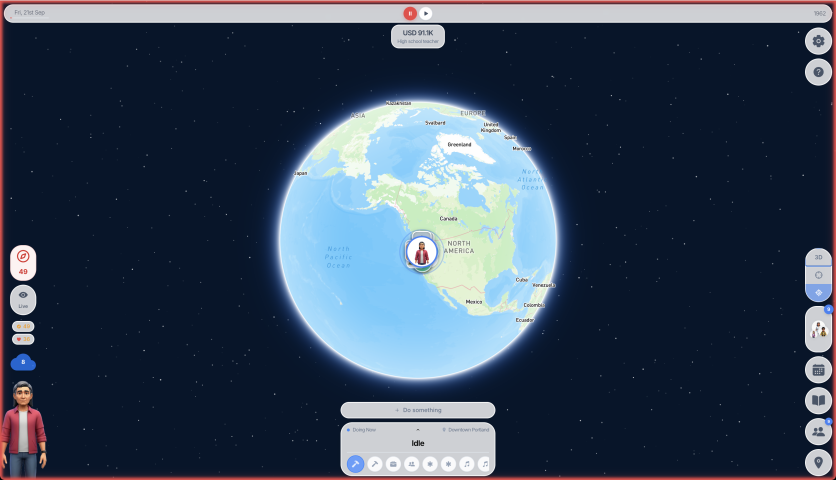
Cris's finished project, LifeSim, is an AI-native life simulation platform in which players can develop their own characters, place them in open-ended worlds, and watch those characters develop personalities, form relationships, and make decisions based on their specific attributes.

LifeSim
Unlike traditional games, where non-player characters follow scripted behavior trees, LifeSim implements what researchers call generative agents: AI characters equipped with persistent memory, meaning they can remember and reflect on past events in the story and make decisions on their own. Stanford's 2023 Generative Agents research demonstrated the concept with 25 in controlled academic environments. Cris translated the same principles into a consumer product, and the result is a game where the story is developed out of how the player and the AI characters interact.
Building a platform of that scope typically demands a team of at least three engineers. Cris, however, went at it alone: architecting the AI cognitive layer and the full-stack infrastructure, coming up with a product strategy, executing marketing strategies, and running the go-to-market execution as a single operator.
The technical aspect, in particular, required solving a hard economic problem. Early academic simulations of generative agents cost thousands of dollars to run just 25 characters over two simulated days. To make the technology viable at consumer prices, Cris developed two solutions.
The first, attention-gating, adjusts the simulation's resolution based on what the player is focused on: time compresses during normal, routine-like moments and expands during emotionally charged interactions, mirroring the ways in which people experience time in real life. The second, a dual-tick simulation, separates the player-facing layer from background world evolution, meaning characters can continue developing when no one is looking and without running up prohibitive compute costs.
Despite this hard work, he doesn't see it as something that held him back; rather, as something that drove him forward. "People ask about founder sacrifices: the sleepless nights and financial uncertainty," he says. "I never called them sacrifices, because that implies loss. When you're building something you believe is inevitable, the hard part feels natural, even though it's tough."
Early Traction and What Comes Next
The clearest signal in LifeSim's early data is session length. The platform has recorded peak user sessions lasting seven hours, a metric more consistent with deep immersion than casual browsing. "The first time I saw a player immersed in my game for seven hours, I knew I'd touched something real: the human need to become anyone, to live lives our physical reality will never permit, to express innate talents we never had time to develop."
The game has also reached 60,000-plus player-created characters and 2 billion AI tokens processed, data that represents what appears to be the first commercial deployment of agent technology at consumer scale.
Cris is now preparing a seed round to hire a team and expand its underlying infrastructure, which would mark the transition from solo founder to company builder. His target market is ambitious: he compares the opportunity to a convergence of Netflix-style content with The Sims-style interactivity, pointing to The Sims franchise's 300 million lifetime players as a reference for potential audience size.
Long-term, he plans to launch a creator program that would let writers, artists, and storytellers build and monetize AI-driven narrative experiences on LifeSim. He also sees applications in education, as the technology's storytelling abilities could be used as an interactive tool for learners of all ages.
Cris Lenta set out to build a platform that gives every character a custom mind of their own, and LifeSim's early numbers suggest that players are willing to stay for hours once they find one. What started as research papers turned into a funded platform with tens of thousands of user-created lives running on it.

-
 C114 Communication Network
 -
 Communication Home
