
 Search


AI-powered medical services
For years, the global AI narrative has been dominated by a singular metric: Parameters. The race was defined by who possessed the largest Large Language Models (LLMs), the most massive GPU clusters, and the highest benchmark scores.
However, entering 2026, the wind has shifted. With the surging popularity of AI applications like Ant Group's AQ, the stories of inclusivity they bring—coupled with widespread user acclaim—have ignited a fierce determination among Chinese tech enterprises to go "All-In" on the application track.
The competition is no longer just about how smart the AI is; it is about who holds the right to use it. A profound divergence in business logic has emerged: while the United States doubles down on a high-margin "Commercial Subscription Model," China is aggressively pivoting toward an "Infrastructure Model," treating AI as a public utility akin to electricity or high-speed rail to maximize its Access.
The Strategic Logic: "Manhattan Project" vs. "15th Five-Year Plan"
This sharp contrast in business logic is not accidental; it is rooted in two fundamentally different national mandates.
The US: A Top-Down "Manhattan Project"
The US Government's 2026 AI policy, exemplified by the America's AI Action Plan, focuses on maintaining a "generational lead" and ensuring "national security." To the White House, AI is a geopolitical "Manhattan Project." The goal is to secure absolute dominance, directing core resources toward top-tier laboratories and defense systems. This represents a distinct "top-down" elitist path.
China: A Bottom-Up "AI+" Infrastructure
In contrast, through the "AI+" Action and the 15th Five-Year Plan, China has positioned AI as "bottom-up" inclusive infrastructure. The core mandate is to deeply integrate AI with industrial development and drive the large-scale implementation of applications. The objective is to solve "social pain points"—such as an aging population and medical inequality—ensuring that AI dividends flow directly to the common person.
The Rise of the "AI Tax" in Silicon Valley
In the US tech ecosystem, the "subscription economy" has firmly taken hold of AI. What began as a standard $19.99 monthly fee for premium access has evolved into a stratified luxury market.
By 2026, a new trend of "intelligence tiering" is evident. With soaring compute costs, US tech giants have introduced ultra-premium tiers—such as ChatGPT Pro at roughly $200/month—reinforcing a commercial reality where superior intelligence is reserved for high-net-worth individuals and enterprises.
For the average American middle-class family, this "AI Tax" is accumulating rapidly.
The Cost: Between two professional subscriptions for parents and educational AI tools for children, a household's monthly spend can easily hit $60–$80.
The Annual Impact: This amounts to an annual expenditure of $720 to $1,000, creating a "digital toll" just to maintain professional and academic competitiveness.
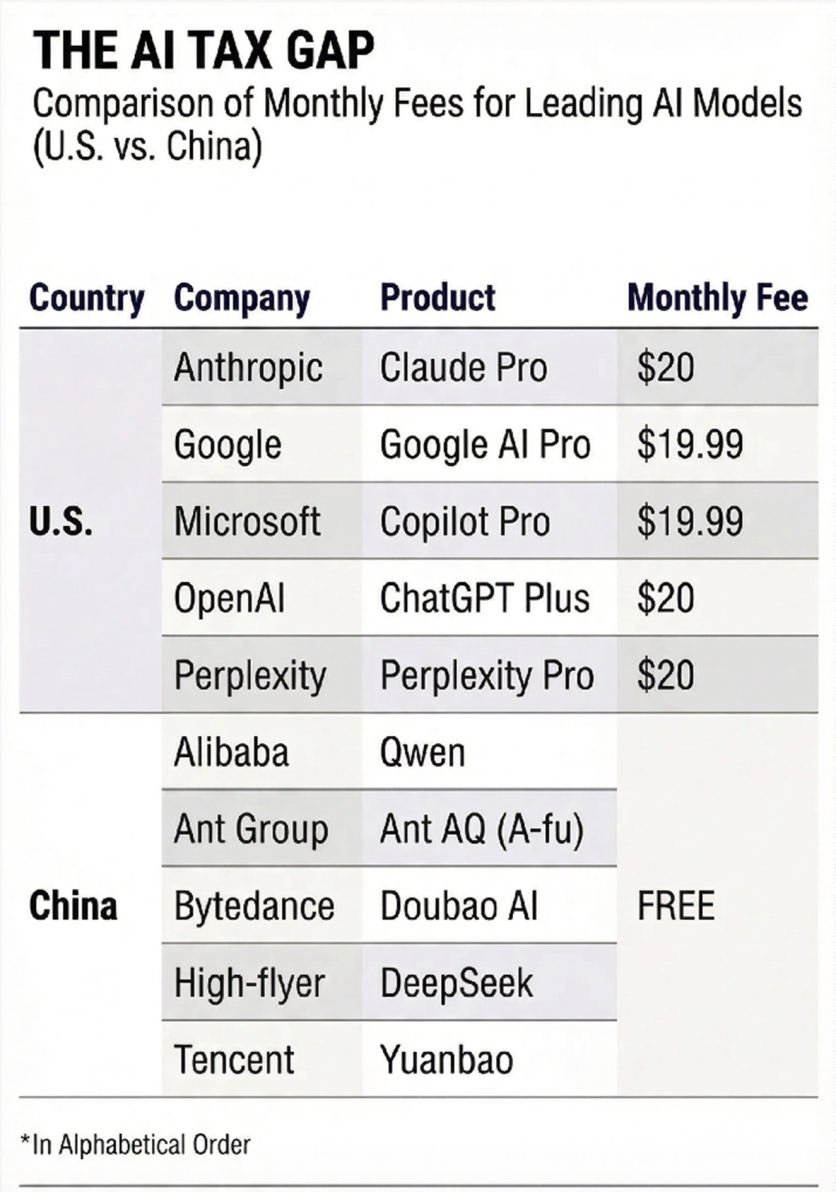
The AI Tax Gap — Comparison of Monthly Fees for Leading AI Models (U.S. vs. China)
In stark contrast, the comparable "AI extra expenditure" for a Chinese household in 2026 remains virtually zero, driven by a strategic push to lower barriers to entry.
Healthcare: Commercialization vs. Accessibility
The divergence is most critical in sectors like healthcare, where the philosophy of deployment differs fundamentally.
The US Model: Commercializing Expertise
In the US, AI in healthcare is largely B2B or "Concierge B2C." Platforms like OpenEvidence offer powerful decision support for physicians, often monetized through targeted pharmaceutical advertising. Meanwhile, consumer-facing health AI is becoming a paid privilege. New modules in 2026 targeting C-suite patients charge subscriptions of $8–$20, while tools like Claude primarily serve as backend processors for clinics, keeping direct access behind a paywall of high consultation fees.
The China Model: Increasing Access with AQ
China is leveraging AI to address deficits in public services. Ant Group's AQ (Chinese name: Ant A-Fu) exemplifies this "AI for the masses" approach.
- Utility: AQ provides 24/7 free health consultations, report interpretations, and medication guidance.
- Reach: Launched in June 2025 and upgraded in December, AQ hit 30 million Monthly Active Users (MAU) by January 2026. Notably, 55% of users reside in Tier-3 cities and below, proving the technology is successfully bridging the urban-rural medical divide.
- Innovation: The platform features "AI Avatars" of over 1,000 top doctors, including Academician Wang Jian'an. His agent, "Jack Anxin," handles pre-consultation inquiries, allowing one expert to effectively serve ten times the patient volume without increasing costs.
Education: The New Digital Divide
Education reflects a similar schism. In the US, AI is risking the creation of a "Digital School District." While Khan Academy is a non-profit, its advanced AI tutor, Khanmigo, requires a subscription ($44/year) to offset computing costs.
Conversely, Chinese tech giants have integrated top-tier pedagogical logic into free assistants like Qwen and Doubao. This infrastructure-first approach ensures that a student in a rural province has the same access to "1-on-1" AI tutoring as a student in Shanghai, leveling the playing field without a price tag.
The Strategic Logic: Infrastructure vs. SaaS
A December 2025 report by Goldman Sachs highlights this structural difference.
US: AI as a Business Operating System: The US market is driven by SaaS metrics. 90% of growth comes from subscriptions, relying on IP protection and closed ecosystems to generate high margins—a classic monetization model.
China: AI as Industrial Infrastructure: China's strategy mirrors its "Build Roads First" economic policy of the last 40 years. Token costs in China saw cliff-like drops in 2025, pushing prices down to near-commodity levels. Just as China built high-speed rail to lower logistical costs, it is now building "Compute Networks" (such as the East Data West Computing project) to lower intellectual costs for the entire economy.
Market Reception
The "Accessibility" model is gaining traction not just domestically, but also among the international community in China.
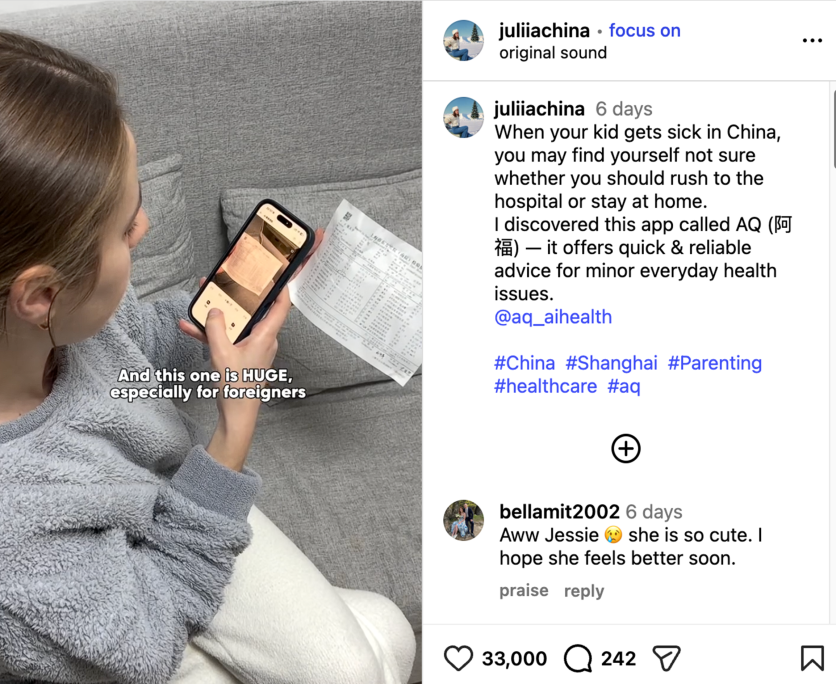
Screenshot from Julia's Instagram page
Julia, a Shanghai-based creator with 1.4 million followers, went viral demonstrating how AQ helped her identify her child's skin allergy, bypassing language barriers and hospital queues.
Global netizens have flooded the comments section, calling this "the correct way to open AI," and contrasting it with the expensive "AI walls" in their own countries.
Conclusion
The US-China AI competition has bifurcated. The US is focused on the height of the technology—achieving AGI and maximizing revenue per user. China is focused on the width of the technology—maximizing adoption and social utility.
As AI becomes as fundamental as electricity, the ultimate winner may not be who builds the smartest model, but who puts that model into the hands of the most people.
The essence of this competition lies in two distinct paths: one protects the "premium pricing power" of technology to ensure excess returns for leaders; the other releases the "accessibility" of technology to ensure every individual can stand on the shoulders of intelligent civilization.
At the onset of 2026, China is using "Inclusivity" as its new calling card to show the world another possibility: While the height of AI is important, it is the thickness of AI that determines a society's future.

-
 C114 Communication Network
 -
 Communication Home
